

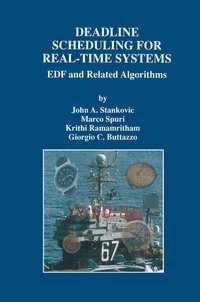
Deadline Scheduling for Real-Time Systems
EDF and Related Algorithms
Erschienen am 22. März 2013
Buch
Softcover
XVI, 273 Seiten
978-1-4613-7530-2 (ISBN)
Beschreibung
Many real-time systems rely on static scheduling algorithms. This includes cyclic scheduling, rate monotonic scheduling and fixed schedules created by off-line scheduling techniques such as dynamic programming, heuristic search, and simulated annealing. However, for many real-time systems, static scheduling algorithms are quite restrictive and inflexible. For example, highly automated agile manufacturing, command, control and communications, and distributed real-time multimedia applications all operate over long lifetimes and in highly non-deterministic environments. Dynamic real-time scheduling algorithms are more appropriate for these systems and are used in such systems. Many of these algorithms are based on earliest deadline first (EDF) policies. There exists a wealth of literature on EDF-based scheduling with many extensions to deal with sophisticated issues such as precedence constraints, resource requirements, system overload, multi-processors, and distributed systems.
Deadline Scheduling for Real-Time Systems: EDF and Related Algorithms aims at collecting a significant body of knowledge on EDF scheduling for real-time systems, but it does not try to be all-inclusive (the literature is too extensive). The book primarily presents the algorithms and associated analysis, but guidelines, rules, and implementation considerations are also discussed, especially for the more complicated situations where mathematical analysis is difficult.
In general, it is very difficult to codify and taxonomize scheduling knowledge because there are many performance metrics, task characteristics, and system configurations. Also, adding to the complexity is the fact that a variety of algorithms have been designed for different combinations of these considerations. In spite of the recent advances there are still gaps in the solution space and there is a need to integrate the available solutions. For example, a list of issues to consider includes:
Deadline Scheduling for Real-Time Systems: EDF and Related Algorithms should be of interest to researchers, real-time system designers, and instructors and students, either as a focussed course on deadline-based scheduling for real-time systems, or, more likely, as part of a more general course on real-time computing. The book serves as an invaluable reference in this fast-moving field.
Deadline Scheduling for Real-Time Systems: EDF and Related Algorithms aims at collecting a significant body of knowledge on EDF scheduling for real-time systems, but it does not try to be all-inclusive (the literature is too extensive). The book primarily presents the algorithms and associated analysis, but guidelines, rules, and implementation considerations are also discussed, especially for the more complicated situations where mathematical analysis is difficult.
In general, it is very difficult to codify and taxonomize scheduling knowledge because there are many performance metrics, task characteristics, and system configurations. Also, adding to the complexity is the fact that a variety of algorithms have been designed for different combinations of these considerations. In spite of the recent advances there are still gaps in the solution space and there is a need to integrate the available solutions. For example, a list of issues to consider includes:
- preemptive versus non-preemptive tasks,
- uni-processors versus multi-processors,
- using EDF at dispatch time versus EDF-based planning,
- precedence constraints among tasks,
- resource constraints,
- periodic versus aperiodic versus sporadic tasks,
- scheduling during overload,
- fault tolerance requirements, and
- providing guarantees and levels of guarantees (meeting quality of service requirements).
Deadline Scheduling for Real-Time Systems: EDF and Related Algorithms should be of interest to researchers, real-time system designers, and instructors and students, either as a focussed course on deadline-based scheduling for real-time systems, or, more likely, as part of a more general course on real-time computing. The book serves as an invaluable reference in this fast-moving field.
Weitere Details
Reihe
Auflage
Softcover reprint of the original 1st ed. 1998
Sprache
Englisch
Verlagsort
New York
USA
Zielgruppe
Für Beruf und Forschung
Research
Illustrationen
XVI, 273 p.
Maße
Höhe: 235 mm
Breite: 155 mm
Dicke: 16 mm
Gewicht
446 gr
ISBN-13
978-1-4613-7530-2 (9781461375302)
DOI
10.1007/978-1-4615-5535-3
Schweitzer Klassifikation
Weitere Ausgaben
Andere Ausgaben
John A. Stankovic | Marco Spuri | Krithi Ramamritham
Deadline Scheduling for Real-Time Systems
EDF and Related Algorithms
E-Book
12/2012
Springer
149,79 €
Als Download verfügbar
John A. Stankovic | Marco Spuri | Krithi Ramamritham
Deadline Scheduling for Real-Time Systems
EDF and Related Algorithms
Buch
10/1998
Kluwer Academic Publishers
163,50 €
Versand in 15-20 Tagen
Inhalt
1 Introduction.- 1.1 Real-Time Systems.- 1.2 Common Misconceptions.- 1.3 A Typical Example of a Real-Time Application.- 1.4 Purpose of this Book.- 1.5 Format of the Book.- References.- 2 Terminology and Assumptions.- 2.1 Task Models, Assumptions and Notation.- 2.2 Static versus Dynamic Scheduling.- 2.3 Metrics.- References.- 3 Fundamentals of EDF Scheduling.- 3.1 Optimality on Uni-Processor Systems.- 3.2 Feasibility Analysis.- 3.3 Summary.- References.- 4 Response Times under EDF Scheduling.- 4.1 Finding Local Maxima.- 4.2 Deadline Busy Periods.- 4.3 Algorithm Description.- 4.4 Extended Task Modeling.- 4.5 Case Study.- 4.6 Summary.- References.- 5 Planning-Based Scheduling.- 5.1 Preliminaries: Load, Metrics, Value Functions.- 5.2 Steps in a Dynamic Planning-Based Scheduling Approach.- 5.3 Algorithms for Dynamic Planning.- 5.4 Timing of the Planning.- 5.5 Implementing Planning-Based Scheduling.- 5.6 Dispatching Jobs in a Planning-based Schedule.- 5.7 Summary.- References.- 6 EDF Scheduling for Shared Resources.- 6.1 The Nature of Resources and the Resulting Scheduling Problems.- 6.2 The Priority Inversion Problem.- 6.3 The Priority Inheritance Protocol.- 6.4 The Dynamic Priority Ceiling Protocol.- 6.5 The Stack Resource Policy.- 6.6 Resource Scheduling in Planning-based Schedulers.- 6.7 Summary.- References.- 7 Precedence Constraints and Shared Resources.- 7.1 Scheduling Dependent Tasks with EDF.- 7.2 The Notion of Quasi-Normality.- 7.3 Integration of Shared Resources and Precedence.- 7.4 Extended Task Model.- 7.5 Summary.- References.- 8 Aperiodic Task Scheduling.- 8.1 Dynamic Priority Exchange server.- 8.2 Dynamic Sporadic Server.- 8.3 Total Bandwidth Server.- 8.4 Earliest Deadline Late server.- 8.5 Improved Priority Exchange server.- 8.6 Performance Results.- 8.7 Summary.- References.- 9 Distributed Scheduling - Part I.- 9.1 Distributed Systems - An Overview.- 9.2 Holistic Scheduling Based on EDF.- 9.3 Performance.- 9.4 Summary.- References.- 10 Distributed Scheduling - Part II.- 10.1 The Spring Complex Task Set Allocation and Scheduling Algorithm.- 10.2 Focussed Addressing and Bidding.- 10.3 Summary.- References.- 11 Summary and Open Questions.- 11.1 Summary.- 11.2 Open Questions.- References.