

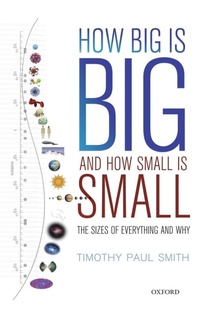
How Big is Big and How Small is Small
The Sizes of Everything and Why
Erschienen am 24. Oktober 2013
Buch
Hardcover
266 Seiten
978-0-19-968119-8 (ISBN)
Beschreibung
This book is about how big is the universe and how small are quarks, and what are the sizes of dozens of things between these two extremes. It describes the sizes of atoms and planets, quarks and galaxies, cells and sequoias. It is a romp through forty-five orders of magnitude from the smallest sub-nuclear particles we have measured, to the edge of the observed universe. It also looks at time, from the epic age of the cosmos to the fleeting lifetimes of ethereal particles. It is a narrative that trips its way from stellar magnitudes to the clocks on GPS satellites, from the nearly logarithmic scales of a piano keyboard through a system of numbers invented by Archimedes and on to the measurement of the size of an atom.
Why do some things happen at certain scales? Why are cells a hundred thousandths of a meter across? Why are stars never smaller than about 100 million meters in diameter? Why are trees limited to about 120 meters in height? Why are planets spherical, but asteroids not? Often the size of an object is determined by something simple but quite unexpected. The size of a cell and a star depend in part on the ratio of surface area to volume. The divide between the size of a spherical planet and an irregular asteroid is the balance point between the gravitational forces and the chemical forces in nature.
Most importantly, with a very few basic principles, it all makes sense. The world really is a most reasonable place.
Why do some things happen at certain scales? Why are cells a hundred thousandths of a meter across? Why are stars never smaller than about 100 million meters in diameter? Why are trees limited to about 120 meters in height? Why are planets spherical, but asteroids not? Often the size of an object is determined by something simple but quite unexpected. The size of a cell and a star depend in part on the ratio of surface area to volume. The divide between the size of a spherical planet and an irregular asteroid is the balance point between the gravitational forces and the chemical forces in nature.
Most importantly, with a very few basic principles, it all makes sense. The world really is a most reasonable place.
Rezensionen / Stimmen
Smith's book "How Big is Big and How Small is Small " is a most enjoyable read, erudite and entertaining. You can learn a great deal not just about how and why we measure things the way we do, but also what limits the sizes of the smallest and largest animals as well as the smallest and largest objects in the Universe. It also puts our human lives into (a Cosmic) perspective. I highly recommend it. * Vlatko Vedral, Professor of Quantum Information Theory at the University of Oxford and the National University of Singapore * This little book is packed with ideas and facts about the sizes of things in the physical world [...] it will interest general readers as well as scientists looking for a different slant on the story of physics. * Choice *Weitere Details
Sprache
Englisch
Verlagsort
Oxford
Großbritannien
Zielgruppe
Interested general readers as well as professional scientists.
Illustrationen
61 b/w illustrations
Maße
Höhe: 240 mm
Breite: 161 mm
Dicke: 19 mm
Gewicht
567 gr
ISBN-13
978-0-19-968119-8 (9780199681198)
Copyright in bibliographic data and cover images is held by Nielsen Book Services Limited or by the publishers or by their respective licensors: all rights reserved.
Schweitzer Klassifikation
Weitere Ausgaben
Andere Ausgaben
E-Book
10/2013
1. Auflage
OUP eBook
35,49 €
Als Download verfügbar
E-Book
10/2013
1. Auflage
OUP eBook
35,49 €
Als Download verfügbar
Person
Tim Smith is a Research Professor at Dartmouth College where he teaches Physics and Environmental Studies. Before then he was a Research Scientist at the MIT accelerator where he spent a decade as part of a team building an experiment to measure the arrangement of quarks inside of neutrons and protons. He has written magazine articles about neutrons, wind power and hiking. In this book he gets to explore all that and much more.
Inhalt
1. From Quarks to the Cosmos - An Introduction ; 2. Scales of the Living World ; 3. Big Numbers; Avogadro's Number ; 4. Scales of Nature ; 5. Little Numbers; Boltzmann's and Planck's Constant ; 6. The Sand Reckoner ; 7. Energy ; 8. Fleeting Moments of Time ; 9. Deep and Epic Time ; 10. Down to Atoms ; 11. How Small is Small ; 12. Stepping Into Space - The Scales of the Solar System ; 13. From the Stars to the Edge of the Universe ; 14. A Little Chapter About Truly Big Numbers ; 15. Forces That Sculpture Nature and Shape Destiny