

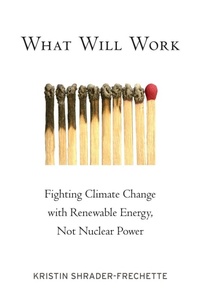
What Will Work
Fighting Climate Change with Renewable Energy, Not Nuclear Power
Erschienen am 6. November 2014
Buch
Softcover
368 Seiten
978-0-19-021518-7 (ISBN)
Beschreibung
What Will Work makes a rigorous and compelling case that energy efficiencies and renewable energy -- and not nuclear fission or "clean coal" -- are the most effective, cheapest, and equitable solutions to the pressing problem of climate change.
Kristin Shrader-Frechette, a respected environmental ethicist and scientist, makes a damning case that the only reason that debate about climate change continues is because fossil-fuel interests pay non-experts to confuse the public. She then builds a comprehensive case against the argument made by many that nuclear fission is a viable solution to the problem, arguing that data on the viability of nuclear power has been misrepresented by the nuclear industry and its supporters. In particular she says that they present deeply flawed cases that nuclear produces low greenhouse gas emissions, that it is financially responsible, that it is safe, and that its risks do not fall mainly on the poor and vulnerable. She argues convincingly that these are all completely false assumptions.
Shrader-Frechette then shows that energy efficiency and renewable solutions meet all these requirements - in particular affordability, safety, and equitability. In the end, the cheapest, lowest-carbon, most-sustainable energy solutions also happen to be the most ethical.
This urgent book on the most pressing issue of our time will be of interest to anyone involved in environmental and energy policy.
Kristin Shrader-Frechette, a respected environmental ethicist and scientist, makes a damning case that the only reason that debate about climate change continues is because fossil-fuel interests pay non-experts to confuse the public. She then builds a comprehensive case against the argument made by many that nuclear fission is a viable solution to the problem, arguing that data on the viability of nuclear power has been misrepresented by the nuclear industry and its supporters. In particular she says that they present deeply flawed cases that nuclear produces low greenhouse gas emissions, that it is financially responsible, that it is safe, and that its risks do not fall mainly on the poor and vulnerable. She argues convincingly that these are all completely false assumptions.
Shrader-Frechette then shows that energy efficiency and renewable solutions meet all these requirements - in particular affordability, safety, and equitability. In the end, the cheapest, lowest-carbon, most-sustainable energy solutions also happen to be the most ethical.
This urgent book on the most pressing issue of our time will be of interest to anyone involved in environmental and energy policy.
Weitere Details
Reihe
Sprache
Englisch
Verlagsort
New York
USA
Zielgruppe
Für Beruf und Forschung
Für höhere Schule und Studium
Maße
Höhe: 234 mm
Breite: 156 mm
Dicke: 22 mm
Gewicht
626 gr
ISBN-13
978-0-19-021518-7 (9780190215187)
Copyright in bibliographic data and cover images is held by Nielsen Book Services Limited or by the publishers or by their respective licensors: all rights reserved.
Schweitzer Klassifikation
Weitere Ausgaben
Andere Ausgaben
Kristin Shrader-Frechette
What Will Work
Fighting Climate Change with Renewable Energy, Not Nuclear Power
E-Book
11/2011
1. Auflage
OUP eBook
20,99 €
Als Download verfügbar
Kristin Shrader-Frechette
What Will Work
Fighting Climate Change with Renewable Energy, Not Nuclear Power
E-Book
06/2011
1. Auflage
OUP eBook
19,99 €
Als Download verfügbar
Person
Kristin Shrader-Frechette, Ph.D is O'Neill Endowed Professor, Department of Biological Sciences and Department of Philosophy, University of Notre Dame. Author of 16 books and 380 professional articles - translated into 13 languages - and energy-environmental-health advisor to many nations and governments, she directs the Notre Dame Center for Environmental Justice and Children's Health. She is also the author of Environmental Justice and Taking Action, Saving Lives, and Tainted: How Philosophy of Science Can Expose Bad Science (forthcoming), all published by Oxford University Press.
Inhalt
Glossary ; Chapter 1: Why Climate-Change Skeptics Are Wrong ; Chapter 2: Trimming the Data on Nuclear Greenhouse Emissions ; Chapter 3: Trimming the Data on Nuclear Costs ; Chapter 4: Nuclear Safety, Flawed Science, and Accident Cover-Up ; Chapter 5: Nuclear Energy and Environmental Justice ; Chapter 6: The Solution: ; Using Renewable Energy, Efficiency, and Conservation to Address Climate Change ; Chapter 7: Answering Objections ; Chapter 8: Conclusions ; Notes