

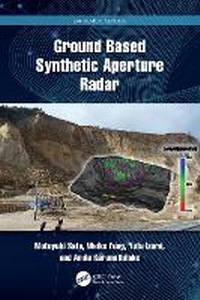
Ground Based Synthetic Aperture Radar
1. Auflage
Erschienen am 1. Dezember 2024
Buch
Buch
306 Seiten
978-1-032-32707-5 (ISBN)
Beschreibung
Ground based synthetic aperture radar (GB-SAR) is used to effectively mitigate natural disasters and monitor social infrastructure such as bridges, dams, and airport pavement surfaces. This book explains the fundamentals of radar technology, the principles of synthetic aperture radar (SAR) image generation, and interferometric SAR (InSAR) processing for observing small ground surface deformation less than 1 mm. More advanced multiple-input multiple-output (MIMO) radar for ground surface observation is introduced. The authors also provide examples of GB-SAR used for monitoring landslide and vegetation to show its potential and limitations. Understanding this advanced technology and its applications will help readers plan and install GB-SAR systems in real-life projects.
Features:
- Introduces GB-SAR, an advanced tool that measures in-millimeter ground surface displacement.
- Explains how the GB-SAR system can be installed for landslide monitoring.
- Provides a new radar technology that monitors vibrations of infrastructure remotely.
- Discusses the advanced radar technology related to polarimetry and interferometry.
- Includes several case studies applying the tools and techniques discussed to natural disasters, such as landslides, volcanoes, glaciers, and so on.
This book is intended for civil professionals who deal with disaster mitigation and infrastructure monitoring and those in electrical engineering, including radar technology. It is also an excellent resource for upper-level undergraduate and graduate students taking courses in remote sensing and photogrammetry, geography, geodesy, information science, engineering, and geology, as well as researchers and scientists interested in learning the techniques and technologies for collecting, analyzing, managing, and visualizing geospatial data sets.
Features:
- Introduces GB-SAR, an advanced tool that measures in-millimeter ground surface displacement.
- Explains how the GB-SAR system can be installed for landslide monitoring.
- Provides a new radar technology that monitors vibrations of infrastructure remotely.
- Discusses the advanced radar technology related to polarimetry and interferometry.
- Includes several case studies applying the tools and techniques discussed to natural disasters, such as landslides, volcanoes, glaciers, and so on.
This book is intended for civil professionals who deal with disaster mitigation and infrastructure monitoring and those in electrical engineering, including radar technology. It is also an excellent resource for upper-level undergraduate and graduate students taking courses in remote sensing and photogrammetry, geography, geodesy, information science, engineering, and geology, as well as researchers and scientists interested in learning the techniques and technologies for collecting, analyzing, managing, and visualizing geospatial data sets.
Weitere Details
Sprache
Englisch
Verlagsort
Boca Raton, Florida
USA
Zielgruppe
Postgraduate, Professional, and Undergraduate Advanced
Illustrationen
350 farbige Abbildungen, 76 Farbfotos bzw. farbige Rasterbilder, 21 s/w Zeichnungen, 274 farbige Zeichnungen, 13 s/w Tabellen, 21 s/w Abbildungen
Maße
Höhe: 234 mm
Breite: 156 mm
ISBN-13
978-1-032-32707-5 (9781032327075)
Copyright in bibliographic data and cover images is held by Nielsen Book Services Limited or by the publishers or by their respective licensors: all rights reserved.
Schweitzer Klassifikation
Weitere Ausgaben
Andere Ausgaben
Motoyuki Sato | Weike Feng | Yuta Izumi
Ground Based Synthetic Aperture Radar
Buch
12/2024
1. Auflage
CRC Press
189,10 €
Versand in 10-20 Tagen
Motoyuki Sato | Weike Feng | Yuta Izumi
Ground Based Synthetic Aperture Radar
E-Book
12/2024
1. Auflage
CRC Press
138,99 €
Als Download verfügbar
Motoyuki Sato | Weike Feng | Yuta Izumi
Ground Based Synthetic Aperture Radar
E-Book
12/2024
1. Auflage
CRC Press
138,99 €
Als Download verfügbar
Person
Motoyuki Sato is a professor emeritus at Tohoku University, Japan, and CEO of ALISys Co., Ltd, Japan. He received his B.E., M.E., and Dr. Eng. in information engineering from Tohoku University, Sendai, Japan, in 1980, 1982, and 1985, respectively. From 2007 to 2011 he was a distinguished professor at Tohoku University and from 2009 to 2013 was the director of the Center for Northeast Asian Studies. He was a visiting researcher at the Federal German Institute for Geoscience and Natural Resources (BGR) in Hannover, Germany, in 1988-1989. His current interests include transient electromagnetics and antennas, radar polarimetry, ground-penetrating radar (GPR), borehole radar, electromagnetic induction sensing, and ground-based synthetic aperture radar (GB-SAR) and multiple-input multiple-output (MIMO) radar systems. He developed GPR sensors for humanitarian demining, and they are used in mine-affected countries, including Cambodia and Ukraine. He received the 2014 Frank Frischknecht Leadership Award from society of exploration Geophysicists (SEG) for his sustained and important contributions to near-surface geophysics in the field of ground-penetrating radar. He received the The Institute of Electronics, Information and Communication Engineers (IEICE) Best Paper award in 2017 (Kiyasu Award) and 2020, Achievement Award in 2019, IEEE GRSS Education Award in 2012, and IEEE Ulrich L. Rohde Innovative Conference Paper Awards on Antenna Measurements and Applications in 2017. He was a visiting professor at Jilin University, China; Delft University of Technology, the Netherlands; and the Mongolian University of Science and Technology. Dr. Sato was the general chair of the IEEE International Geoscience and Remote Sensing Symposium (IGARSS) in 2011 in Sendai-Vancouver.
Weike Feng is an associate professor at Air Force Engineering University, Shaanxi, China, and the leader of a youth innovation team of Shaanxi universities. He received his B.E. from Air Force Engineering University, Shaanxi, China, in 2013 and his Ph.D. from Tohoku University, Sendai, Japan, in 2019. Dr. Feng received the Young Researcher Award from the IEEE GRSS All Japan Joint Chapter, the Student Award from IEEE AP-S Japan, and the Excellent Paper Award from IET International Radar Conference in 2018, as well as the Professor Fujino Incentive Award from Tohoku University and the Best Student Paper Award from PIERS in 2019.
Yuta Izumi received his B. Eng and M. Eng from Chiba University, Japan, in 2016 and 2018, respectively, and his Ph.D. in radar remote sensing from Tohoku University, Japan, in 2021. From 2018 to 2020, he was a JSPS research fellow DC1. From 2019 to 2020, he stayed at the Swiss Federal Institute of Technology (ETH), Zurich, Switzerland. From 2021 to 2022, he was a JSPS research fellow (postdoctoral) at the Institute of Industrial Science, University of Tokyo. He is currently an assistant professor at the Muroran Institute of Technology. His research interests include SAR interferometry and polarimetry and their applications for disaster mitigation and infrastructure health monitoring. Dr. Izumi is a recipient of the Student Paper Award at the ISRS in 2017, President Award from Chiba University in 2018, Dean Award from the Graduate School of Advanced Integration in 2018, Science Young Researcher Award from the IEEE Geoscience and Remote Sensing Society All Japan Joint Chapter in 2019, and Student Poster Award at the IEICE-AP in 2020.
Amila Karunathilake is a senior researcher at Advanced Technologies Research Laboratory, Asia Air Survey Co., LTD., Kawasaki, Japan. He received his B.Sc. and M.Sc. from the University of Peradeniya, Kandy, Sri Lanka, in 2011 and 2014, respectively, and his Ph.D. in environmental studies from Tohoku University, Sendai, Japan, in 2017. He was a post-doctoral research fellow with Tohoku University in 2018. He has shown his expertise by involvement in multi-participant disaster prevention research projects under the Cross-Ministerial Strategic Innovation Promotion Program (SIP) from 2019 to 2020. He collaborated with the Ministry of Land, Infrastructure, Transport and Tourism (MLIT) from 2021-2022 in Japan by consulting SAR remote sensing, spatial data processing, and analysis. His research interests include 3D spatial modeling, LiDAR-based mobile mapping systems (MMSs), new algorithms, application development for spaceborne and ground-based synthetic aperture radar, interferometric and polarimetric SAR analysis for infrastructure monitoring, and disaster prevention and mitigation. Dr. Karunathilake was a recipient of the Young Researcher Award from the IEEE GRSS Japan Chapter and the best Ph.D. Student Award from Graduate School of Environmental Studies, Tohoku University, in 2017.
Weike Feng is an associate professor at Air Force Engineering University, Shaanxi, China, and the leader of a youth innovation team of Shaanxi universities. He received his B.E. from Air Force Engineering University, Shaanxi, China, in 2013 and his Ph.D. from Tohoku University, Sendai, Japan, in 2019. Dr. Feng received the Young Researcher Award from the IEEE GRSS All Japan Joint Chapter, the Student Award from IEEE AP-S Japan, and the Excellent Paper Award from IET International Radar Conference in 2018, as well as the Professor Fujino Incentive Award from Tohoku University and the Best Student Paper Award from PIERS in 2019.
Yuta Izumi received his B. Eng and M. Eng from Chiba University, Japan, in 2016 and 2018, respectively, and his Ph.D. in radar remote sensing from Tohoku University, Japan, in 2021. From 2018 to 2020, he was a JSPS research fellow DC1. From 2019 to 2020, he stayed at the Swiss Federal Institute of Technology (ETH), Zurich, Switzerland. From 2021 to 2022, he was a JSPS research fellow (postdoctoral) at the Institute of Industrial Science, University of Tokyo. He is currently an assistant professor at the Muroran Institute of Technology. His research interests include SAR interferometry and polarimetry and their applications for disaster mitigation and infrastructure health monitoring. Dr. Izumi is a recipient of the Student Paper Award at the ISRS in 2017, President Award from Chiba University in 2018, Dean Award from the Graduate School of Advanced Integration in 2018, Science Young Researcher Award from the IEEE Geoscience and Remote Sensing Society All Japan Joint Chapter in 2019, and Student Poster Award at the IEICE-AP in 2020.
Amila Karunathilake is a senior researcher at Advanced Technologies Research Laboratory, Asia Air Survey Co., LTD., Kawasaki, Japan. He received his B.Sc. and M.Sc. from the University of Peradeniya, Kandy, Sri Lanka, in 2011 and 2014, respectively, and his Ph.D. in environmental studies from Tohoku University, Sendai, Japan, in 2017. He was a post-doctoral research fellow with Tohoku University in 2018. He has shown his expertise by involvement in multi-participant disaster prevention research projects under the Cross-Ministerial Strategic Innovation Promotion Program (SIP) from 2019 to 2020. He collaborated with the Ministry of Land, Infrastructure, Transport and Tourism (MLIT) from 2021-2022 in Japan by consulting SAR remote sensing, spatial data processing, and analysis. His research interests include 3D spatial modeling, LiDAR-based mobile mapping systems (MMSs), new algorithms, application development for spaceborne and ground-based synthetic aperture radar, interferometric and polarimetric SAR analysis for infrastructure monitoring, and disaster prevention and mitigation. Dr. Karunathilake was a recipient of the Young Researcher Award from the IEEE GRSS Japan Chapter and the best Ph.D. Student Award from Graduate School of Environmental Studies, Tohoku University, in 2017.
Inhalt
1. Introduction. 2. Fundamentals of GB-SAR. 3. Installation and operation of GB-SAR. 4. Atmospheric Phase Delay. 5. Applications. 6. MIMO radar system.