

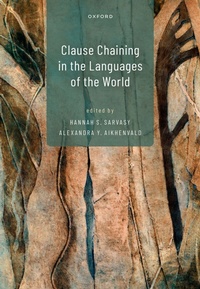
Clause Chaining in the Languages of the World
Erschienen am 28. November 2024
Buch
Hardcover
880 Seiten
978-0-19-887031-9 (ISBN)
Beschreibung
The languages of the world make use of a variety of techniques for describing events and putting sentences together. This volume takes a typological approach to clause chaining, a fascinating feature of the grammar of hundreds of languages outside Europe, especially in the Asia-Pacific region, East Africa, across Central Asia, and the Americas. Clause chains consist of several dependent clauses and one main clause, and are used to organize discourse and to foreground or background events and participants; they often go together with switch-reference marking, an indication of whether upcoming subjects will be co-referential with preceding subjects or not.
The introductory chapter features a discussion of the typological properties of clause chaining, with a brief overview of previous approaches to and investigations of clause chains followed by an overview of their recurrent grammatical features; it ends with an appendix featuring notes for fieldworkers. The first part of the book explores general issues in clause chaining, including prosody, acquisition, and language contact and history; later parts then examine clause chaining and related phenomena in a wide range of languages from around the world.
The introductory chapter features a discussion of the typological properties of clause chaining, with a brief overview of previous approaches to and investigations of clause chains followed by an overview of their recurrent grammatical features; it ends with an appendix featuring notes for fieldworkers. The first part of the book explores general issues in clause chaining, including prosody, acquisition, and language contact and history; later parts then examine clause chaining and related phenomena in a wide range of languages from around the world.
Weitere Details
Sprache
Englisch
Verlagsort
Oxford
Großbritannien
Zielgruppe
Für höhere Schule und Studium
Produkt-Hinweis
Fadenheftung
Gewebe-Einband
Maße
Höhe: 247 mm
Breite: 181 mm
Dicke: 47 mm
Gewicht
1501 gr
ISBN-13
978-0-19-887031-9 (9780198870319)
Copyright in bibliographic data and cover images is held by Nielsen Book Services Limited or by the publishers or by their respective licensors: all rights reserved.
Schweitzer Klassifikation
Weitere Ausgaben
Andere Ausgaben
Hannah S. Sarvasy | Alexandra Y. Aikhenvald
Clause Chaining in the Languages of the World
E-Book
02/2025
OUP eBook
184,99 €
Als Download verfügbar
Personen
Hannah S. Sarvasy is Senior Researcher at the MARCS Institute for Brain, Behaviour and Development at Western Sydney University. Her research combines fieldwork on Papuan, Atlantic and other languages, child language acquisition research, and psycholinguistic experimentation. She is the author of A Grammar of Nungon: A Papuan Language of Northeast New Guinea (Brill, 2017), among other volumes, and led a Nungon-speaking team to build the Nungon Child Speech Corpus, one of the largest digitized corpora of child-caregiver interactions in a Papuan language. She has published multiple studies on the grammar, history, acquisition, and processing of clause chains and switch-reference marking.
Alexandra Y. Aikhenvald is Professor, Australian Laureate Fellow, and Head of Research Cluster 'Language and well-being' at the Jawun Centre, Central Queensland University. She is a major authority on languages of the Arawak family, from northern Amazonia, and has written grammars of Bare (1995) and Warekena (1998), plus A Grammar of Tariana, from Northwest Amazonia (CUP, 2003) and The Manambu Language of East Sepik, Papua New Guinea (OUP, 2008; paperback 2010), in addition to essays on various typological and areal features of South American and Papuan languages and typological issues including evidentials, classifiers, serial verbs, and language and well-being.
Alexandra Y. Aikhenvald is Professor, Australian Laureate Fellow, and Head of Research Cluster 'Language and well-being' at the Jawun Centre, Central Queensland University. She is a major authority on languages of the Arawak family, from northern Amazonia, and has written grammars of Bare (1995) and Warekena (1998), plus A Grammar of Tariana, from Northwest Amazonia (CUP, 2003) and The Manambu Language of East Sepik, Papua New Guinea (OUP, 2008; paperback 2010), in addition to essays on various typological and areal features of South American and Papuan languages and typological issues including evidentials, classifiers, serial verbs, and language and well-being.
Inhalt
1: Hannah S. Sarvasy and Alexandra Y. Aikhenvald: Clause chaining in the languages of the world in typological perspective
Part I. General issues in clause chaining
2: Matthew K. Gordon: Prosody in clause chaining constructions
3: Hannah S. Sarvasy and Soonja Choi: The acquisition of clause chaining
4: Alexandra Y. Aikhenvald: Clause chaining and switch-reference in language contact and language history
Part II. Clause chaining in languages of New Guinea
5: Lourens de Vries: Clause chaining in Greater Awyu languages of West Papua
6: Alexandra Y. Aikhenvald: Clause chaining and switch-reference in Ndu languages
7: Hannah S. Sarvasy: Clause chaining in Finisterre Papuan languages
8: Robert L. Bradshaw: Clause chaining and other means of clause linking in Doromu-Koki
9: Grant Aiton: Clause chaining in Eibela
10: Danielle Barth and Malcolm Ross: Clause chaining in Matukar Panau (Oceanic, Papua New Guinea)
Part III. Clause chaining in North American Indian languages
11: George Aaron Broadwell: Clause chaining in Muskogean languages
12: Maziar Toosarvandani: Clause chaining in Uto-Aztecan: A Northern Paiute perspective
13: Marianne Mithun: Delineating typological categories: Central Alaskan Yup'ik
Part IV. Clause chaining in South American Indian languages
14: Simon E. Overall: Clause chaining in Aguaruna (Chicham)
15: Kristine Stenzel: Clause chaining in East Tukanoan Kotiria and Wa'ikhana: Structural and pragmatic features
16: Roberto Zariquiey and Pilar M. Valenzuela: Object-oriented switch-reference in Pano
17: Rafael Nonato: Switch-reference and clause chaining in Northern Je
Part V. Clause chaining in languages of Eurasia
18: Gwendolyn Hyslop: Clause chaining in Kurtoep
19: Stephen Watters: Clause chaining in Dzongkha
20: Mark W. Post and Yankee Modi: Clause chains and related structures in Macro-Tani languages
21: Diana Forker: Clause chaining in Adyghe (West Caucasian)
22: Felix Anker: Clause chaining in Tsova-Tush and East Caucasian
23: Lars Johanson, Eva A. Csato, and Birsel Karakoc: Clause chaining in Turkic
24: Ayhan Aksu-Koc and Hale OEgel-Balaban: The development of clause chaining in Turkish
25: Elena Skribnik: Clause chaining in Buryat (North Mongolic)
26: Patricia M. Clancy: Clause chains and intonation units in Japanese narratives
Part VI. Clause chaining in languages of Eastern and Southern Africa
27: Mengistu Amberber: The Amharic converb in clause chaining
28: Yvonne Treis and Martine Vanhove: Converb constructions and clause chaining in Cushitic
29: Kristina Riedel and Hannah Gibson: Clause chaining in Bantu languages
Part I. General issues in clause chaining
2: Matthew K. Gordon: Prosody in clause chaining constructions
3: Hannah S. Sarvasy and Soonja Choi: The acquisition of clause chaining
4: Alexandra Y. Aikhenvald: Clause chaining and switch-reference in language contact and language history
Part II. Clause chaining in languages of New Guinea
5: Lourens de Vries: Clause chaining in Greater Awyu languages of West Papua
6: Alexandra Y. Aikhenvald: Clause chaining and switch-reference in Ndu languages
7: Hannah S. Sarvasy: Clause chaining in Finisterre Papuan languages
8: Robert L. Bradshaw: Clause chaining and other means of clause linking in Doromu-Koki
9: Grant Aiton: Clause chaining in Eibela
10: Danielle Barth and Malcolm Ross: Clause chaining in Matukar Panau (Oceanic, Papua New Guinea)
Part III. Clause chaining in North American Indian languages
11: George Aaron Broadwell: Clause chaining in Muskogean languages
12: Maziar Toosarvandani: Clause chaining in Uto-Aztecan: A Northern Paiute perspective
13: Marianne Mithun: Delineating typological categories: Central Alaskan Yup'ik
Part IV. Clause chaining in South American Indian languages
14: Simon E. Overall: Clause chaining in Aguaruna (Chicham)
15: Kristine Stenzel: Clause chaining in East Tukanoan Kotiria and Wa'ikhana: Structural and pragmatic features
16: Roberto Zariquiey and Pilar M. Valenzuela: Object-oriented switch-reference in Pano
17: Rafael Nonato: Switch-reference and clause chaining in Northern Je
Part V. Clause chaining in languages of Eurasia
18: Gwendolyn Hyslop: Clause chaining in Kurtoep
19: Stephen Watters: Clause chaining in Dzongkha
20: Mark W. Post and Yankee Modi: Clause chains and related structures in Macro-Tani languages
21: Diana Forker: Clause chaining in Adyghe (West Caucasian)
22: Felix Anker: Clause chaining in Tsova-Tush and East Caucasian
23: Lars Johanson, Eva A. Csato, and Birsel Karakoc: Clause chaining in Turkic
24: Ayhan Aksu-Koc and Hale OEgel-Balaban: The development of clause chaining in Turkish
25: Elena Skribnik: Clause chaining in Buryat (North Mongolic)
26: Patricia M. Clancy: Clause chains and intonation units in Japanese narratives
Part VI. Clause chaining in languages of Eastern and Southern Africa
27: Mengistu Amberber: The Amharic converb in clause chaining
28: Yvonne Treis and Martine Vanhove: Converb constructions and clause chaining in Cushitic
29: Kristina Riedel and Hannah Gibson: Clause chaining in Bantu languages