

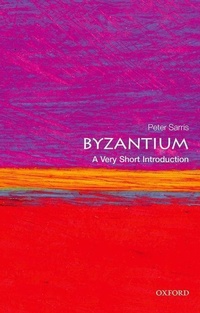
Byzantium
A Very Short Introduction
Erschienen am 23. Juli 2015
Buch
Softcover
176 Seiten
978-0-19-923611-4 (ISBN)
Beschreibung
After surviving the fifth century fall of the Western European Roman Empire, the Byzantine Empire flourished as one of the most powerful economic, cultural, and military forces in Europe for a thousand years.
In this Very Short Introduction Peter Sarris introduces the reader to the unique fusion of Roman political culture, Greek intellectual tradition and Christian faith that took place in the imperial capital of Byzantium under the emperor Constantine and his heirs. Using examples from Byzantine architecture, art and literature, Sarris shows how their legacy was re-worked and re-invented in the centuries ahead, in the face of external challenges and threats. Charting the impact of warfare with the Persian and Islamic worlds to the east, Sarris explores the creativity of Byzantine statecraft and strategy, as well as the empire's repeated (but ultimately forlorn) attempts to enlist aid from the Christian powers of Western Europe to ensure its survival.
ABOUT THE SERIES: The Very Short Introductions series from Oxford University Press contains hundreds of titles in almost every subject area. These pocket-sized books are the perfect way to get ahead in a new subject quickly. Our expert authors combine facts, analysis, perspective, new ideas, and enthusiasm to make interesting and challenging topics highly readable.
In this Very Short Introduction Peter Sarris introduces the reader to the unique fusion of Roman political culture, Greek intellectual tradition and Christian faith that took place in the imperial capital of Byzantium under the emperor Constantine and his heirs. Using examples from Byzantine architecture, art and literature, Sarris shows how their legacy was re-worked and re-invented in the centuries ahead, in the face of external challenges and threats. Charting the impact of warfare with the Persian and Islamic worlds to the east, Sarris explores the creativity of Byzantine statecraft and strategy, as well as the empire's repeated (but ultimately forlorn) attempts to enlist aid from the Christian powers of Western Europe to ensure its survival.
ABOUT THE SERIES: The Very Short Introductions series from Oxford University Press contains hundreds of titles in almost every subject area. These pocket-sized books are the perfect way to get ahead in a new subject quickly. Our expert authors combine facts, analysis, perspective, new ideas, and enthusiasm to make interesting and challenging topics highly readable.
Rezensionen / Stimmen
a broad perspective on Byzantine history which will be useful for readers with some background in the topic who want to learn more. * Paul England, Medieval Warfare * thorough and informative * Northern Echo, Stephen Craggs * a brilliantly distilled introduction to the idea of Byzantium, its reality and its legacy. * Adrian Spooner, Classics for All *Weitere Details
Reihe
Sprache
Englisch
Verlagsort
Oxford
Großbritannien
Illustrationen
15 black and white illustrations
Maße
Höhe: 175 mm
Breite: 113 mm
Dicke: 12 mm
Gewicht
131 gr
ISBN-13
978-0-19-923611-4 (9780199236114)
Copyright in bibliographic data and cover images is held by Nielsen Book Services Limited or by the publishers or by their respective licensors: all rights reserved.
Schweitzer Klassifikation
Weitere Ausgaben
Person
Peter Sarris was educated at St Albans School and Balliol College, Oxford, where he read Modern History, specialising in Byzantine and medieval topics. In 1993 he was elected to a Prize Fellowship at All Souls College, and since 2000 he has taught at the University of Cambridge, where he is currently Reader in Late Roman, Medieval and Byzantine History and a Fellow of Trinity College. His previous books include Empires of Faith - The Fall of Rome to the Rise of Islam (OUP, 2011).
Inhalt
1. What was Byzantium? ; 2. Constantinople, 'the ruling city' ; 3. From antiquity to the middle ages ; 4. Byzantium and Islam ; 5. Strategies for survival ; 6. Text, image, space, and spirit ; 7. End of empire ; Further reading ; Index