

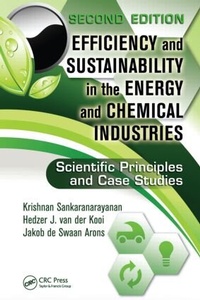
Efficiency and Sustainability in the Energy and Chemical Industries
Scientific Principles and Case Studies, Second Edition
2. Auflage
Erschienen am 24. Mai 2010
Buch
Hardcover
393 Seiten
978-1-4398-1470-3 (ISBN)
Beschreibung
Using classic thermodynamic principles as the point of departure, this new edition of a popular resource supplies the understanding and tools required to measure process efficiency and sustainability with much improved accuracy. Exploring the driving forces in the chemical and power industries, Efficiency and Sustainability in the Energy and Chemical Industries: Scientific Principles and Case Studies, Second Edition investigates why losses occur and explains how to reduce such losses.
Numerous case studies, examples, and problems illustrate the thermodynamic analysis of process performance to explain how to effectively analyze and optimize work flows and environmental resources. The authors compare the present industrial society with an emerging one in which mass production and consumption are in harmony with the natural environment through closure of material cycles. In this second edition, the book's structure of Basics, Thermodynamic Analysis of Processes, Case Studies, and Sustainability has been unaffected, but a few additions have been made.
New and updated information includes:
A new chapter dedicated to the increasing levels of CO2 emissions, with special attention to the removal and storage of CO2
A new chapter on the rapidly emerging hydrogen economy
An extended chapter on lifecycle analysis that examines the fate of the quality of energy during the lifecycle
Increased focus on integrating the environment into the thermodynamic analysis of the systems or processes considered
New problem sets and exercises
Complete with the keys to a quantification of process efficiency and sustainability, this cutting-edge resource is the ideal guide for those engaged in the transition from fossil-based fuels to renewable and sustainable energy sources using low-waste procedures.
Numerous case studies, examples, and problems illustrate the thermodynamic analysis of process performance to explain how to effectively analyze and optimize work flows and environmental resources. The authors compare the present industrial society with an emerging one in which mass production and consumption are in harmony with the natural environment through closure of material cycles. In this second edition, the book's structure of Basics, Thermodynamic Analysis of Processes, Case Studies, and Sustainability has been unaffected, but a few additions have been made.
New and updated information includes:
A new chapter dedicated to the increasing levels of CO2 emissions, with special attention to the removal and storage of CO2
A new chapter on the rapidly emerging hydrogen economy
An extended chapter on lifecycle analysis that examines the fate of the quality of energy during the lifecycle
Increased focus on integrating the environment into the thermodynamic analysis of the systems or processes considered
New problem sets and exercises
Complete with the keys to a quantification of process efficiency and sustainability, this cutting-edge resource is the ideal guide for those engaged in the transition from fossil-based fuels to renewable and sustainable energy sources using low-waste procedures.
Rezensionen / Stimmen
"The authors have written a much needed textbook, appropriate for chemical, mechanical, process, and environmental engineers. ... Overall, the text is highly readable and the authors have done an excellent job at combining a difficult subject (thermodynamics) with an area that eludes quantification due to its complexity (the environment). ... It is a highly recommended read."-Polymer News, 2005, Vol. 30Weitere Details
Reihe
Auflage
2nd edition
Sprache
Englisch
Verlagsort
Bosa Roca
USA
Verlagsgruppe
Taylor & Francis Inc
Zielgruppe
Für Beruf und Forschung
Professional Practice & Development
Produkt-Hinweis
Pappband
Illustrationen
153 s/w Abbildungen, 2 s/w Photographien bzw. Rasterbilder, 35 s/w Tabellen
35 Tables, black and white; 2 Halftones, black and white; 153 Illustrations, black and white
Maße
Höhe: 234 mm
Breite: 156 mm
Gewicht
703 gr
ISBN-13
978-1-4398-1470-3 (9781439814703)
Copyright in bibliographic data and cover images is held by Nielsen Book Services Limited or by the publishers or by their respective licensors: all rights reserved.
Schweitzer Klassifikation
Weitere Ausgaben
Nachauflagen
Krishnan Sankaranarayanan
Efficiency and Sustainability in the Energy and Chemical Industries
Scientific Principles and Case Studies
Buch
09/2023
3. Auflage
CRC Press
197,20 €
Versand in 10-20 Tagen
Vorauflage
Krishnan Sankaranarayanan | Hedzer J. van der Kooi | Jakob de Swaan Arons
Efficiency and Sustainability in the Energy and Chemical Industries
Scientific Principles and Case Studies
Buch
01/2004
1. Auflage
CRC Press
175,31 €
Artikel ist vergriffen; siehe Neuauflage
Personen
Jakob de Swaan Arons received his MSc and PhD degrees from the Delft University of Technology, the Netherlands. He spent some 20 years with Shell International, before he was appointed to the chair of Applied Thermodynamics and Phase Equilibria at Delft University of Technology. He is an elected member of the Royal Netherlands Academy of Arts and Sciences, and an honorary professor of the Beijing University of Chemical Technology, China. From 2003 to 2009, he served as chair in the chemical engineering department of Tsinghua University, Beijing, China. Much of his inspiration was drawn from his many visits to Japan and its research centers. He received the Hoogewerff Gold Medal for his lifetime contributions to process technology in 2006.
Krishnan Sankaranarayanan received his MSc at Delft University of Technology, the Netherlands and his PhD at Princeton University, New Jersey. At Delft, he did an extensive study of the energy effi ciency of the polyolefi n industry, for which activity DSM acted as host. He is currently group head reactor engineering and mixing at ExxonMobil Research and Engineering, Fairfax, Virginia.
Hedzer J. van der Kooi received his MSc and PhD degrees from Delft University of Technology and specialized in phase equilibria. In the last decade, he worked closely together with Sankaranarayanan on the subject of this book, assisted by many students. He is currently active in the Department of Architecture at Delft University of Technology.
Krishnan Sankaranarayanan received his MSc at Delft University of Technology, the Netherlands and his PhD at Princeton University, New Jersey. At Delft, he did an extensive study of the energy effi ciency of the polyolefi n industry, for which activity DSM acted as host. He is currently group head reactor engineering and mixing at ExxonMobil Research and Engineering, Fairfax, Virginia.
Hedzer J. van der Kooi received his MSc and PhD degrees from Delft University of Technology and specialized in phase equilibria. In the last decade, he worked closely together with Sankaranarayanan on the subject of this book, assisted by many students. He is currently active in the Department of Architecture at Delft University of Technology.
Inhalt
BASICS. Thermodynamics Revisited. Energy "Consumption" and Lost Work. Entropy Generation: Cause and Effect. Reduction of Lost Work. THERMODYNAMIC ANALYSIS OF PROCESSES. Exergy, a Convenient Concept. Chemical Exergy. Simple Applications. CASE STUDIES. Energy Conversion. Separations. Chemical Conversion. SUSTAINABILITY. Sustainable Development. Efficiency and Sustainability in the Chemical Process Industry. CO2 Capture and Sequestration. Sense and Nonsense of Green Chemistry and Biofuels. Solar Energy Conversion. Future? Future Trends. Epilogue. Problems. Index. Each chapter includes an "Introduction", "Concluding remarks", and "References".