

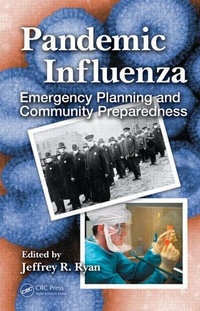
Pandemic Influenza
Emergency Planning and Community Preparedness
1. Auflage
Erscheint ca. am 1. August 2008
Buch
Hardcover
276 Seiten
978-1-4200-6087-4 (ISBN)
Beschreibung
The swine flu emergency needn't become a crisis. This critically acclaimed work provides public health officials, doctors, responders, and emergency planners with accurate current information that will help them understand the nature of an outbreak, assess risk, answer public concerns, and develop informed strategies.
Devoid of sensationalism and agenda, this CRC Press resource provides all the information needed to understand pandemic influenzas including, avian, swine, and human variations and outlines the steps needed to develop and implement prevention, stabilization, and recovery efforts as needed at the local level.
"... an amazing resource ... Dr. Ryan has assembled some of the best experts in the field to guide you in understanding the threat of pandemic influenza and how it can affect you and the people you are responsible for. ..." --From the foreword by Lynn A. Slepski, Captain, United States Public Health Service
Make certain your response to Swine Flu is proactive and informed
Edited by Jeffrey Ryan, Institute for Emergency Preparedness, this volume -
Arms planners and responders with guidance from 13 leading experts
Takes lessons from past pandemics
Covers biological and clinical aspects of influenza
Discusses pharmaceutical and non-pharmaceutical measures
Details response actions related to communication, travel, and quarantine
While the swine flu outbreak has impacted Mexico; influenza has no respect for boundaries and is already being felt up north. Despite warnings from the World Health Organization, our preparedness continues to lag. Part of the problem is that the real action must occur at the local level. Triage, care, and containment, along with maintenance of infrastructure, are functions that must be carried out by local planners and responders.
The first section reviews the history of pandemics. The middle chapters examine the biology of a virus and clinical aspects of influenza. The final chapters examine international and federal programs and discuss response at the local level, including service continuation planning and fatality management.
Devoid of sensationalism and agenda, this CRC Press resource provides all the information needed to understand pandemic influenzas including, avian, swine, and human variations and outlines the steps needed to develop and implement prevention, stabilization, and recovery efforts as needed at the local level.
"... an amazing resource ... Dr. Ryan has assembled some of the best experts in the field to guide you in understanding the threat of pandemic influenza and how it can affect you and the people you are responsible for. ..." --From the foreword by Lynn A. Slepski, Captain, United States Public Health Service
Make certain your response to Swine Flu is proactive and informed
Edited by Jeffrey Ryan, Institute for Emergency Preparedness, this volume -
Arms planners and responders with guidance from 13 leading experts
Takes lessons from past pandemics
Covers biological and clinical aspects of influenza
Discusses pharmaceutical and non-pharmaceutical measures
Details response actions related to communication, travel, and quarantine
While the swine flu outbreak has impacted Mexico; influenza has no respect for boundaries and is already being felt up north. Despite warnings from the World Health Organization, our preparedness continues to lag. Part of the problem is that the real action must occur at the local level. Triage, care, and containment, along with maintenance of infrastructure, are functions that must be carried out by local planners and responders.
The first section reviews the history of pandemics. The middle chapters examine the biology of a virus and clinical aspects of influenza. The final chapters examine international and federal programs and discuss response at the local level, including service continuation planning and fatality management.
Rezensionen / Stimmen
No one is immune to the potential devastation of a mass pandemic influenza outbreak, yet despite recent small outbreaks and dire warnings from the WHO that such an event is imminent and overdue, our readiness continues to lag. ... This collection aims to introduce readers to the most critical global and domestic issues regarding a potential pandemic. Featuring the contributions of thirteen experts, the volume helps planners and responders with an understanding of outbreak containment and response planning, providing a detailed analysis of our present capabilities and potential weaknesses. The first section reviews the history of pandemics and discusses the deadly 1918 Spanish flu. The middle chapters examine the biology of the virus and the clinical aspects of influenza, with special attention given to avian flu. The final chapters examine international and federal programs and discuss response at the local level, including service continuation planning and fatality management. Public health and emergency preparedness professionals, as well as policymakers at all levels, will find a wealth of relevant information that will let them figure out their priorities and allocate the proper resources to mitigate the damages of a pandemic influenza. -Abstracts of Public Administration, Development, and Environment (APADE), Fall 2010This helpful, concise volume covers all the basics of pandemic preparedness. Written by emergency management professionals (from agencies like the US Public Health Service, FEMA, and state health departments) who know the nuts and bolts of disaster response, it will be useful to a wide range of planners, whether they work in public services or are formulating business operations plans . . . The graphs, photos, glossaries, resource lists, and tables-on everything from the facilities involved in poultry population to vaccine priority groups to guidelines for certifying deaths and strong bodies-make this a hand manual for both emergency management professionals and laypeople.-K.H. Jacobsen, George Mason University, in Choice: Current Reviews for Academic Libraries, Vol. 46, No. 10, June 2009
... targeted primarily at public health planners involved in preparing community responses to the next influenza pandemic. However, this book also serves as a good reference to many aspects of pandemic influenza, providing a historical perspective as well as up-to-date information in the field of molecular virology. ... a very interesting book that covers some of the less documented and less understood aspects of pandemic planning. For those planners who delve into the finer details, it will improve their ability to inform communities and businesses to "fight back" when the big one hits.-Alex J. Elliot, Health Protection Agency West Midlands-Regional Surveillance Unit, Birmingham, UK, in CID, August 2009, Vol. 49
Weitere Details
Sprache
Englisch
Verlagsort
Bosa Roca
USA
Verlagsgruppe
Taylor & Francis Inc
Zielgruppe
Für Beruf und Forschung
Academic and Professional Practice & Development
Illustrationen
51 s/w Abbildungen, 16 s/w Photographien bzw. Rasterbilder, 26 s/w Tabellen
26 Tables, black and white; 16 Halftones, black and white; 51 Illustrations, black and white
Maße
Höhe: 234 mm
Breite: 156 mm
Gewicht
521 gr
ISBN-13
978-1-4200-6087-4 (9781420060874)
Copyright in bibliographic data and cover images is held by Nielsen Book Services Limited or by the publishers or by their respective licensors: all rights reserved.
Schweitzer Klassifikation
Weitere Ausgaben
Andere Ausgaben
E-Book
08/2008
1. Auflage
CRC Press
211,99 €
Als Download verfügbar
E-Book
08/2008
1. Auflage
CRC Press
211,99 €
Als Download verfügbar
Person
Jacksonville State University, Alabama, USA
Inhalt
Defining the Threat of Influenza. Natural History of Influenza. Defining the Response.