

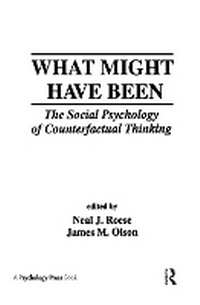
What Might Have Been
The Social Psychology of Counterfactual Thinking
Erschienen am 1. Oktober 1995
Buch
Hardcover
420 Seiten
978-0-8058-1613-6 (ISBN)
Beschreibung
Within a few short years, research on counterfactual thinking has mushroomed, establishing itself as one of the signature domains within social psychology. Counterfactuals are thoughts of what might have been, of possible past outcomes that could have taken place. Counterfactuals and their implications for perceptions of time and causality have long fascinated philosophers, but only recently have social psychologists made them the focus of empirical inquiry.
Following the publication of Kahneman and Tversky's seminal 1982 paper, a burgeoning literature has implicated counterfactual thinking in such diverse judgments as causation, blame, prediction, and suspicion; in such emotional experiences as regret, elation, disappointment and sympathy; and also in achievement, coping, and intergroup bias. But how do such thoughts come about? What are the mechanisms underlying their operation? How do their consequences benefit, or harm, the individual? When is their generation spontaneous and when is it strategic? This volume explores these and other numerous issues by assembling contributions from the most active researchers in this rapidly expanding subfield of social psychology. Each chapter provides an in-depth exploration of a particular conceptual facet of counterfactual thinking, reviewing previous work, describing ongoing, cutting-edge research, and offering novel theoretical analysis and synthesis. As the first edited volume to bring together the many threads of research and theory on counterfactual thinking, this book promises to be a source of insight and inspiration for years to come.
Following the publication of Kahneman and Tversky's seminal 1982 paper, a burgeoning literature has implicated counterfactual thinking in such diverse judgments as causation, blame, prediction, and suspicion; in such emotional experiences as regret, elation, disappointment and sympathy; and also in achievement, coping, and intergroup bias. But how do such thoughts come about? What are the mechanisms underlying their operation? How do their consequences benefit, or harm, the individual? When is their generation spontaneous and when is it strategic? This volume explores these and other numerous issues by assembling contributions from the most active researchers in this rapidly expanding subfield of social psychology. Each chapter provides an in-depth exploration of a particular conceptual facet of counterfactual thinking, reviewing previous work, describing ongoing, cutting-edge research, and offering novel theoretical analysis and synthesis. As the first edited volume to bring together the many threads of research and theory on counterfactual thinking, this book promises to be a source of insight and inspiration for years to come.
Weitere Details
Sprache
Englisch
Verlagsort
Philadelphia
USA
Verlagsgruppe
Taylor & Francis Inc
Zielgruppe
Für höhere Schule und Studium
Für Beruf und Forschung
Maße
Höhe: 229 mm
Breite: 152 mm
Gewicht
940 gr
ISBN-13
978-0-8058-1613-6 (9780805816136)
Copyright in bibliographic data and cover images is held by Nielsen Book Services Limited or by the publishers or by their respective licensors: all rights reserved.
Schweitzer Klassifikation
Weitere Ausgaben
Andere Ausgaben

E-Book
01/2014
1. Auflage
Psychology Press Ltd
110,99 €
Als Download verfügbar

E-Book
01/2014
1. Auflage
Psychology Press Ltd
110,99 €
Als Download verfügbar
Buch
10/1995
Psychology Press
118,90 €
Versand in 10-20 Tagen
Personen
Neal J. Roese, James M. Olson
Inhalt
Contents: N.J. Roese, J.M. Olson, Counterfactual Thinking: A Critical Overview. E.P. Seelau, S.M. Seelau, G.L. Wells, P.D. Windschitl, Counterfactual Constraints. M. Kasimatis, G.L. Wells, Individual Differences in Couterfactual Thinking. D. Dunning, S.F. Madey, Comparison Processes in Counterfactual Thought. M.N. McMullen, K.D. Markman, I. Gavanski, Living in Neither the Best Nor the Worst of All Possible Worlds: Antecedents and Consequences of Upward and Downward Counterfactual Thinking. N.J. Roese, J.M. Olson, Functions of Counterfactual Thinking. S.J. Sherman, A.R. McConnell, Dysfunctional Implications of Counterfactual Thinking: When Alternatives to Reality Fail Us. J. Landman, Through a Glass Darkly: Worldviews, Counterfactual Thought, and Emotion. T. Gilovich, V.H. Medvec, Some Counterfactual Determinants of Satisfaction and Regret. F. Gleicher, D.S. Boninger, A. Strathman, D. Armor, J. Hetts, M. Ahn, With an Eye Toward the Future: The Impact of Counterfactual Thinking on Affect, Attitudes, and Behavior. D.T. Miller, B.R. Taylor, Counterfactual Thought, Regret, and Superstition: How to Avoid Kicking Yourself. A.L. McGill, J.G. Klein, Counterfactual and Contrastive Reasoning in Explanations for Performance: Implications for Gender Bias. C.G. Davis, D.R. Lehman, Counterfactual Thinking and Coping With Traumatic Life Events. D. Kahneman, Varieties of Counterfactual Thinking.