

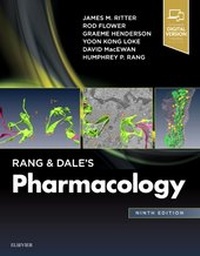
Rang & Dale's Pharmacology
9. Auflage
Erschienen am 22. Januar 2019
Buch
Softcover
808 Seiten
978-0-7020-7448-6 (ISBN)
Beschreibung
Comprehensive yet easy to use, Rang and Dale's Pharmacology has been providing core basic and clinical science information to students and healthcare practitioners worldwide for more than 25 years. The fully revised 9th Edition keeps you up to date with all that's new in the field, including new and emerging drugs and recent studies. From cover to cover, you'll progressively increase your knowledge of all relevant aspects of pharmacology, from a molecular understanding of receptors and drug actions through clinical uses of key groups of drugs.
Keeps you up-to-date with new information in this fast-changing field, including significantly revised coverage of CNS drugs, cognitive enhancers, anti-infectives, biologicals/biopharmaceuticals, lifestyle drugs, and more.
Includes access to unique features online, including more than 100 brand new chapter-specific multiple-choice questions and 6 new cases for immediate self-assessment.
Features a color-coded layout for faster navigation and cross-referencing.
Clarifies complex concepts with Key Points boxes, Clinical Uses boxes and full-color illustrations throughout.
Enhanced eBook version included with purchase. Your enhanced eBook allows you to access all of the text, figures, and references from the book on a variety of devices.
Keeps you up-to-date with new information in this fast-changing field, including significantly revised coverage of CNS drugs, cognitive enhancers, anti-infectives, biologicals/biopharmaceuticals, lifestyle drugs, and more.
Includes access to unique features online, including more than 100 brand new chapter-specific multiple-choice questions and 6 new cases for immediate self-assessment.
Features a color-coded layout for faster navigation and cross-referencing.
Clarifies complex concepts with Key Points boxes, Clinical Uses boxes and full-color illustrations throughout.
Enhanced eBook version included with purchase. Your enhanced eBook allows you to access all of the text, figures, and references from the book on a variety of devices.
Rezensionen / Stimmen
"This book is well suited for a graduate-level pharmacology course for MS or PhD students or MD/PhD students."-Carol L Beck, PharmD, PhD (Thomas Jefferson University) Doody's Review Score: 90-4 Stars!
Weitere Details
Auflage
9th edition
Sprache
Englisch
Verlagsort
London
Großbritannien
Zielgruppe
Für höhere Schule und Studium
Illustrationen
Approx. 370 illustrations (370 in full color); Illustrations
Maße
Höhe: 276 mm
Breite: 216 mm
Gewicht
2210 gr
ISBN-13
978-0-7020-7448-6 (9780702074486)
Copyright in bibliographic data and cover images is held by Nielsen Book Services Limited or by the publishers or by their respective licensors: all rights reserved.
Schweitzer Klassifikation
Weitere Ausgaben
Nachauflagen
James M. Ritter | Rod J. Flower | Graeme Henderson
Rang & Dale's Pharmacology
Buch
05/2023
10. Auflage
Elsevier
71,00 €
Sofort lieferbar
Andere Ausgaben
James M. Ritter | Humphrey P. Rang | Rod J. Flower
Rang & Dale's Pharmacology
E-Book
11/2018
9. Auflage
Elsevier
50,99 €
Als Download verfügbar
Vorauflage
James M. Ritter | Rod J. Flower | Graeme Henderson
Rang & Dale's Pharmacology
Buch
01/2015
8. Auflage
Churchill Livingstone
81,86 €
Artikel ist vergriffen; siehe Neuauflage
Personen
Autor*in
Emeritus Professor of Clinical Pharmacology, King's College London, and Medical Research Director, Quintiles, London, UK
Professor, Biochemical Pharmacology, The William Harvey Research Institute, Barts and the London School of Medicine and Dentistry, Queen Mary University of London , London, UK
Professor of Pharmacology, University of Bristol, Bristol, UK
Senior Lecturer in Clinical Pharmacology, School of Medicine, Health Policy and Practice, University of East Anglia, Norwich, UK
Professor of Molecular Pharmacology/Toxicology & Head of Department, Department of Molecular and Clinical Pharmacology, University of Liverpool, Liverpool, UK
Emeritus Professor of Pharmacology, University College London, London, UK
Inhalt
Rang and Dale's Pharmacology
Section 1. General principles
1. What is pharmacology?
2. How drugs act: general principles
3. How drugs act: molecular aspects
4. How drugs act: cellular aspects excitation, contraction and secretion
5. Biopharmaceuticals and gene therapy
6. Cell proliferation, apoptosis, repair and regeneration
7. Cellular mechanisms: host defence
8. Method and measurement in pharmacology
9. Absorption and distribution of drugs
10. Drug metabolism and elimination
11. Pharmacokinetics
12. Individual Variation, Pharmacogenomics and Personalised Medicine
Section 2. Chemical Mediators
13. Chemical mediators and the autonomic nervous system
14. Cholinergic transmission
15. Noradrenergic transmission
16. 5-Hydroxytryptamine and the Pharmacology of Migraine
17. Purines
18. Local Hormones 1: Histamin and the Biologically Active Lipids.
19. Local Hormones 2: Peptides and Proteins
20. Cannabinoids
21. Nitric oxide and other gaseous mediators
Section 3. Drugs affecting major organ systems
22. The heart
23. The vascular system
24. Atherosclerosis and lipid metabolism
25. Haemostasis and thrombosis
26. Haemopoietic system
27. Anti-inflammatory and immunosuppressant drugs
28. Skin
29. Respiratory system
30. The Kidney and urinary system
31. The Gastrointestinal tract
32. The control of blood glucose and drug treatment of diabetes mellitus
33. Obesity
34. The Pituitary and the adrenal cortex
35. Thyroid
36. The reproductive system
37. Bone metabolism
Section 4. Nervous System
38. Chemical transmission and drug action in the nervous system
39. Amino acid transmitters
40. Other transmitters and modulators
41. Neurodegenerative diseases
42. General anaesthetic agents
43. Analgesic drugs
44. Local anaesthetics and other drugs affecting sodium channels
45. Anxiolytic and hypnotic drugs
46. Antiepileptic drugs
47. Antipsychotic drugs
48. Antidepressant drugs
49. CNS stimulants and psychotomimetic drugs
50. Drug addiction, dependence and abuse
Section 5. Drugs used for the treatment of infections and cancer
51. Basic principles of antimicrobial chemotherapy
52. Antibacterial drugs
53. Antiviral drugs
54. Antifungal drugs
55. Antiprotozoal drugs
56. Anthelmintic drugs
57. Anti-cancer drugs
Section 6. Special Topics
58. Harmful effects of drugs
59. Lifestyle drugs and drugs in sport
60. Drug discovery and development
Section 1. General principles
1. What is pharmacology?
2. How drugs act: general principles
3. How drugs act: molecular aspects
4. How drugs act: cellular aspects excitation, contraction and secretion
5. Biopharmaceuticals and gene therapy
6. Cell proliferation, apoptosis, repair and regeneration
7. Cellular mechanisms: host defence
8. Method and measurement in pharmacology
9. Absorption and distribution of drugs
10. Drug metabolism and elimination
11. Pharmacokinetics
12. Individual Variation, Pharmacogenomics and Personalised Medicine
Section 2. Chemical Mediators
13. Chemical mediators and the autonomic nervous system
14. Cholinergic transmission
15. Noradrenergic transmission
16. 5-Hydroxytryptamine and the Pharmacology of Migraine
17. Purines
18. Local Hormones 1: Histamin and the Biologically Active Lipids.
19. Local Hormones 2: Peptides and Proteins
20. Cannabinoids
21. Nitric oxide and other gaseous mediators
Section 3. Drugs affecting major organ systems
22. The heart
23. The vascular system
24. Atherosclerosis and lipid metabolism
25. Haemostasis and thrombosis
26. Haemopoietic system
27. Anti-inflammatory and immunosuppressant drugs
28. Skin
29. Respiratory system
30. The Kidney and urinary system
31. The Gastrointestinal tract
32. The control of blood glucose and drug treatment of diabetes mellitus
33. Obesity
34. The Pituitary and the adrenal cortex
35. Thyroid
36. The reproductive system
37. Bone metabolism
Section 4. Nervous System
38. Chemical transmission and drug action in the nervous system
39. Amino acid transmitters
40. Other transmitters and modulators
41. Neurodegenerative diseases
42. General anaesthetic agents
43. Analgesic drugs
44. Local anaesthetics and other drugs affecting sodium channels
45. Anxiolytic and hypnotic drugs
46. Antiepileptic drugs
47. Antipsychotic drugs
48. Antidepressant drugs
49. CNS stimulants and psychotomimetic drugs
50. Drug addiction, dependence and abuse
Section 5. Drugs used for the treatment of infections and cancer
51. Basic principles of antimicrobial chemotherapy
52. Antibacterial drugs
53. Antiviral drugs
54. Antifungal drugs
55. Antiprotozoal drugs
56. Anthelmintic drugs
57. Anti-cancer drugs
Section 6. Special Topics
58. Harmful effects of drugs
59. Lifestyle drugs and drugs in sport
60. Drug discovery and development