

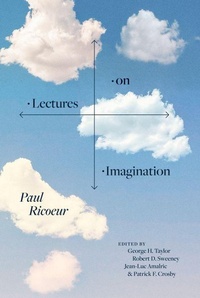
Lectures on Imagination
Erschienen am 11. März 2024
Buch
Hardcover
400 Seiten
978-0-226-82053-8 (ISBN)
Beschreibung
Ricoeur's theory of productive imagination in previously unpublished lectures.
The eminent philosopher Paul Ricoeur was devoted to the imagination. These previously unpublished lectures offer Ricoeur's most significant and sustained reflections on creativity as he builds a new theory of imagination through close examination, moving from Aristotle, Pascal, Spinoza, Hume, and Kant to Ryle, Price, Wittgenstein, Husserl, and Sartre. These thinkers, he contends, underestimate humanity's creative capacity. While the Western tradition generally views imagination as derived from the reproductive example of the image, Ricoeur develops a theory about the mind's power to produce new realities. Modeled most clearly in fiction, this productive imagination, Ricoeur argues, is available across conceptual domains. His theory provocatively suggests that we are not constrained by existing political, social, and scientific structures. Rather, our imaginations have the power to break through our conceptual horizons and remake the world.
The eminent philosopher Paul Ricoeur was devoted to the imagination. These previously unpublished lectures offer Ricoeur's most significant and sustained reflections on creativity as he builds a new theory of imagination through close examination, moving from Aristotle, Pascal, Spinoza, Hume, and Kant to Ryle, Price, Wittgenstein, Husserl, and Sartre. These thinkers, he contends, underestimate humanity's creative capacity. While the Western tradition generally views imagination as derived from the reproductive example of the image, Ricoeur develops a theory about the mind's power to produce new realities. Modeled most clearly in fiction, this productive imagination, Ricoeur argues, is available across conceptual domains. His theory provocatively suggests that we are not constrained by existing political, social, and scientific structures. Rather, our imaginations have the power to break through our conceptual horizons and remake the world.
Rezensionen / Stimmen
"By its depth and the breadth of the path traveled, [Lectures on Imagination] stands out as nothing less than a centerpiece of the corpus." * Le Monde des Livres | on the French edition * "This publication is of tremendous importance not only because of the centrality of the theme in Ricoeur's oeuvre, but also because of the contribution that it makes to phenomenology, hermeneutics, post-Kantian European philosophy and philosophy of imagination. While imagination was a marginal theme in philosophy when Ricoeur delivered his lectures, today it has moved to the very center of intellectual discussions. The lectures include plenty of thought-provoking reflections that will continue to inspire thinkers writing on imagination, both in philosophy and beyond." * Review of Metaphysics * "The much anticipated, posthumous publication of Paul Ricoeur's Lectures on Imagination showcases his distinctive elucidation of the productive imagination as fiction, and, more generally, his sustained reflections on the overarching problematic of the imagination. . . The absence of a published, systematic engagement with the question of the (productive) imagination in Ricoeur's lifetime only makes the Imagination Lectures more significant." * International Journal of Social Imaginaries * "This volume is an essential text for anyone interested in understanding how the human imagination works. With this careful translation, the editors have given us a necessary piece of Ricoeur's towering contributions to the Western understanding of the creative imagination." -- John Arthos Jr., Indiana University "This eagerly awaited book invites the reader on a fascinating dive into the depths of human imagination. Tracing a philosophical history from Aristotle and Kant to Husserl and Wittgenstein, Ricoeur offers a unique take on the metaphorical power of fiction in poetry and painting. An indispensable book for anyone interested in the sheer pleasure of invention." -- Richard Kearney, Boston College "This articulately edited series of lectures reveals key insights into the fruitfulness of Ricoeur's wide-ranging engagement with different intellectual traditions, including phenomenology, analytic philosophy, linguistics, and poetics." -- Roger W. H. Savage, University California-Los AngelesWeitere Details
Sprache
Englisch
Verlagsort
Chicago
USA
Verlagsgruppe
The University of Chicago Press
Zielgruppe
Für Beruf und Forschung
Produkt-Hinweis
Fadenheftung
Gewebe-Einband
Illustrationen
1 tables
Maße
Höhe: 235 mm
Breite: 165 mm
Dicke: 35 mm
Gewicht
755 gr
ISBN-13
978-0-226-82053-8 (9780226820538)
Copyright in bibliographic data and cover images is held by Nielsen Book Services Limited or by the publishers or by their respective licensors: all rights reserved.
Schweitzer Klassifikation
Weitere Ausgaben
Andere Ausgaben
Ricoeur Paul Ricoeur | Taylor George H. Taylor | Sweeney Robert D. Sweeney
Lectures on Imagination
E-Book
03/2024
1. Auflage
University of Chicago Press
55,49 €
Als Download verfügbar
Personen
Paul Ricoeur (1913-2005) was the John Nuveen Professor in the Divinity School, the Department of Philosophy, and the Committee on Social Thought at the University of Chicago. He was the author of many books, including Memory, History, Forgetting, Oneself as Another, and the three-volume Time and Narrative, all published by the University of Chicago Press. George H. Taylor is professor emeritus of law at the University of Pittsburgh. Robert D. Sweeney (1929-2016) was the Don Shula Chair in Philosophy at John Carroll University. Jean-Luc Amalric teaches at the CPGE Arts and Design in Nimes and the Research Center for Arts and Language (CRAL), EHESS, Paris. Patrick F. Crosby (1948-2020) was an independent Ricoeur scholar
Inhalt
Editor's Acknowledgments by George H. Taylor
Editor's Introduction by George H. Taylor
1 Introductory Lecture
Part One: Classical Readings
2 Aristotle
3 Pascal and Spinoza
4 Hume
5 Kant: Critique of Pure Reason
6 Kant: Critique of Judgment
Part Two: Modern Readings
7 Ryle
8 Ryle (2) and Price
9 Wittgenstein
10 Husserl: Logical Investigations
11 Husserl: Ideas
12 Sartre (1)
13 Sartre (2)
14. Sartre (3)
Part Three: Imagination as Fiction
15 Fiction (1): Introduction
16 Fiction (2): Metaphor
17 Fiction (3): Painting
18 Fiction (4): Models
19 Fiction (5): Poetic Language
Notes
Bibliography
Index
Editor's Introduction by George H. Taylor
1 Introductory Lecture
Part One: Classical Readings
2 Aristotle
3 Pascal and Spinoza
4 Hume
5 Kant: Critique of Pure Reason
6 Kant: Critique of Judgment
Part Two: Modern Readings
7 Ryle
8 Ryle (2) and Price
9 Wittgenstein
10 Husserl: Logical Investigations
11 Husserl: Ideas
12 Sartre (1)
13 Sartre (2)
14. Sartre (3)
Part Three: Imagination as Fiction
15 Fiction (1): Introduction
16 Fiction (2): Metaphor
17 Fiction (3): Painting
18 Fiction (4): Models
19 Fiction (5): Poetic Language
Notes
Bibliography
Index