

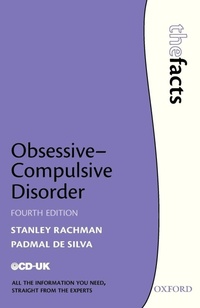
Obsessive-Compulsive Disorder
4. Auflage
Erschienen am 26. März 2009
Buch
Softcover
198 Seiten
978-0-19-956177-3 (ISBN)
Beschreibung
Obsessive-compulsive disorder (OCD) is a relatively common psychological problem. The symptoms - which can be seriously disabling in extreme cases - can include excessive hand-washing or other cleaning rituals, repeated checking, extreme slowness and unwanted, repugnant intrusive thoughts.
This book covers the nature, symptoms, causes and theories of OCD. It discusses the treatments that are available and provides valuable practical advice to those who may need help. Numerous case histories are given throughout the book, highlighting various aspects of the disorder and its treatment. There are in-depth sections on scrupulosity, culture and OCD, mental pollution, OCD in children and on the similarities and differences between childhood OCD and autistic disorder.
This fourth edition has been updated with succinct explanations of recent research, information on treatment advances and the recent expansion of treatment services for anxiety disorders, including OCD, in the NHS.
In this updated fourth edition, Stanley Rachman gives a clear account of the nature of obsessive-compulsive problems which will prove useful for sufferers and their families, as well as general readers interested in finding out about the disorder.
This book covers the nature, symptoms, causes and theories of OCD. It discusses the treatments that are available and provides valuable practical advice to those who may need help. Numerous case histories are given throughout the book, highlighting various aspects of the disorder and its treatment. There are in-depth sections on scrupulosity, culture and OCD, mental pollution, OCD in children and on the similarities and differences between childhood OCD and autistic disorder.
This fourth edition has been updated with succinct explanations of recent research, information on treatment advances and the recent expansion of treatment services for anxiety disorders, including OCD, in the NHS.
In this updated fourth edition, Stanley Rachman gives a clear account of the nature of obsessive-compulsive problems which will prove useful for sufferers and their families, as well as general readers interested in finding out about the disorder.
Rezensionen / Stimmen
This fourth edition of Rachman and da Silvas wellestablished volume in this series (earlier editions appearing in 1992, 1998 and 2004) provides a helpful introduction and guide to families dealing with OCD issues. Discussions of key points, patient and family perspectives on those affected, and a number of brief individual case studies, should help to make this an easy book for families and individuals to access and relate to. * Journal of Autism and Development Disorders * This book doese a superior job of describing OCD and provides excellent resources for those either afflicted with OCD or close to someone who is. Review from previous edition From reviews of the previous edition: The book is intended as an information source for patients who have OCD and their families and friends, but it would also be very useful for workers in health care who need to have an overview of this disorder but are not directly involved in assessment and treatment. It would also be useful for family practitioners as a quick read... an excellent description of obsessions and compulsions with great attention to detail... extremely helpful for a patient and family when first engaging in cognitive behavioural therapy... well written, well organized, and easy to read. * Journal of Psychiatry and Neuroscience * Clear and accessible language [and] practical advice... Strengths of the book include the frequent use of clinical examples and case material. This feature makes the book a useful primer on the condition for undergraduate and graduate psychology students, quickly giving them the clinical flavour of the condition... a fascinating read for the general public... the book is beautifully written in a concise, simple (yet extremely accurate) style... this is the best short work for the general public, on any psychiatric disorder [and] it will prove invaluable for sufferers of OCD, their families and their clinicians. * Behaviour and Research Therapy * Very well written, it is easy to read, with no baffling medical jargon. * No Panic Website * This book is easily accessible to the general public with is easy-to-read style and well structured chapters. Given that the overall tone is one of hope for individuals with OCD, the book offers an invaluable resource to patients, their families and service providers. * The Psychologist *Weitere Details
Reihe
Auflage
4th Revised edition
Sprache
Englisch
Verlagsort
Oxford
Großbritannien
Editions-Typ
Überarbeitete Ausgabe
Illustrationen
7 black and white line drawings
Maße
Höhe: 198 mm
Breite: 129 mm
Dicke: 11 mm
Gewicht
217 gr
ISBN-13
978-0-19-956177-3 (9780199561773)
Copyright in bibliographic data and cover images is held by Nielsen Book Services Limited or by the publishers or by their respective licensors: all rights reserved.
Schweitzer Klassifikation
Weitere Ausgaben
Andere Ausgaben
Stanley Rachman | Padmal de Silva
Obsessive-Compulsive Disorder
E-Book
03/2009
4. Auflage
OUP eBook
15,49 €
Als Download verfügbar
Stanley Rachman | Padmal de Silva
Obsessive-Compulsive Disorder
E-Book
03/2009
4. Auflage
OUP eBook
15,49 €
Als Download verfügbar
Vorauflage
Buch
11/2004
3. Auflage
Oxford University Press
16,08 €
Artikel ist vergriffen; siehe Neuauflage
Personen
Autor*in
Professor, Psychology Department, University of British Columbia, Vancouver, Canada
Former Senior Lecturer in Psychology, at the Institute of Psychiatry, King's College, University of London and Consultant Clinical Psychologist, South London and Maudsley National Health Service Trust, London, UK
Inhalt
1. Obsessive-Compulsive Disorder: What is it? ; 2. Relationship to other disorders ; 3. Obsessive-compulsive patients ; 4. Effects on family, work and social life ; 5. Prevalence and related matters ; 6. Theories and explanations ; 7. Treatment ; 8. Assessment and evaluation ; 9. Obsessive-compulsive disorders in children ; 10. Some practical advice ; Appendices 1-8