

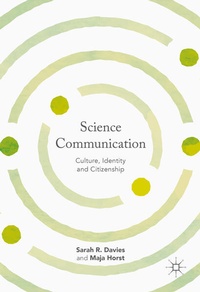
Science Communication
Culture, Identity and Citizenship
Erschienen am 19. Dezember 2016
Buch
Hardcover
VIII, 266 Seiten
978-1-137-50364-0 (ISBN)
Beschreibung
This book describes current practices in science communication, from citizen science to Twitter storms, and celebrates this diversity through case studies and examples. However, the authors also reflect on how scholars and practitioners can gain better insight into science communication through new analytical methods and perspectives. From science PR to the role of embodiment and materiality, some aspects of science communication have been under-studied. How can we better notice these?
Science Communication provides a new synthesis for Science Communication Studies. It uses the historical literature of the field, new empirical data, and interdisciplinary thought to argue that the frames which are typically used to think about science communication often omit important features of how it is imagined and practised. It is essential reading for students, scholars, and practitioners of science education, science and technology studies, museum studies, and media and communication studies.
Science Communication provides a new synthesis for Science Communication Studies. It uses the historical literature of the field, new empirical data, and interdisciplinary thought to argue that the frames which are typically used to think about science communication often omit important features of how it is imagined and practised. It is essential reading for students, scholars, and practitioners of science education, science and technology studies, museum studies, and media and communication studies.
Rezensionen / Stimmen
"It explores the role of capitalism in this context, the relevance of ecology, and more. It reminds readers that scientists publicize their research to persuade funding agencies rather than for the intrinsic worth of the science. . This is a relevant, readable, informative book . . Summing Up: Highly recommended. Upper-division undergraduates through faculty." (V. V. Raman, Choice, Vol. 54 (10), June, 2017)Weitere Details
Auflage
2016
Sprache
Englisch
Verlagsort
London
Großbritannien
Zielgruppe
Für Beruf und Forschung
Illustrationen
1 farbige Abbildung
VIII, 266 p. 1 illus. in color.
Maße
Höhe: 216 mm
Breite: 153 mm
Dicke: 20 mm
Gewicht
473 gr
ISBN-13
978-1-137-50364-0 (9781137503640)
DOI
10.1057/978-1-137-50366-4
Schweitzer Klassifikation
Weitere Ausgaben
Andere Ausgaben
E-Book
10/2016
1. Auflage
Palgrave Macmillan
160,49 €
Als Download verfügbar
Personen
Sarah R. Davies is Assistant Professor at the University of Copenhagen, Denmark. She researches science communication, public engagement with science, and the role of science in democracy. Her previous books include the edited volume
Science and its Publics
(2008).
Maja Horst is Professor of Science Communication at University of Copenhagen, Denmark. She has studied public controversies over emerging technology, innovation communication, and scientific social responsibility. In 2009 she won the Danish Science Communication prize for her work with interactive debate installations.
Maja Horst is Professor of Science Communication at University of Copenhagen, Denmark. She has studied public controversies over emerging technology, innovation communication, and scientific social responsibility. In 2009 she won the Danish Science Communication prize for her work with interactive debate installations.
Inhalt
Chapter 1. Introduction.- Chapter 2. Histories.- Chapter 3. Identities.- Chapter 4. The Changing Nature of Science Communication.- Chapter 5. The Changing Nature of Science.- Chapter 6. Futures.- Chapter 7. Images, Spaces and Emotions.- Chapter 8. Citizenship.- Chapter 9. Deficit and Dialogue.