

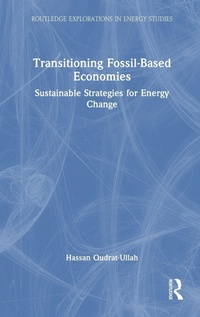
Transitioning Fossil-Based Economies
Sustainable Strategies for Energy Change
1. Auflage
Erschienen am 5. Dezember 2024
Buch
Hardcover
274 Seiten
978-1-032-90491-7 (ISBN)
Beschreibung
This book offers a comprehensive exploration of the role of fossil-based economies in the global energy transition toward sustainability.
The book's main themes include understanding the challenges and opportunities inherent in transitioning from fossil fuels to renewable energy sources, analyzing the economic, environmental, and social impacts of this transition, and identifying strategies for fostering sustainable practices within fossil-based economies. Through a multidisciplinary lens, this book navigates the complex dynamics of transitioning from fossil fuels to sustainable energy sources, addressing environmental, economic, and social dimensions. From understanding the challenges and opportunities posed by fossil-based practices to exploring successful case studies of green transitions, this book offers actionable insights for policymakers, practitioners, and stakeholders alike. The case studies showcase a range of real-world examples of successful green transitions and initiatives within fossil-based economies. With a visionary approach and a call for collaborative global efforts, this book advocates for a sustainable, equitable, and resilient energy future.
This book will be useful for students and researchers studying energy transitions, sustainability, environmental economics, and global policy. It will appeal to professionals working in government agencies, energy companies, environmental organizations, international development agencies, and academic institutions.
The book's main themes include understanding the challenges and opportunities inherent in transitioning from fossil fuels to renewable energy sources, analyzing the economic, environmental, and social impacts of this transition, and identifying strategies for fostering sustainable practices within fossil-based economies. Through a multidisciplinary lens, this book navigates the complex dynamics of transitioning from fossil fuels to sustainable energy sources, addressing environmental, economic, and social dimensions. From understanding the challenges and opportunities posed by fossil-based practices to exploring successful case studies of green transitions, this book offers actionable insights for policymakers, practitioners, and stakeholders alike. The case studies showcase a range of real-world examples of successful green transitions and initiatives within fossil-based economies. With a visionary approach and a call for collaborative global efforts, this book advocates for a sustainable, equitable, and resilient energy future.
This book will be useful for students and researchers studying energy transitions, sustainability, environmental economics, and global policy. It will appeal to professionals working in government agencies, energy companies, environmental organizations, international development agencies, and academic institutions.
Weitere Details
Reihe
Sprache
Englisch
Verlagsort
London
Großbritannien
Verlagsgruppe
Taylor & Francis Ltd
Zielgruppe
Für höhere Schule und Studium
Für Beruf und Forschung
Academic, Postgraduate, Professional Reference, Undergraduate Advanced, and Undergraduate Core
Illustrationen
9 s/w Abbildungen, 9 s/w Zeichnungen, 42 s/w Tabellen
42 Tables, black and white; 9 Line drawings, black and white; 9 Illustrations, black and white
Maße
Höhe: 240 mm
Breite: 161 mm
Dicke: 20 mm
Gewicht
599 gr
ISBN-13
978-1-032-90491-7 (9781032904917)
Copyright in bibliographic data and cover images is held by Nielsen Book Services Limited or by the publishers or by their respective licensors: all rights reserved.
Schweitzer Klassifikation
Weitere Ausgaben
Person
Hassan Qudrat-Ullah is a professor of decision sciences with the School of Administrative Studies at York University, Toronto, Canada. Dr. Hassan has over 20 years of teaching, research, industry, and consulting experience in the United States, Canada, Singapore, Norway, the United Kingdom, Korea, China, Saudi Arabia, Latvia, Switzerland, Spain, and Pakistan. He is a well-known scholar in "decision sciences," "energy policy modeling," and "system dynamics" areas. He has authored and edited over 150 refereed publications, including 20 books (including edited volumes), 43 journal articles, and numerous conference proceedings and presentations. In 2017, he won York University's Faculty of Liberal Arts and Professional Studies' Excellence in Research Award. He is also an appointed member of the Program Advisory and Editorial Board of Springer Complexity, United States. He has been honored as a state guest of Pakistan in 2016 and 2017. He loves traveling and the exploration of various cultures across the globe. He has been to 140 countries: part business and part pleasure.
Inhalt
Chapter 1: Introduction: Energy Transition and Sustainability
Chapter 2: Understanding Fossil-Based Economies
Chapter 3: Navigating the Imperatives for Sustainability
Chapter 4: The Green Economies: Success Stories
Chapter 5: Renewable Energy Technologies
Chapter 6: The Nexus of Government Policies, Regulations, and International Collaboration
Chapter 7: Technological Innovation and Research
Chapter 8: Economic Impacts of Transition
Chapter 9: Social and Cultural Dimensions of Sustainability Transition
Chapter 10: Global Leadership and Cooperation for Energy Transition
Chapter 11: Conclusion and A Way Forward for Energy Transition and Sustainability
Index
Chapter 2: Understanding Fossil-Based Economies
Chapter 3: Navigating the Imperatives for Sustainability
Chapter 4: The Green Economies: Success Stories
Chapter 5: Renewable Energy Technologies
Chapter 6: The Nexus of Government Policies, Regulations, and International Collaboration
Chapter 7: Technological Innovation and Research
Chapter 8: Economic Impacts of Transition
Chapter 9: Social and Cultural Dimensions of Sustainability Transition
Chapter 10: Global Leadership and Cooperation for Energy Transition
Chapter 11: Conclusion and A Way Forward for Energy Transition and Sustainability
Index