

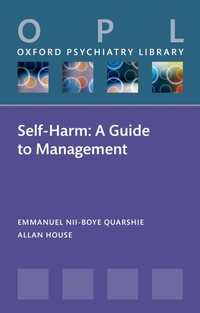
Self-Harm
A Guide to Management
Erschienen am 27. September 2024
Buch
Softcover
112 Seiten
978-0-19-285953-2 (ISBN)
Beschreibung
A book written by experts in the field, its comprehensive coverage touches all the main areas of importance to those needing to understand and respond to one of the most pressing contemporary challenges in public mental health.
As part of the Oxford Psychiatry Library series, this book covers topics such as the nature of self-harm, who it affects, and the reasons for self-harm especially in the young and in females. The important risk factors - individual, interpersonal, and societal - are identified and reviewed. Chapters on how to respond to individuals who self-harm cover the essentials of assessment, self-management, and brief interventions that may require specialist involvement. Population-level approaches to prevention are covered, as is intervention in special settings such as schools and prisons. Modern developments in the online world are also recognized as potential risks but also as potential resources. The challenges for those working in low income settings are acknowledged and discussed.
Each chapter is informed by the latest research while remaining practical in its focus - with the key topics illustrated by real-world examples. While the book is aimed primarily at those working in health or social care, it is written in a style that will be accessible to many other professionals who are likely to encounter self-harm, including those working in education and with young people in community settings. Further reading offers practical guides for the interested professional who wants useful advice in an accessible format.
As part of the Oxford Psychiatry Library series, this book covers topics such as the nature of self-harm, who it affects, and the reasons for self-harm especially in the young and in females. The important risk factors - individual, interpersonal, and societal - are identified and reviewed. Chapters on how to respond to individuals who self-harm cover the essentials of assessment, self-management, and brief interventions that may require specialist involvement. Population-level approaches to prevention are covered, as is intervention in special settings such as schools and prisons. Modern developments in the online world are also recognized as potential risks but also as potential resources. The challenges for those working in low income settings are acknowledged and discussed.
Each chapter is informed by the latest research while remaining practical in its focus - with the key topics illustrated by real-world examples. While the book is aimed primarily at those working in health or social care, it is written in a style that will be accessible to many other professionals who are likely to encounter self-harm, including those working in education and with young people in community settings. Further reading offers practical guides for the interested professional who wants useful advice in an accessible format.
Weitere Details
Reihe
Sprache
Englisch
Verlagsort
Oxford
Großbritannien
Zielgruppe
Für Beruf und Forschung
Produkt-Hinweis
Broschur/Paperback
Klebebindung
Maße
Höhe: 206 mm
Breite: 135 mm
Dicke: 8 mm
Gewicht
136 gr
ISBN-13
978-0-19-285953-2 (9780192859532)
Copyright in bibliographic data and cover images is held by Nielsen Book Services Limited or by the publishers or by their respective licensors: all rights reserved.
Schweitzer Klassifikation
Weitere Ausgaben
Personen
Emmanuel Nii-Boye Quarshie is a Senior Lecturer in the Department of Psychology, University of Ghana, Accra. Nii is a Community and Applied Health Psychologist with a BA in Psychology with Sociology (University of Ghana, Accra), MPhil in Human Development - Community Psychology track - (Norwegian University of Science and Technology, Trondheim), and PhD in Psychological Sciences (University of Leeds, UK). His research focuses on adolescent self-harm and suicide in low- and middle-income countries (LMICs). In 2021 he was awarded the De Leo Fund Award (International Association for Suicide Prevention), for outstanding research on suicidal behaviours carried out in developing countries: https://www.iasp.info/awards/
Allan House graduated in medicine from St Bartholomews Hospital London. He undertook early career posts in hospital medicine before training in psychiatry in Nottingham. After research in Oxford into the psychiatric consequences of stroke, he moved in 1989 to an NHS consultant post in liaison psychiatry at the General Infirmary, Leeds. He was appointed professor of liaison psychiatry in 1999, moving to work fulltime in the university in 2005. As well as teaching at undergraduate and postgraduate level, he has researched and published in many areas of liaison psychiatry including mental health aspects of physical illness, medically-unexplained syndromes and self-harm.
Allan House graduated in medicine from St Bartholomews Hospital London. He undertook early career posts in hospital medicine before training in psychiatry in Nottingham. After research in Oxford into the psychiatric consequences of stroke, he moved in 1989 to an NHS consultant post in liaison psychiatry at the General Infirmary, Leeds. He was appointed professor of liaison psychiatry in 1999, moving to work fulltime in the university in 2005. As well as teaching at undergraduate and postgraduate level, he has researched and published in many areas of liaison psychiatry including mental health aspects of physical illness, medically-unexplained syndromes and self-harm.
Inhalt
- Part 1: The nature of self-harm: an overview
- 1.: Introduction
- 2.: Self-harm: the nature of the problem
- 3.: Understanding the reasons for self-harm
- Part 2: Intervention for and prevention of self-harm
- 4.: Self-harm prevention in clinical and non-clinical contexts
- 5.: Self-harm intervention in clinical and non-clinical contexts
- Part 3: Managing the personal
- 6.: Self-management and self-harm
- 7.: The personal encounter
- 8.: Conclusions and looking to the future