

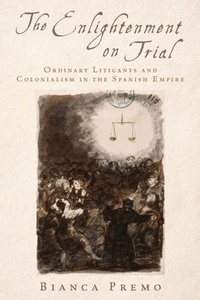
The Enlightenment on Trial
Ordinary Litigants and Colonialism in the Spanish Empire
Erschienen am 9. März 2017
Buch
Softcover
384 Seiten
978-0-19-063873-3 (ISBN)
Beschreibung
This is a history not of an Enlightenment but rather the Enlightenment--the rights-oriented, formalist, secularizing, freedom-inspired eighteenth-century movement that defined modern Western law. Its principal protagonists, rather than members of a cosmopolitan Republic of Letters, are non-literate, poor, and enslaved litigants who sued their superiors in the royal courts of Spain's American colonies.
Despite growing evidence of the Hispanic world's contributions to Enlightenment science, the writing of history, and statecraft, it is conventionally believed to have taken an alternate route to modernity. This book grapples with the contradiction between this legacy and eighteenth-century Spanish Americans' active production of concepts fundamental to modern law. The book is intensely empirical even as it is sly situated within current theoretical debates about imperial geographies of history. The Enlightenment on Trial offers readers new insight into how legal documents were made, fresh interpretations of the intellectual transformations and legal reform policies of the period, and comparative analysis of the volume of civil suits from six regions in Mexico, Peru and Spain.
Ordinary litigants in the colonies-far more often than peninsular Spaniards-sued superiors at an accelerating pace in the second half of the eighteenth century. Three types of cases increased even faster than a stunning general rise of civil suits in the colonies: those that slaves, native peasants and women initiated against masters, native leaders and husbands. As they entered court, these litigants advanced a new law-centered culture distinct from the casuistic, justice-oriented legal culture of the early modern period. And they did so at precisely the same time that a few bright minds of Europe enshrined them in print. The conclusion considers why, if this is so, the Spanish empire has remained marginal to the story of the advent of the modern West.
Despite growing evidence of the Hispanic world's contributions to Enlightenment science, the writing of history, and statecraft, it is conventionally believed to have taken an alternate route to modernity. This book grapples with the contradiction between this legacy and eighteenth-century Spanish Americans' active production of concepts fundamental to modern law. The book is intensely empirical even as it is sly situated within current theoretical debates about imperial geographies of history. The Enlightenment on Trial offers readers new insight into how legal documents were made, fresh interpretations of the intellectual transformations and legal reform policies of the period, and comparative analysis of the volume of civil suits from six regions in Mexico, Peru and Spain.
Ordinary litigants in the colonies-far more often than peninsular Spaniards-sued superiors at an accelerating pace in the second half of the eighteenth century. Three types of cases increased even faster than a stunning general rise of civil suits in the colonies: those that slaves, native peasants and women initiated against masters, native leaders and husbands. As they entered court, these litigants advanced a new law-centered culture distinct from the casuistic, justice-oriented legal culture of the early modern period. And they did so at precisely the same time that a few bright minds of Europe enshrined them in print. The conclusion considers why, if this is so, the Spanish empire has remained marginal to the story of the advent of the modern West.
Rezensionen / Stimmen
A truly brilliant study that changes the field as we know it....The combined force of Premo's numerical data and her culturalist analysis of the cases is overwhelming. She is simply right * Camilla Townsend, Journal of Women's History * Premo does a solid job of reading deeply into the written record to show how the litigants were active participants in a process that was often handled largely in text. This is important groundwork for what comes later... Premo's book is a very worthwhile collection of battle stories from the front lines of the Enlightenment. * Rufus F, Ordinary Times *Weitere Details
Sprache
Englisch
Verlagsort
New York
USA
Zielgruppe
Für höhere Schule und Studium
Illustrationen
25 illus.
Maße
Höhe: 234 mm
Breite: 156 mm
Dicke: 22 mm
Gewicht
642 gr
ISBN-13
978-0-19-063873-3 (9780190638733)
Copyright in bibliographic data and cover images is held by Nielsen Book Services Limited or by the publishers or by their respective licensors: all rights reserved.
Schweitzer Klassifikation
Weitere Ausgaben
Andere Ausgaben
Buch
04/2017
Oxford University Press Inc
211,30 €
Versand in 15-20 Tagen
E-Book
01/2017
1. Auflage
OUP eBook
29,49 €
Als Download verfügbar
E-Book
01/2017
1. Auflage
OUP eBook
29,49 €
Als Download verfügbar
Person
Bianca Premo is professor of History at Florida International University. She is the author of Children of the Father King: Youth, Authority and Legal Minority in Colonial Lima and a co-editor of Raising an Empire: Children in Early Modern Iberia and Colonial Latin America.
Inhalt
Acknowledgments
Notes on Laws
Introduction Why is it Enlightenment?
Part I: Suing in the Spanish Empire
Chapter 1 Agents and Powers: Litigants and Writers in the Courts
Chapter 2 Derecho and Law: Legal Enlightenment in Philosophy and Policy
Chapter 3 Numbers and Values: Counting Cases in the Spanish Empire
Part II: Lights from Litigants
Chapter 4 Pleitos and Lawsuits: Conjugal Conflicts in Civil Courts
Chapter 5 Then and Now: Native Status and Custom
Chapter 6 Being and Becoming: Freedom and Slave Lawsuits
Conclusion Why Not Enlightenment?
Appendix I Archival Methods
Appendix II Analysis of Civil Litigation over Time
Archival Abbreviations
Notes
Bibliography
Index
Notes on Laws
Introduction Why is it Enlightenment?
Part I: Suing in the Spanish Empire
Chapter 1 Agents and Powers: Litigants and Writers in the Courts
Chapter 2 Derecho and Law: Legal Enlightenment in Philosophy and Policy
Chapter 3 Numbers and Values: Counting Cases in the Spanish Empire
Part II: Lights from Litigants
Chapter 4 Pleitos and Lawsuits: Conjugal Conflicts in Civil Courts
Chapter 5 Then and Now: Native Status and Custom
Chapter 6 Being and Becoming: Freedom and Slave Lawsuits
Conclusion Why Not Enlightenment?
Appendix I Archival Methods
Appendix II Analysis of Civil Litigation over Time
Archival Abbreviations
Notes
Bibliography
Index