

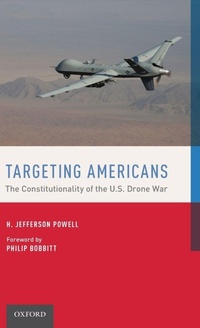
Targeting Americans
The Constitutionality of the U.S. Drone War
Erschienen am 21. April 2016
Buch
Hardcover
264 Seiten
978-0-19-049284-7 (ISBN)
Beschreibung
Targeting Americans: The Constitutionality of the U.S. Drone War focuses on the legal debate surrounding drone strikes, the use of which has expanded significantly under the Obama Presidency as part of the continuing war against terror. Despite the political salience of the legal questions raised by targeted killing, the author asserts that there has been remarkably little careful analysis of the fundamental legal question: the constitutionality of the policy.
From a position of deep practical expertise in constitutional issues, Prof. Powell provides a dispassionate and balanced analysis of the issues posed by U.S. targeted killing policy, using the killing of Anwar al-Awlaki in September 2011 as a focus for discussion. While Powell concludes that the al-Awlaki strike was constitutional under 2001 legislation, he rejects the Obama administration's broader claims of authority for its drone policies. Furthermore, he argues, citizens acting as combatants in al-Qaeda and associated groups are not entitled to due process protections: by due process standards, the administration's procedures are legally inadequate.
A fundamental theme of the book is that the conclusion that an action or policy is constitutional should not be confused with claims about its wisdom, morality, or legality under international norms. Part of the purpose of constitutional analysis is to draw attention to these other normative concerns and not, as is too often the case, to occlude them.
From a position of deep practical expertise in constitutional issues, Prof. Powell provides a dispassionate and balanced analysis of the issues posed by U.S. targeted killing policy, using the killing of Anwar al-Awlaki in September 2011 as a focus for discussion. While Powell concludes that the al-Awlaki strike was constitutional under 2001 legislation, he rejects the Obama administration's broader claims of authority for its drone policies. Furthermore, he argues, citizens acting as combatants in al-Qaeda and associated groups are not entitled to due process protections: by due process standards, the administration's procedures are legally inadequate.
A fundamental theme of the book is that the conclusion that an action or policy is constitutional should not be confused with claims about its wisdom, morality, or legality under international norms. Part of the purpose of constitutional analysis is to draw attention to these other normative concerns and not, as is too often the case, to occlude them.
Rezensionen / Stimmen
"Professor Powell s...rewarding book is a powerful contribution to the constitutional debate about drones." -Congress and the Presidency"H. Jefferson Powell, in this rewarding and thoughtful book. . .addresses the vexing question of targeted killing from a constitutional point of view. . .[T]he point of a superb essay like Powell's [is] that it structures our analysis, provides a playing field with rules on which we can agree, narrows the points of contention, and gives us an overall assessment that is incontrovertible. . .Without some grounding in American legal precedents, rationales and
practices, how can a member of the public tell whether what the public is being told about the content of the law is true or false? This book provides the answer: by reading an example of scrupulous,
impeccable legal analysis. It is a gift to our democracy and there was rarely a time when such a gift was more needed." (From the Foreword) -Philip Bobbitt, Herbert Wechsler Professor of Federal Jurisprudence, Columbia University, Distinguished Senior Lecturer, University of Texas School of Law
"Without giving too much away, allow me to say that one of the things I very much like about the book is how succinct it is (187 pages of text, along with another 29 pages of a very interesting appendix). I also appreciate how eminently readable Jeff made it. It's very much not a book limited to legal specialists, but is readily intellectually 'accessible' to interested members of the general public. All in all, this is one book so relevant and timely that
everyone ought to read it (and, because of its lucidity and reasonable length, everyone actually can read it!)." -Charlie Dunlap, J.D., Lawfare Blog
Weitere Details
Sprache
Englisch
Verlagsort
New York
USA
Zielgruppe
Für höhere Schule und Studium
Maße
Höhe: 222 mm
Breite: 145 mm
Dicke: 19 mm
Gewicht
508 gr
ISBN-13
978-0-19-049284-7 (9780190492847)
Copyright in bibliographic data and cover images is held by Nielsen Book Services Limited or by the publishers or by their respective licensors: all rights reserved.
Schweitzer Klassifikation
Weitere Ausgaben
Andere Ausgaben
E-Book
03/2016
1. Auflage
OUP eBook
28,49 €
Als Download verfügbar
E-Book
03/2016
1. Auflage
OUP eBook
22,99 €
Als Download verfügbar
Personen
H. Jefferson Powell is Professor of Law at Duke University. He is a prolific legal scholar and has written extensively on how constitutional concerns bear on other legal fields such as intellectual property and national security. He has taken sabbaticals from teaching during the Clinton and Obama administrations to serve as a Deputy Assistant Attorney General in the U.S. Department of Justice's Office of Legal Counsel and Principal Deputy Solicitor General.
Inhalt
Introduction
Chapter One
The Constitutional History of the War on Terror
Chapter Two
How to Think Constitutionally
Chapter Three
The War Powers of the United States Government
Chapter Four
The Killing of Anwar al-Awlaki: A Constitutional Analysis
Chapter Five
Targeted Killing and the Future: Three Speculations
Conclusion
Index
Chapter One
The Constitutional History of the War on Terror
Chapter Two
How to Think Constitutionally
Chapter Three
The War Powers of the United States Government
Chapter Four
The Killing of Anwar al-Awlaki: A Constitutional Analysis
Chapter Five
Targeted Killing and the Future: Three Speculations
Conclusion
Index