

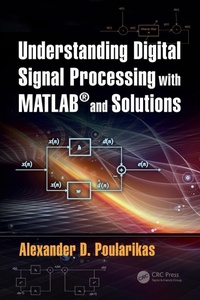
Understanding Digital Signal Processing with MATLAB (R) and Solutions
1. Auflage
Erschienen am 9. November 2017
Buch
Hardcover
455 Seiten
978-1-138-08143-7 (ISBN)
Beschreibung
The book discusses receiving signals that most electrical engineers detect and study. The vast majority of signals could never be detected due to random additive signals, known as noise, that distorts them or completely overshadows them. Such examples include an audio signal of the pilot communicating with the ground over the engine noise or a bioengineer listening for a fetus' heartbeat over the mother's. The text presents the methods for extracting the desired signals from the noise. Each new development includes examples and exercises that use MATLAB to provide the answer in graphic forms for the reader's comprehension and understanding.
Rezensionen / Stimmen
"Timely and fundamental subject, sparking interest for students and engineers alike. Starts from the basics and builds up the complexity in a logic and very understandable way, so that both beginners and experienced professionals will be able to profit from the book.The book is very useful as a reference, with an extensive set of digital processing operations and clear MATLAB examples and proposed exercises for all of them. The reader can easily find everything related to one specific topic (eg. Fourier transform)."
- Alexandre Giulietti de Barros, Teledyne Anafocus, Spain
"The book deals with methods for processing noisy signals. The contents is fairly complete and covers all important topics ranging from discrete and continuous Fourier processing, digital filtering to random signal processing and nonlinear filtering."
-Hans-Georg Stark (Aschaffenburg) "Timely and fundamental subject, sparking interest for students and engineers alike. Starts from the basics and builds up the complexity in a logic and very understandable way, so that both beginners and experienced professionals will be able to profit from the book.
The book is very useful as a reference, with an extensive set of digital processing operations and clear MATLAB examples and proposed exercises for all of them. The reader can easily find everything related to one specific topic (eg. Fourier transform)."
- Alexandre Giulietti de Barros, Teledyne Anafocus, Spain
"The book deals with methods for processing noisy signals. The contents is fairly complete and covers all important topics ranging from discrete and continuous Fourier processing, digital filtering to random signal processing and nonlinear filtering."
-Hans-Georg Stark (Aschaffenburg)
Weitere Details
Sprache
Englisch
Verlagsort
London
Großbritannien
Verlagsgruppe
Taylor & Francis Ltd
Zielgruppe
Für höhere Schule und Studium
Illustrationen
3 s/w Photographien bzw. Rasterbilder, 3 Farbfotos bzw. farbige Rasterbilder, 206 s/w Zeichnungen, 24 s/w Tabellen
24 Tables, black and white; 206 Line drawings, black and white; 3 Halftones, color; 3 Halftones, black and white
Maße
Höhe: 260 mm
Breite: 183 mm
Dicke: 30 mm
Gewicht
1075 gr
ISBN-13
978-1-138-08143-7 (9781138081437)
Copyright in bibliographic data and cover images is held by Nielsen Book Services Limited or by the publishers or by their respective licensors: all rights reserved.
Schweitzer Klassifikation
Weitere Ausgaben
Andere Ausgaben
Alexander D. Poularikas
Understanding Digital Signal Processing with MATLAB (R) and Solutions
Buch
03/2021
1. Auflage
CRC Press
122,10 €
Versand in 15-20 Tagen
Alexander D. Poularikas
Understanding Digital Signal Processing with MATLAB (R) and Solutions
E-Book
11/2017
CRC Press
78,99 €
Als Download verfügbar
Alexander D. Poularikas
Understanding Digital Signal Processing with MATLAB (R) and Solutions
E-Book
11/2017
1. Auflage
CRC Press
78,99 €
Als Download verfügbar
Person
Dr. Poularikas previously held the positions of Professor at University of Rhode Island, Kingston, USA, Chairman of the Engineering Department at the University of Denver, Colorado, USA, and Chairman of the Electrical and Computer Engineering Department at the University of Alabama in Huntsville, USA. He has published, coauthored, and edited 14 books and served as an editor-in-chief of numerous book series. A Fulbright scholar, lifelong senior member of the IEEE, and member of Tau Beta Pi, Sigma Nu, and Sigma Pi, he received the IEEE Outstanding Educators Award, Huntsville Section in both 1990 and 1996. Dr. Poularikas holds a Ph.D from the University of Arkansas, Fayetteville, USA.
Inhalt
Abbreviations
Chapter 1 Continuous and Discrete Signals
Chapter 2 Fourier Analysis of Continuous and Discrete Signals
Chapter 3 The z-Transform, Difference Equations, and Discrete Systems
Chapter 4 Finite Impulse Response (FIR) Digital Filter Design
Chapter 5 Random Variables, Sequences, and Probability Functions
Chapter 6 Linear Systems with Random Inputs, Filtering, and Power Spectral Density
Chapter 7 Least Squares-Optimum Filtering
Chapter 8 Nonparametric (Classical) Spectra Estimation
Chapter 9 Parametric and Other Methods for Spectra Estimation
Chapter 10 Newton's and Steepest Descent Methods
Chapter 11 The Least Mean Square (LMS) Algorithm
Chapter 12 Variants of Least Mean Square Algorithm
Chapter 13 Nonlinear Filtering
Appendix 1: Suggestions and Explanations for MATLAB Use
Appendix 2: Matrix Analysis
Appendix 3: Mathematical Formulas
Appendix 4: MATLAB Function Bibliography
Index
Chapter 1 Continuous and Discrete Signals
Chapter 2 Fourier Analysis of Continuous and Discrete Signals
Chapter 3 The z-Transform, Difference Equations, and Discrete Systems
Chapter 4 Finite Impulse Response (FIR) Digital Filter Design
Chapter 5 Random Variables, Sequences, and Probability Functions
Chapter 6 Linear Systems with Random Inputs, Filtering, and Power Spectral Density
Chapter 7 Least Squares-Optimum Filtering
Chapter 8 Nonparametric (Classical) Spectra Estimation
Chapter 9 Parametric and Other Methods for Spectra Estimation
Chapter 10 Newton's and Steepest Descent Methods
Chapter 11 The Least Mean Square (LMS) Algorithm
Chapter 12 Variants of Least Mean Square Algorithm
Chapter 13 Nonlinear Filtering
Appendix 1: Suggestions and Explanations for MATLAB Use
Appendix 2: Matrix Analysis
Appendix 3: Mathematical Formulas
Appendix 4: MATLAB Function Bibliography
Index