

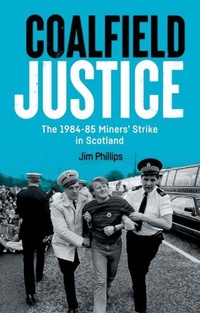
Coalfield Justice
The 1984-85 Miners' Strike in Scotland
Erschienen am 31. August 2024
Buch
Hardcover
248 Seiten
978-1-3995-3649-3 (ISBN)
Beschreibung
In June 2022, former miners secured through the Scottish Parliament a collective pardon for convictions acquired during the 1984-85 miners' strike. The Miners' Strike (Pardons) (Scotland) Act recognised the distinct injustices facing Scottish strikers: twice as likely to be arrested as those in England and Wales and three times as likely to be sacked.
This book analyses the injustices of the strike, and shows how the pardons were won, using thirty oral history testimonies from former strikers and family members. They remembered the injustices of arrest, conviction and employment dismissal. They emphasised how the National Coal Board, police and courts operated as confederates of Margaret Thatcher's Conservative government, silencing union voice and closing pits deemed unprofitable, to maximise returns from intended privatisation.
These testimonies were used in the successful campaign which pushed the Scottish government to provide the broad-based collective and posthumous pardon that was won in Parliament in 2022.
This book analyses the injustices of the strike, and shows how the pardons were won, using thirty oral history testimonies from former strikers and family members. They remembered the injustices of arrest, conviction and employment dismissal. They emphasised how the National Coal Board, police and courts operated as confederates of Margaret Thatcher's Conservative government, silencing union voice and closing pits deemed unprofitable, to maximise returns from intended privatisation.
These testimonies were used in the successful campaign which pushed the Scottish government to provide the broad-based collective and posthumous pardon that was won in Parliament in 2022.
Rezensionen / Stimmen
reminds me not only of the tough times but of the courage and resilience of the mining communities, and which [Phillips] documents so clearly and eloquently -- Gordon Brown, former UK Prime Minister This is a faithful history of the miners' battle for justice: inevitably emotional but always authoritative, built on a foundation of personal testimonies covering the 1960's to the 2020's. It is an outstanding and fitting history on the fortieth anniversary of the strike, of a class and a community, of women and men, whose spirit remains unbroken, and whose fight for compensation, and so justice, carries on. -- Richard Leonard MSP, former Leader of the Scottish Labour Party It would be hard to conceive of a better book about the miners' strike in Scotland. The research is impeccable, and the complex narrative of events presented in a clear and accessible manner... Professor Phillips deserves the Mick McGahey Memorial Medal for this seminal contribution to our labour history. -- Sean Damer * Scottish Affairs * An impeccably researched, clear-eyed, powerful and moving account of the campaign to right the injustices suffered by Scottish miners, their families and communities, during and after the Great Strike, in which Jim Phillips is both a historian and a historical actor. -- Robert Gildea, University of Oxford Jim is a friend as well as a historian of veteran miners and their families. His book tells our stories about our strike for our jobs, communities and futures. It explains how we won the Pardon from the Scottish Parliament for our public order convictions during the strike, and why we're going to keep fighting for financial compensation. -- Andrew (Watty) Watson, the youngest miner sacked in 1984, fighting for justice to this day very human, sometimes funny and most of all sincere. The book is written not by an academic who wants to be considered as a "miners friend" but by a man who truly cares about his fellow workers and the wellbeing of communities. -- Jim Lennie, former miner sacked during the 1984-85 strike [Jim's] involvement with the miners and their struggle for justice after the way they were victimised after the Strike has struck a deep chord of respect in the former mining areas, and on behalf of all miners I say this to Jim yer no jaist a frien yer a guid frien. Many many thanks our appreciation goes where no words can. -- Iain Chalmers, Jim's first interviewee and author of 'Beneath the Kingdom: Memoirs of a Miner' A monument to the integrity, courage and perseverance of Scotland's striking miners, this is engaged scholarship at its best. -- Joerg Arnold, University of Nottingham and author of 'The British Miner in the Age of De-industrialization' Coalfield Justice is an important insider account. It tells the story of a successful decades-long campaign by Scottish miners, their families, trade union and political supporters against unjust convictions incurred during the 1984-5 strike. -- Dr Ewan Gibbs, University of Glasgow and author of 'Coal Country: The Meaning and Memory of Deindustrialization in Postwar Scotland' Jim Phillips is the pre-eminent historian of modern Scottish coalmining. In this book he provides a distinctive account of the 1984/5 miners' strike in Scotland, by combining his deep historical understanding with an impassioned account of how the injustices meted out in the strike were eventually redressed. The result is a significant contribution to our understanding not only of the strike, but also the complexities of the legal and political system in contemporary Scotland. -- Professor Jim Tomlinson, University of Glasgow and co-author of 'Deindustrialisation and the Moral Economy in Scotland since 1955' Jim Phillips' book is an essential account of the campaign for justice in the Scottish coalfields since the 1984-5 strike. It is a model of politically engaged history, providing an essential resource for those miners that are still denied justice, but also in the broader struggle for economic security and industrial democracy. -- Dr Diarmaid Kelliher, University of Glasgow and author of 'Making Cultures of Solidarity: London and the 1984-5 Miners' Strike' an excellent volume -- Quentin Outram, Senior Lecturer at Leeds University Business School and Secretary of the Society for the Study of Labour History * Scottish Labour History * the richness and uniqueness of this study come from the many interviews with the mine workers and their supporters... Overall, Phillips provides a nuanced view of the miners' strike, demonstrating the injustice that took place during it. -- M. K. Thompson, Pittsburg State University * CHOICE *Weitere Details
Sprache
Englisch
Verlagsort
Edinburgh
Großbritannien
Zielgruppe
Für höhere Schule und Studium
Produkt-Hinweis
Fadenheftung
Gewebe-Einband
Illustrationen
16 black and white illustrations, 10 black and white tables
Maße
Höhe: 216 mm
Breite: 140 mm
Dicke: 16 mm
Gewicht
435 gr
ISBN-13
978-1-3995-3649-3 (9781399536493)
Copyright in bibliographic data and cover images is held by Nielsen Book Services Limited or by the publishers or by their respective licensors: all rights reserved.
Schweitzer Klassifikation
Weitere Ausgaben
Andere Ausgaben
E-Book
08/2024
1. Auflage
Edinburgh University Press
14,99 €
Als Download verfügbar
Person
Jim Phillips is Professor in Economic & Social History at the University of Glasgow, and author of Scottish Coal Miners in the Twentieth Century (Edinburgh University Press, 2019) and with Valerie Wright and Jim Tomlinson Deindustrialisation and the Moral Economy since 1955 (Edinburgh University Press, 2021).
Inhalt
Acknowledgements
Abbreviations
List of Tables
List of Illustrations
Introduction
Chapter 1. A just transition before the strike
Chapter 2. A legitimate and lawful strike
Chapter 3. Criminalising the strikers
Chapter 4. The scale of injustice
Chapter 5. Picket-line injustice
Chapter 6. Injustice in communities
Chapter 7. After the strike
Chapter 8. Justice
Conclusion
Interviews
References
Abbreviations
List of Tables
List of Illustrations
Introduction
Chapter 1. A just transition before the strike
Chapter 2. A legitimate and lawful strike
Chapter 3. Criminalising the strikers
Chapter 4. The scale of injustice
Chapter 5. Picket-line injustice
Chapter 6. Injustice in communities
Chapter 7. After the strike
Chapter 8. Justice
Conclusion
Interviews
References