

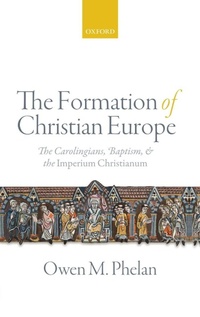
The Formation of Christian Europe
The Carolingians, Baptism, and the Imperium Christianum
Erschienen am 23. Oktober 2014
Buch
Hardcover
324 Seiten
978-0-19-871803-1 (ISBN)
Beschreibung
The Formation of Christian Europe analyses the Carolingians' efforts to form a Christian Empire with the organizing principle of the sacrament of baptism. Owen M. Phelan argues that baptism provided the foundation for this society, and offered a medium for the communication and the popularization of beliefs and ideas, through which the Carolingian Renewal established the vision of an imperium christianum in Europe. He analyses how baptism unified people theologically, socially, and politically and helped Carolingian leaders order their approaches to public life. It enabled reformers to think in ways which were ideologically consistent, publically available, and socially useful.
Phelan also examines the influential court intellectual, Alcuin of York, who worked to implement a sacramental society through baptism. The book finally looks at the dissolution of Carolingian political aspirations for an imperium christianum and how, by the end of the ninth century, political frustrations concealed the deeper achievement of the Carolingian Renewal.
Phelan also examines the influential court intellectual, Alcuin of York, who worked to implement a sacramental society through baptism. The book finally looks at the dissolution of Carolingian political aspirations for an imperium christianum and how, by the end of the ninth century, political frustrations concealed the deeper achievement of the Carolingian Renewal.
Rezensionen / Stimmen
This work is laboriously documented and replete with historical detail that supports Phelan's thesis...The breadth and depth of his textual examination, including theological, liturgical, and political texts, make The Formation of Christian Europe an impressive work of historical scholarship. Yet Phelan's study of the sacramentum and the development of baptismal formation also makes his work useful to theologians. As such, his work holds a strong appeal across academic disciplines. * Sean Robertson, Reading Religion * lucidly organized and thoroughly researched. Indeed, it serves as a model of its kind ... With this admirable contribution to the scholarly literature on the Carolingian era, a reader can find little to quarrel ... there is no fault in this work's worthy substance. * Daniel J. Heisey, Ecclesia orans *Weitere Details
Sprache
Englisch
Verlagsort
Oxford
Großbritannien
Zielgruppe
Für Beruf und Forschung
Maße
Höhe: 240 mm
Breite: 161 mm
Dicke: 22 mm
Gewicht
652 gr
ISBN-13
978-0-19-871803-1 (9780198718031)
Copyright in bibliographic data and cover images is held by Nielsen Book Services Limited or by the publishers or by their respective licensors: all rights reserved.
Schweitzer Klassifikation
Weitere Ausgaben
Andere Ausgaben
Owen M. Phelan
The Formation of Christian Europe
The Carolingians, Baptism, and the Imperium Christianum
E-Book
10/2014
1. Auflage
OUP eBook
69,49 €
Als Download verfügbar
Person
Owen Phelan is Associate Professor of Church History at Mount Saint Mary's University. Dr. Phelan works on Church History, History of Christianity, and Medieval History. He specializes in the study of Late Antiquity and the Early Middle Ages. He is the co-editor of Rome and Religion in the Medieval World: Studies in Honor of Thomas F.x. Noble with Valerie L. Garver (Ashgate, 2014).
Inhalt
Introduction ; 1. Sacramentum: An Ordering Concept from Antiquity to the Early Middle Ages ; 2. The Articulation of Polity: Baptism as the Foundation of an Imperium Christianum ; 3. The Carolingian Subject: The Sacramentum of Baptism and the Formation of Identity in Alcuin of York ; 4. The Carolingian Machinery of Christian Formation: Charlemagne's Encyclical Letter n Baptism from 811/812 and its implications ; 5. The Sacramental Assumption: Baptism and Carolingian Society in the Ninth Century ; Conclusion: Loss and Legacy ; Bibliography ; Index