

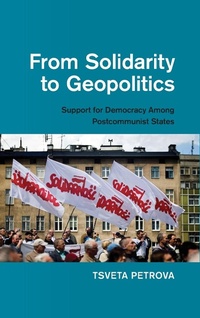
From Solidarity to Geopolitics
Support for Democracy among Postcommunist States
Erschienen am 22. September 2014
Buch
Hardcover
232 Seiten
978-1-107-04998-7 (ISBN)
Beschreibung
This book theorizes a mechanism underlying regime-change waves, the deliberate efforts of diffusion entrepreneurs to spread a particular regime and regime-change model across state borders. Why do only certain states and non-state actors emerge as such entrepreneurs? Why, how, and how effectively do they support regime change abroad? To answer these questions, the book studies the entrepreneurs behind the third wave of democratization, with a focus on the new eastern European democracies - members of the European Union. The study finds that it is not the strongest democracies nor the democracies trying to ensure their survival in a neighborhood of non-democracies that become the most active diffusion entrepreneurs. It is, instead, the countries where the organizers of the domestic democratic transitions build strong solidarity movements supporting the spread of democracy abroad that do. The book also draws parallels between their activism abroad and their experiences with democratization and democracy assistance at home.
Rezensionen / Stimmen
'In this original and thought-provoking study, Tsveta Petrova demonstrates how mobilized democratic transition from below in Eastern Europe fostered the emergence of a new generation of democracy promoters in the region. In doing so, she provides new insights into transnational diffusion processes and the linkages between the foreign and domestic dimensions of democracy promotion.' Mark R. Beissinger, Henry W. Putnam Professor of Politics, Princeton University, and Director, Princeton Institute for International and Regional Studies 'A masterful study of a critical yet understudied new area of international democracy support. With notable clarity and rigor, Petrova advances innovative, persuasive ideas about the motivations, methods, and impact of the external democracy work by Eastern European countries. A field-defining work that will stand as a benchmark on the topic for years.' Thomas Carothers, Carnegie Endowment for International Peace 'What Tsveta Petrova carefully documents will surprise many: new democracies often do more than old ones to spread democracy internationally. What is more, Petrova's meticulous use of hundreds of interviews in Eastern Europe shows that pro-democracy activists, linked to transnational networks, do much of the work - both in directly promoting liberalism and popular rule, and in pressing their governments to do the same - and that they do it in part to entrench democracy in their own countries.' John Owen, Henry Taylor Professor of Politics, University of Virginia 'The emergence of Third Wave democracies as providers of democracy assistance is increasingly visible, but still has not received the scholarly attention that it merits. Tsveta Petrova's thoughtful comparative study of postcommunist Eastern Europe helps to fill this gap. It not only illuminates how and why some postcommunist states have become enthusiastic supporters of democracy beyond their borders, but also yields a number of broader insights about the enterprise of democracy promotion.' Marc F. Plattner, Editor, Journal of Democracy 'Tsveta Petrova has written an elegant and impressively thorough account of the democracy promotion activities of Central and Eastern European states. The book provides sophisticated explanations for these countries' evolving foreign policies and is astute in revealing the idealistic, but also geostrategic, prompts to East European democracy support. Petrova's analysis is convincingly sympathetic to these member states' efforts to further democratic norms, while also recognizing their shortcomings. The book offers illuminating background that helps shed light on European reactions to the current uncertainty in Ukraine and other Eastern Partnership countries.' Richard Youngs, Carnegie Endowment for International Peace, and Warwick UniversityWeitere Details
Sprache
Englisch
Verlagsort
Cambridge
Großbritannien
Zielgruppe
Für Beruf und Forschung
Produkt-Hinweis
Fadenheftung
Gewebe-Einband
Illustrationen
17 Tables, unspecified; 3 Line drawings, unspecified
Maße
Höhe: 235 mm
Breite: 157 mm
Dicke: 18 mm
Gewicht
532 gr
ISBN-13
978-1-107-04998-7 (9781107049987)
Copyright in bibliographic data and cover images is held by Nielsen Book Services Limited or by the publishers or by their respective licensors: all rights reserved.
Schweitzer Klassifikation
Weitere Ausgaben
Andere Ausgaben
E-Book
09/2014
Cambridge University Press
73,99 €
Als Download verfügbar
E-Book
09/2014
1. Auflage
Cambridge University Press
73,99 €
Als Download verfügbar
Person
Tsveta Petrova received her PhD in political science from Cornell University in 2011 and then completed postdoctoral fellowships at Harvard University's Davis Center and Columbia University's Harriman Institute. Petrova is the recipient of research awards from the Association for Women in Slavic Studies and the Johnson Institute for Responsible Leadership at the University of Pittsburgh. She has also earned many fellowships and grants from organizations including the Social Science Research Council, the American Council of Learned Societies, the National Council for Eurasian and East European Research, the Woodrow Wilson Center for International Scholars, IREX, the National Endowment for Democracy, the Smith Richardson Foundation, and the Council for European Studies. Her work has been published in Comparative Political Studies, the Journal of Democracy, and the Review of International Affairs.
Inhalt
1. Regime-change waves and eastern EU democracy promotion; 2. Exporting the revolution: why only some eastern EU new democracies support democratization abroad; 3. From solidarity to survival: the motivations behind eastern EU civic democracy promotion; 4. An improved domestic and international order?: The rationales behind eastern EU official democracy promotion; 5. A new generation of democracy promoters?: Eastern EU approaches to democracy promotion; 6. Conclusion: making a difference?