

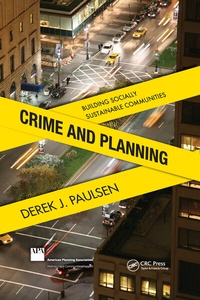
Crime and Planning
Building Socially Sustainable Communities
1. Auflage
Erschienen am 7. November 2012
Buch
Hardcover
206 Seiten
978-1-4398-7166-9 (ISBN)
Beschreibung
The form and layout of a built environment has a significant influence on crime by creating opportunities for it and, in turn, shaping community crime patterns. Effective urban planners and designers will consider crime when making planning and design decisions. A co-publication with the American Planning Association, Crime and Planning: Building Socially Sustainable Communities presents a comprehensive discussion of the interconnections between urban planning, criminal victimization, and crime prevention.
An introduction into the main concerns at the intersection of criminology and community planning, the book first provides an overview of crime patterns. It then explores major issues within planning and their impact on crime. Critical topics discussed include connectivity, mixed-use developments, land use and zoning, transit-oriented design, and pedestrian trails, greenways, and parks. The remaining chapters explore:
Crime prevention theories
Crime prevention as a central component of sustainability
How to incorporate social sustainability and planning guidelines into local planning decisions
Policy discussion of issues such as zoning
How tools such as smart growth and form-based codes relate to crime and crime prevention
Examples of how planning decisions can impact crime patterns in both a residential and retail setting, and what has already worked in real-world communities
As communities continue to grapple with foreclosure, sprawl, and infill/redevelopment, a sound understanding of how the built environment impacts crime is of increasing importance. This book provides planners with the tools and knowledge necessary to minimize the impact of crime on communities with the goal of creating socially sustainable communities.
An introduction into the main concerns at the intersection of criminology and community planning, the book first provides an overview of crime patterns. It then explores major issues within planning and their impact on crime. Critical topics discussed include connectivity, mixed-use developments, land use and zoning, transit-oriented design, and pedestrian trails, greenways, and parks. The remaining chapters explore:
Crime prevention theories
Crime prevention as a central component of sustainability
How to incorporate social sustainability and planning guidelines into local planning decisions
Policy discussion of issues such as zoning
How tools such as smart growth and form-based codes relate to crime and crime prevention
Examples of how planning decisions can impact crime patterns in both a residential and retail setting, and what has already worked in real-world communities
As communities continue to grapple with foreclosure, sprawl, and infill/redevelopment, a sound understanding of how the built environment impacts crime is of increasing importance. This book provides planners with the tools and knowledge necessary to minimize the impact of crime on communities with the goal of creating socially sustainable communities.
Weitere Details
Sprache
Englisch
Verlagsort
New York
USA
Verlagsgruppe
Taylor & Francis Inc
Zielgruppe
Für höhere Schule und Studium
Urban planners, criminal justice prevention professionals, public administrators and policy makers, professionals in construction and facilities housing.
Illustrationen
37 s/w Abbildungen, 11 s/w Tabellen
11 Tables, black and white; 37 Illustrations, black and white
Maße
Höhe: 234 mm
Breite: 156 mm
Gewicht
548 gr
ISBN-13
978-1-4398-7166-9 (9781439871669)
Copyright in bibliographic data and cover images is held by Nielsen Book Services Limited or by the publishers or by their respective licensors: all rights reserved.
Schweitzer Klassifikation
Weitere Ausgaben
Andere Ausgaben
E-Book
11/2012
1. Auflage
Routledge
60,49 €
Als Download verfügbar
E-Book
11/2012
1. Auflage
Routledge
60,49 €
Als Download verfügbar
Person
Derek J. Paulsen, PhD is currently the first ever commissioner of planning, preservation and development for the City of Lexington, KY as well as a pro?fessor in the Department of Criminal Justice at Eastern Kentucky University. In his prior work as the director of the Center for Crime and the Built Environment (CABE) at Eastern Kentucky University, Paulsen worked with numerous police agencies on crime analysis and crime prevention issues. In addition to his work as commissioner, Dr. Paulsen is active in research on crime analysis, crime prevention, and urban planning issues. He is the lead author of two books on the spatial analysis of crime data as well as numerous articles dealing with crime mapping and crime prevention issues that have appeared in such journals as Policing: An International Journal of Police Strategies and Management, Journal of Investigative Psychology and Offender Profiling, and International Journal of Police Science and Management. A frequent presenter on crime mapping and crime prevention topics at both academic and professional conferences, Dr. Paulsen has been an invited speaker at numerous international conferences including the NIJ MAPS Conference, NIJ Conference, United Kingdom Crime Mapping Conference, and the American Planning Association Conference.
Inhalt
Introduction. Why a Disconnect? Crime, Planning, and Sustainability. Structure of This Book. A Brief Overview of Crime and Crime Issues. Major Issues in Crime and Urban Planning. Redefining Sustainability. Redefining and Refocusing Sustainable Communities. Integrating Crime Prevention into a Socially Sustainable Planning Program. Current Crime Prevention-Planning Programs. Integrating Crime Prevention into the Everyday Planning Process. Tools for Understanding Context. Design Guidance. Planning Policy and Socially Sustainable Communities. Smart Growth. Form-Based Codes. Suburban Retrofitting. Case Studies. Residential Neighborhood Case Study. Retail District Case Study.