

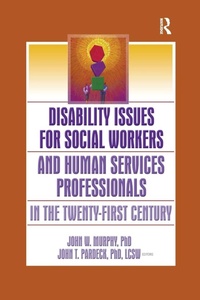
Disability Issues for Social Workers and Human Services Professionals in the Twenty-First Century
1. Auflage
Erschienen am 10. Mai 2005
Buch
Softcover
200 Seiten
978-0-7890-2714-6 (ISBN)
Beschreibung
Examine issues of vital importance to you and your disabled clientstoday and in the years to come!
This groundbreaking text provides you with up-to-date, authoritative information that will prove to be of critical importance for disability professionals in the coming years. It will leave you better informed about aspects of disability that have not been well covered in the literatureissues surrounding spirituality, civil rights, and the medical model vs. social (or minority) model (of viewing disability) controversy. You'll examine the impact of the Americans with Disabilities Act in the wake of the Supreme Court's narrowing of the Act's powers and explore newly developed theories designed to more accurately define the true meaning of disability.
Disability Issues for Social Workers and Human Services Professionals in the Twenty-First Century explores:
the currentand potentialroles of spirituality and religion in the rehabilitation process
the use of medication in treating disabilitywith a study focusing on children in foster care whose emotional/behavioral disabilities are medically (rather than psychologically) treated
Attention-Deficit/Hyperactivity Disorder (ADHD) in college studentshow it impacts them as a disability requiring academic accommodations
disability as an aspect of cultural diversitywith suggested methods for educating the non-disabled about people with disabilities
limitations on the civil rights of those with disabilitiesand what can be done to eliminate those limitations
computer technologies designed to aid people with disabilitieswith an examination of a health promotion Web site for children with disabilities and their families
disability and the managed mental health systemwith an examination of the differences in service utilization and satisfaction in rural and urban areas
how disability can be viewed as a social construct, rather than something that is inherent to the disabled person
Keeping current with new developments is imperative for social workers and other professionals whose work affects people with disabilities. Disability Issues for Social Workers and Human Services Professionals in the Twenty-First Century provides the information you need to stay on the cutting edge of progress in this rapidly evolving field.
This groundbreaking text provides you with up-to-date, authoritative information that will prove to be of critical importance for disability professionals in the coming years. It will leave you better informed about aspects of disability that have not been well covered in the literatureissues surrounding spirituality, civil rights, and the medical model vs. social (or minority) model (of viewing disability) controversy. You'll examine the impact of the Americans with Disabilities Act in the wake of the Supreme Court's narrowing of the Act's powers and explore newly developed theories designed to more accurately define the true meaning of disability.
Disability Issues for Social Workers and Human Services Professionals in the Twenty-First Century explores:
the currentand potentialroles of spirituality and religion in the rehabilitation process
the use of medication in treating disabilitywith a study focusing on children in foster care whose emotional/behavioral disabilities are medically (rather than psychologically) treated
Attention-Deficit/Hyperactivity Disorder (ADHD) in college studentshow it impacts them as a disability requiring academic accommodations
disability as an aspect of cultural diversitywith suggested methods for educating the non-disabled about people with disabilities
limitations on the civil rights of those with disabilitiesand what can be done to eliminate those limitations
computer technologies designed to aid people with disabilitieswith an examination of a health promotion Web site for children with disabilities and their families
disability and the managed mental health systemwith an examination of the differences in service utilization and satisfaction in rural and urban areas
how disability can be viewed as a social construct, rather than something that is inherent to the disabled person
Keeping current with new developments is imperative for social workers and other professionals whose work affects people with disabilities. Disability Issues for Social Workers and Human Services Professionals in the Twenty-First Century provides the information you need to stay on the cutting edge of progress in this rapidly evolving field.
Weitere Details
Sprache
Englisch
Verlagsort
New York
USA
Verlagsgruppe
Taylor & Francis Inc
Maße
Höhe: 229 mm
Breite: 152 mm
Dicke: 11 mm
Gewicht
298 gr
ISBN-13
978-0-7890-2714-6 (9780789027146)
Copyright in bibliographic data and cover images is held by Nielsen Book Services Limited or by the publishers or by their respective licensors: all rights reserved.
Schweitzer Klassifikation
Weitere Ausgaben
Andere Ausgaben
Jean A. Pardeck | John W. Murphy
Disability Issues for Social Workers and Human Services Professionals in the Twenty-First Century
E-Book
12/2012
1. Auflage
Routledge
68,49 €
Als Download verfügbar
Jean A. Pardeck | John W. Murphy
Disability Issues for Social Workers and Human Services Professionals in the Twenty-First Century
E-Book
12/2012
1. Auflage
Routledge
68,49 €
Als Download verfügbar
Jean A. Pardeck | John W. Murphy
Disability Issues for Social Workers and Human Services Professionals in the Twenty-First Century
Buch
05/2005
1. Auflage
Routledge
266,68 €
Artikel z.Zt. nicht lieferbar
Personen
Jean A Pardeck (Author) , John W Murphy (Author)
Inhalt
About the Contributors
Preface
Introduction (John W. Murphy and John T. Pardeck)
SECTION I. DISABILITY PRACTICE IN THE TWENTY-FIRST CENTURY
The Use of Religion and Spiritual Strategies in Rehabilitation (Debra J. Morrison-Orton)
Medication of Children and Youth in Foster Care (Diane L. Green, Wesley Hawkins, and Michelle Hawkins)
Attention-Deficit/Hyperactivity Disorder in Community College Students: A Seldom Considered Factor in Academic Success (Paula Gilbert)
Using Children's Books as an Approach to Enhancing Our Understanding of Disability (John T. Pardeck)
SECTION II. DISABILITY POLICY AND PROGRAMS IN THE TWENTY-FIRST CENTURY
Reaching Out: Evaluation of a Health Promotion Website for Children with Disabilities and Their Families (Virginia Rondero Hernandez, Katherine Selber, Mary Tijerina, and Jennifer Mallow)
Rural and Urban Differences Among Mental Health Consumers in One Midwestern State: Implications for Policy, Practice, and Research (John Q. Hodges, Martha Markward, Dong Pil Yoon, and Carol J. Evans)
An Analysis of the Americans with Disabilities Act (ADA) in the Twenty-First Century (John T. Pardeck)
SECTION III. DISABILITY THEORY IN THE TWENTY-FIRST CENTURY
Social Norms and Their Implications for Disability (John W. Murphy)
Conclusion (John W. Murphy and John T. Pardeck)
Index
Reference Notes Included
Preface
Introduction (John W. Murphy and John T. Pardeck)
SECTION I. DISABILITY PRACTICE IN THE TWENTY-FIRST CENTURY
The Use of Religion and Spiritual Strategies in Rehabilitation (Debra J. Morrison-Orton)
Medication of Children and Youth in Foster Care (Diane L. Green, Wesley Hawkins, and Michelle Hawkins)
Attention-Deficit/Hyperactivity Disorder in Community College Students: A Seldom Considered Factor in Academic Success (Paula Gilbert)
Using Children's Books as an Approach to Enhancing Our Understanding of Disability (John T. Pardeck)
SECTION II. DISABILITY POLICY AND PROGRAMS IN THE TWENTY-FIRST CENTURY
Reaching Out: Evaluation of a Health Promotion Website for Children with Disabilities and Their Families (Virginia Rondero Hernandez, Katherine Selber, Mary Tijerina, and Jennifer Mallow)
Rural and Urban Differences Among Mental Health Consumers in One Midwestern State: Implications for Policy, Practice, and Research (John Q. Hodges, Martha Markward, Dong Pil Yoon, and Carol J. Evans)
An Analysis of the Americans with Disabilities Act (ADA) in the Twenty-First Century (John T. Pardeck)
SECTION III. DISABILITY THEORY IN THE TWENTY-FIRST CENTURY
Social Norms and Their Implications for Disability (John W. Murphy)
Conclusion (John W. Murphy and John T. Pardeck)
Index
Reference Notes Included