

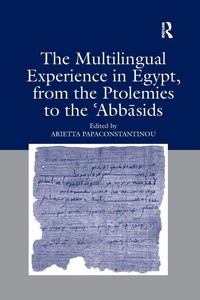
The Multilingual Experience in Egypt, from the Ptolemies to the Abbasids
1. Auflage
Erschienen am 28. November 2016
Buch
Softcover
250 Seiten
978-1-138-25734-4 (ISBN)
Beschreibung
For over a millennium and a half, Egypt was home to at least two commonly used languages of communication. Although this situation is by no means exceptional in the ancient and medieval worlds, the wealth of documentary sources preserved by Egypt's papyri makes the country a privileged observation ground for the study of ancient multilingualism. One of the greatest contributions of papyri to this subject is that they capture more linguistic registers than other ancient and medieval sources, since they range from very private documents not meant by their author to be read by future generations, to official documents produced by the administration, which are preserved in their original form. This collection of essays aims to make this wealth better known, as well as to give a diachronic view of multilingual practices in Egypt from the arrival of the Greeks as a political force in the country with Alexander the Great, to the beginnings of Abbasid rule when Greek, and slowly also Coptic, receded from the documentary record. The first section of the book gives an overview of the documentary sources for this subject, which for ancient history standards are very rich and as yet under-exploited. The second part contains several case studies from different periods that deal with language use in contexts of varying breadth and scope, from its the ritual use in magic or the liturgy to private letters and state administration.
Rezensionen / Stimmen
'The essays by Torallas, Clarysse, Clackson, Sijpesteijn, and Richter combine background material that would be very helpful to both beginners and advanced students with expert analysis of a specific problem. The entire case study section (Part Two) offers material from the cutting edge of multilingual studies, where technical command of the material is combined with understanding of the theoretical framework.' The Medieval Review 'Toutes les contributions sont de tres grande qualite et donnent un aperA?u utile, argumente et original sur les contacts entre langues et textes en Egypte. On ne peut que remercier l'editrice du volume pour la demarche qui sous-tend le livre, la qualite de realisation et la tres belle introduction.' Chronique d'Egypte '...thought-provoking and informative... well researched and well executed' ArctosWeitere Details
Sprache
Englisch
Verlagsort
London
Großbritannien
Verlagsgruppe
Taylor & Francis Ltd
Zielgruppe
Für höhere Schule und Studium
Maße
Höhe: 234 mm
Breite: 156 mm
Dicke: 14 mm
Gewicht
389 gr
ISBN-13
978-1-138-25734-4 (9781138257344)
Copyright in bibliographic data and cover images is held by Nielsen Book Services Limited or by the publishers or by their respective licensors: all rights reserved.
Schweitzer Klassifikation
Weitere Ausgaben
Andere Ausgaben
Arietta Papaconstantinou
The Multilingual Experience in Egypt, from the Ptolemies to the Abbasids
E-Book
12/2016
Routledge
73,49 €
Als Download verfügbar
Arietta Papaconstantinou
The Multilingual Experience in Egypt, from the Ptolemies to the Abbasids
E-Book
12/2016
Routledge
73,49 €
Als Download verfügbar
Arietta Papaconstantinou
The Multilingual Experience in Egypt, from the Ptolemies to the Abbasids
Buch
09/2010
1. Auflage
Routledge
233,20 €
Versand in 10-20 Tagen
Person
Dr Arietta Papaconstantinou is lecturer at the Universite Paris 1, Pantheon-Sorbonne, France, and Oriental Institute, University of Oxford, UK
Inhalt
Contents: Introduction, Arietta Papaconstantinou; Linguistic identity in Graeco-Roman Egypt, Sofia Torallas Tovar; Bilingual papyrological archives, Willy Clarysse; Coptic or Greek? Bilingualism in the papyri, Sarah J. Clackson; Multilingual archives and documents in post-conquest Egypt, Petra Sijpesteijn; What's in a sign? Translating filiation in the demotic magical papyri, Jacco Dieleman; Early Coptic epistolography, Malcolm Choat; Toujours honneur au grec? AEUR propos d'un papyrus greco-copte de la region thebaine, Anne Boud'hors; Language choice in the Qurra dossier, Tonio Sebastian Richter; Aristophanes son of Johannes: an 8th-century bilingual scribe? A study of graphic bilingualism, Jennifer Cromwell; Index.