

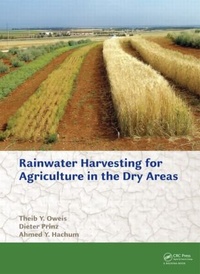
Rainwater Harvesting for Agriculture in the Dry Areas
1. Auflage
Erschienen am 21. Mai 2012
Buch
Hardcover
284 Seiten
978-0-415-62114-4 (ISBN)
Beschreibung
Dry areas suffer not only from limited rainfall but also 'natural leakage'-90% of rainwater is lost directly or indirectly, and is unavailable for agriculture or domestic use. Water harvesting is a low-cost, easy-to-use, environmentally-friendly way to recover a large part of this lost water.
How does water harvesting work? Which sites or areas are best suited and how can these areas be identified? How to design, build and maintain a water harvesting system tailored to local needs? How can water harvesting contribute to combating land degradation, enhancing food security and adapting to climate change? This book provides the answers.
The book is based on many years of research, training and development by three of the world's leading experts in water management and agriculture. It is authoritative, comprehensive, and easy to read, containing practical examples, many illustrations and little jargon. This volume will be of great interest to researchers, development workers, farmers, policymakers, students of the natural sciences-in fact, anyone interested in efficient, sustainable management of water resources and agriculture.
How does water harvesting work? Which sites or areas are best suited and how can these areas be identified? How to design, build and maintain a water harvesting system tailored to local needs? How can water harvesting contribute to combating land degradation, enhancing food security and adapting to climate change? This book provides the answers.
The book is based on many years of research, training and development by three of the world's leading experts in water management and agriculture. It is authoritative, comprehensive, and easy to read, containing practical examples, many illustrations and little jargon. This volume will be of great interest to researchers, development workers, farmers, policymakers, students of the natural sciences-in fact, anyone interested in efficient, sustainable management of water resources and agriculture.
Rezensionen / Stimmen
Eight chapters of this book describe the principles and practices of rainwater harvesting in dry areas, covering a wide range of water harvesting systems,... Throughout the text there are line drawings and photographs, which are particularly well done, as are the additional 25 pages of colour plates. The last two chapters, which address associated socio-economic and environmental aspacts of rainwater harvesting, complement the strong practical engineering focus of the book.Readers will find this book to be a valuable source on rainwater harvesting.
Erik Craswell, Experimental Agriculture, volume 49(I) - 2013, Cambridge University Press
Weitere Details
Sprache
Englisch
Verlagsort
London
Großbritannien
Verlagsgruppe
Taylor & Francis Ltd
Zielgruppe
Für höhere Schule und Studium
Für Beruf und Forschung
Professional Practice & Development
Maße
Höhe: 246 mm
Breite: 174 mm
Gewicht
690 gr
ISBN-13
978-0-415-62114-4 (9780415621144)
Copyright in bibliographic data and cover images is held by Nielsen Book Services Limited or by the publishers or by their respective licensors: all rights reserved.
Schweitzer Klassifikation
Weitere Ausgaben
Andere Ausgaben
Theib Y. Oweis | Dieter Prinz | Ahmed Y. Hachum
Rainwater Harvesting for Agriculture in the Dry Areas
Buch
10/2024
1. Auflage
CRC Press
61,00 €
Versand in 10-20 Tagen
Theib Y. Oweis | Dieter Prinz | Ahmed Y. Hachum
Rainwater Harvesting for Agriculture in the Dry Areas
E-Book
05/2014
1. Auflage
CRC Press
64,49 €
Als Download verfügbar
Theib Y. Oweis | Dieter Prinz | Ahmed Y. Hachum
Rainwater Harvesting for Agriculture in the Dry Areas
E-Book
05/2012
1. Auflage
CRC Press
64,49 €
Als Download verfügbar
Personen
T. Oweis is the director of the Integrated Water and Land Management Program (IWLMP) at the International Center for Agricultural Research in the Dry Areas (ICARDA) (CGIAR Future Harvest Center). He has carried out research into and published extensively on irrigation and water management since the 1980s, fulfilling numerous academic and institutional roles over time.
D. Prinz is an independent consultant in matters concerning irrigation, water management and harvesting, and water & soil conservation. During the course of his career, he has published and lectured extensively on many aspects of rural engineering, with a particular focus on water and land resources development; irrigation, water and soil conservation and water harvesting in agriculture.
A. Hachum is Professor in the Department of Water Resources Engineering, College of Engineering, Mosul University, Iraq and consultant for the Integrated Water and Land Management Program, ICARDA. He has published many articles as well as a number of monographs on the topics of irrigation and water harvesting.
D. Prinz is an independent consultant in matters concerning irrigation, water management and harvesting, and water & soil conservation. During the course of his career, he has published and lectured extensively on many aspects of rural engineering, with a particular focus on water and land resources development; irrigation, water and soil conservation and water harvesting in agriculture.
A. Hachum is Professor in the Department of Water Resources Engineering, College of Engineering, Mosul University, Iraq and consultant for the Integrated Water and Land Management Program, ICARDA. He has published many articles as well as a number of monographs on the topics of irrigation and water harvesting.
Inhalt
1. Principles and practices of water harvesting 2. Hydrological aspects of water harvesting 3. Methods and techniques in water harvesting 4. Runoff inducement methods 5. Identification of areas suitable for water harvesting 6. Planning and design of water harvesting systems 7. Storage of harvested water 8. Implementation, operation, and maintenance of water harvesting systems 9. Socioeconomic issues 10. Water quality and environmental considerations