

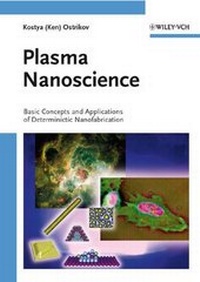
Plasma Nanoscience
Basic Concepts and Applications of Deterministic Nanofabrication
1. Auflage
Erschienen am 13. August 2008
Buch
Hardcover
XXV, 538 Seiten
978-3-527-40740-8 (ISBN)
Beschreibung
Filling the need for a single work specifically addressing how to use plasma for the fabrication of nanoscale structures, this book is the first to cover plasma deposition in sufficient depth.
The author has worked with numerous R&D institutions around the world, and here he begins with an introductory overview of plasma processing at micro- and nanoscales, as well as the current problems and challenges, before going on to address surface preparation, generation and diagnostics, transport and the manipulation of nano units.
Weitere Details
Auflage
1. Auflage
Sprache
Englisch
Verlagsort
Berlin
Deutschland
Zielgruppe
Für Beruf und Forschung
Illustrationen
158
9 farbige Abbildungen, 18 s/w Tabellen, 131 s/w Abbildungen
Maße
Höhe: 24 cm
Breite: 17 cm
Dicke: 3.3 cm
Gewicht
1223 gr
ISBN-13
978-3-527-40740-8 (9783527407408)
Schweitzer Klassifikation
Weitere Ausgaben
Andere Ausgaben
E-Book
09/2008
1. Auflage
Wiley-VCH
142,99 €
Als Download verfügbar
Person
Dr. Ken Ostrikov is Australian Queen Elizabeth II Fellow at University of Sydney, Australia. He has been with numerous R&D institutions in Germany, Japan, Singapore, and Australia. His research topics include chemically active plasmas for nanofabrication, synthesis of functional materials and bio-compatible coatings, development of industrial process specifications and integrated plasma facilities for materials synthesis and surface modification, as well as several fundamental topics. Dr. Ostrikov's contribution to the field was honored by several awards and fellowships and published in more than 200 papers in peer-reviewed international journals and conference proceedings.
Inhalt
1. Introduction
2. What Makes Low-Temperature Plasmas a Versatile Nanotool?
3. Specific Examples and Practical Framework
4. Generation of Building and Working Units
5. Transport, Manipulation and Deposition of Building and Working Units
6. Surface Science of Plasma-Exposed Surfaces and Self-Organization Processes
7. Ion-Focusing Nanoscale Objects
8. Building and Working Units at Work: Applications
9. Conclusions and Outlook
10. Appendix A. Reactions and Rate Equations
11. Appendix B. Why Plasma-based Nanoassembly: A Host of Further Reasons