

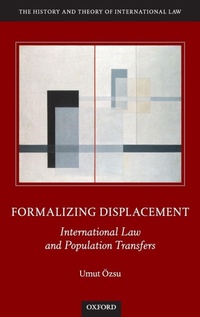
Formalizing Displacement
International Law and Population Transfers
Erschienen am 18. Dezember 2014
Buch
Hardcover
190 Seiten
978-0-19-871743-0 (ISBN)
Beschreibung
Large-scale population transfers are immensely disruptive. Interestingly, though, their legal status has shifted considerably over time. In this book, Umut OEzsu situates population transfer within the broader history of international law by examining its emergence as a legally formalized mechanism of nation-building in the early twentieth century. The book's principal focus is the 1922-34 compulsory exchange of minorities between Greece and Turkey, a crucially important endeavour whose legal dimensions remain under-scrutinized. Drawing upon historical sociology and economic history in addition to positive international law, the book interrogates received assumptions about international law's history by exploring the 'semi-peripheral' context within which legally formalized population transfers came to arise.
Supported by the League of Nations, the 1922-34 population exchange reconfigured the demographic composition of Greece and Turkey with the aim of stabilizing a region that was regarded neither as European nor as non-European. The scope and ambition of the undertaking was staggering: over one million were expelled from Turkey, and over a quarter of a million were expelled from Greece. The book begins by assessing minority protection's development into an instrument of intra-European governance during the course of the nineteenth and early twentieth centuries. It then shows how population transfer emerged in the 1910s and 1920s as a radical alternative to minority protection in Anatolia and the Balkans, focusing in particular on the 1922-3 Conference of Lausanne, at which a peace settlement formalizing the compulsory Greek-Turkish exchange was concluded. Finally, it analyses the Permanent Court of International Justice's 1925 advisory opinion in Exchange of Greek and Turkish Populations, contextualizing it in the wide-ranging debates concerning humanitarianism and internationalism that pervaded much of the exchange process.
Supported by the League of Nations, the 1922-34 population exchange reconfigured the demographic composition of Greece and Turkey with the aim of stabilizing a region that was regarded neither as European nor as non-European. The scope and ambition of the undertaking was staggering: over one million were expelled from Turkey, and over a quarter of a million were expelled from Greece. The book begins by assessing minority protection's development into an instrument of intra-European governance during the course of the nineteenth and early twentieth centuries. It then shows how population transfer emerged in the 1910s and 1920s as a radical alternative to minority protection in Anatolia and the Balkans, focusing in particular on the 1922-3 Conference of Lausanne, at which a peace settlement formalizing the compulsory Greek-Turkish exchange was concluded. Finally, it analyses the Permanent Court of International Justice's 1925 advisory opinion in Exchange of Greek and Turkish Populations, contextualizing it in the wide-ranging debates concerning humanitarianism and internationalism that pervaded much of the exchange process.
Rezensionen / Stimmen
The author is extremely effective in relating the legal and diplomatic side of this fascinating story ... It sheds a great deal of light on a murky corner of international legal history which deserves to be much better known. For this, we are greatly in the authors debt. * Stephen C. Neff, International Journal of Constitutional Law * In Formalizing Displacement, Umut OEzsu provides a new and engaging analysis of the role of international law in the interwar Greek-Turkish population exchanges. Against interpretations that present the exchange of minorities as a sui generis development, OEzsu situates it within the longue duree of Ottoman disintegration and traces its roots to antecedent forced migrations in the Balkans and Asia Minor. Rich historical detail provides the context within which OEzsu analyses the role of international law, legal institutions and lawyers in engineering the compulsory exchange ... Rich in detail and trenchant analysis, Formalizing Displacement is an important and welcome new work. * Tor Krever, London School of Economics and Assistant Editor of the London Review of International Law (OUP) * The book is important for highlighting the intricate relationship between law and politics and reminding the reader that even the purest notions and ideals that form the basis of interstate legal relations cannot escape being entangled in the political realties of their time. * Resat Kasaba, University of Washington * OEzsu's book is based on exhaustive reading of secondary material on population change, and an extensive review of the legal documents that formed the basis of discussions and descisions in Lausanne. The book is important for highlighting the intricate relationship between law and politics and reminding the reader that even the purest notions and ideals that form the basis of interstate legal relations cannot escape being entangled in the political realities of their time. They are, after all, the products of those very political realities. * Resat Kasaba, Law and History Review * This first book by Umut OEzsu reads all the more readily because the subject is fascinating and because of the legal analysis, nourished by the diplomatic background that the author has restored very well....[T]he author succeeds in presenting the context and impact of population displacements in all their complexity. * Alain Zamaria, Journal of the History of International Law *Weitere Details
Reihe
Sprache
Englisch
Verlagsort
Oxford
Großbritannien
Zielgruppe
Für höhere Schule und Studium
Für Beruf und Forschung
Maße
Höhe: 240 mm
Breite: 161 mm
Dicke: 15 mm
Gewicht
455 gr
ISBN-13
978-0-19-871743-0 (9780198717430)
Copyright in bibliographic data and cover images is held by Nielsen Book Services Limited or by the publishers or by their respective licensors: all rights reserved.
Schweitzer Klassifikation
Weitere Ausgaben
Andere Ausgaben
E-Book
12/2014
1. Auflage
OUP eBook
55,99 €
Als Download verfügbar
E-Book
12/2014
1. Auflage
OUP eBook
64,49 €
Als Download verfügbar
Person
Umut OEzsu is an Assistant Professor of Law at the University of Manitoba. His research interests lie principally in public international law, the history and theory of international law, and socio-legal studies.
Inhalt
Introduction ; 1. The Ottoman Empire and the International Law of Minority Protection, 1815-1923 ; 2. Early Experiments in Population Transfer, 1913-9 ; 3. 'A Subject Which Excites the Deepest Interest Throughout the Civilised World': Legal Diplomacy at the Conference of Lausanne ; 4. Humanitarianism, the World Court, and the Relation between Domestic and International Law ; Conclusion