

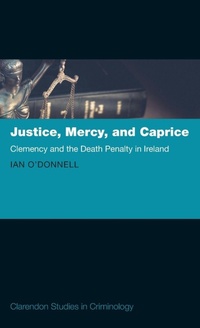
Justice, Mercy, and Caprice
Clemency and the Death Penalty in Ireland
Erschienen am 9. November 2017
Buch
Hardcover
330 Seiten
978-0-19-879847-7 (ISBN)
Beschreibung
Justice, Mercy, and Caprice is a work of criminal justice history that speaks to the gradual emergence of a more humane Irish state. It is a close examination of the decision to grant clemency to men and women sentenced to death between the end of the civil war in 1923 and the abolition of capital punishment in 1990.
Frequently, the decision to deflect the law from its course was an attempt to introduce a measure of justice to a system where the mandatory death sentence for murder caused predictable unfairness and undue harshness. In some instances the decision to spare a life sprang from merciful motivations. In others it was capricious, depending on factors that should have had no place in the government's decision-making calculus. The custodial careers of those whose lives were spared repay scrutiny. Women tended to serve relatively short periods in prison but were often transferred to a religious institution where their confinement continued, occasionally for life. Men, by contrast, served longer in prison but were discharged directly to the community. Political offenders were either executed hastily or, when the threat of capital punishment had passed, incarcerated for extravagant periods.
This book addresses issues that are of continuing relevance for countries that employ capital punishment. It will appeal to scholars with an interest in criminal justice history, executive discretion, and death penalty studies, as well as being a useful resource for students of penology.
Frequently, the decision to deflect the law from its course was an attempt to introduce a measure of justice to a system where the mandatory death sentence for murder caused predictable unfairness and undue harshness. In some instances the decision to spare a life sprang from merciful motivations. In others it was capricious, depending on factors that should have had no place in the government's decision-making calculus. The custodial careers of those whose lives were spared repay scrutiny. Women tended to serve relatively short periods in prison but were often transferred to a religious institution where their confinement continued, occasionally for life. Men, by contrast, served longer in prison but were discharged directly to the community. Political offenders were either executed hastily or, when the threat of capital punishment had passed, incarcerated for extravagant periods.
This book addresses issues that are of continuing relevance for countries that employ capital punishment. It will appeal to scholars with an interest in criminal justice history, executive discretion, and death penalty studies, as well as being a useful resource for students of penology.
Rezensionen / Stimmen
... meticulous evaluation of primary sources ... an authoritative account of clemency in Ireland ... raises important questions about the role of gender in the adjudication of punishment ... This book will be useful to legal scholars, historians, sociologists, criminologists, abolitionists, and any laypeople who seek to drive their home countries away from practices rooted in cruelty and caprice, and towards policies rooted in justice and mercy. * Muzzaker Mathias, Rutgers Criminal Law and Criminal Justice Book Reviews * While this is a serious academic book, informed by criminological theory and wider socio-legal scholarship, the stories that O'Donnell uncovers, and describes in exquisite detail, could engage an audience beyond the academy ... This book is a pleasure to read. O'Donnell is skilled at weaving an engaging narrative from his rich empirical data ... A close reading of the text is repaid with some wonderful nuggets of detail, often hidden in footnotes, but together presenting a rich tapestry of clemency decision-making ... His critical lens zooms in to provide thick description of key variables in the cases that might account for clemency decisions, and then draws back to a wide angle to explicate the cultural, political, and legal factors that influenced decision-making. This makes for a beautifully produced monograph that deserves to be widely read. * Carolyn Hoyle, Dublin University Law Journal * ...fascinating, thought-provoking ... original, consistently challenging, and sites Ireland's history in the wider world of imprisonment and punishment history ... [a] model for future work. * William Murphy, Irish Economic and Social History * ... a masterful study ... a fine overview of the law and practice of capital punishment over the past century ... a compelling, thoughtful and extremely well-researched contribution with the potential to influence debates elsewhere in the world. * William A. Schabas, (The Irish Jurist, Vol. 59, 2018) * In analysing the factors that led to the exercise of clemency and its aftermath, O'Donnell's extensive research sheds light on the exercise of State power in Ireland and the potent mix of politics, chivalry, morality and deference over time. * Nicola Carr, University of Nottingham (The Irish Times, January 2018) * ... an exemplar of methodological rigour and literary verve ... O'Donnell's exhaustive research pierces the opaque operation of clemency. He delivers on his commitment to grasping the legal, political, and societal setting of clemency in order to understand it. The author has a special knack for zooming in and out when relating historical detail and the book is superbly written ... of great value to every researcher of clemency, no matter what their discipline or location * David Prendergast, Trinity College Dublin (The Howard Journal, October 2018) *Weitere Details
Reihe
Sprache
Englisch
Verlagsort
Oxford
Großbritannien
Zielgruppe
Für höhere Schule und Studium
Für Beruf und Forschung
Maße
Höhe: 222 mm
Breite: 145 mm
Dicke: 21 mm
Gewicht
548 gr
ISBN-13
978-0-19-879847-7 (9780198798477)
Copyright in bibliographic data and cover images is held by Nielsen Book Services Limited or by the publishers or by their respective licensors: all rights reserved.
Schweitzer Klassifikation
Weitere Ausgaben
Andere Ausgaben
E-Book
11/2017
1. Auflage
OUP eBook
58,49 €
Als Download verfügbar
E-Book
11/2017
1. Auflage
OUP eBook
58,49 €
Als Download verfügbar
Person
Ian O'Donnell MRIA is Professor of Criminology at University College Dublin and an Adjunct Fellow of Linacre College, Oxford. His last book, also published as part of OUP's Clarendon Studies in Criminology, was Prisoners, Solitude, and Time.
Inhalt
Preface
List of tables
Introduction
The revolutionary period
Parameters of inquiry
Avoiding death-eligibility
Classifying Clemency
Who, where, how?
A tripartitie scheme
The 'prerogative'
For and Against Clemency
Discretion and desert
Cons
Pros
Justice, mercy, caprice
Juries and Judges
Weighing the evidence
Composition
Softening the verdict
Donning the black cap
A singular case
Extraordinary Courts
Special Powers Tribunal
The 'terror court'
Astounding legal manoeuvres
Capital murder
Governments
Limits to discretion
Public opinion
Groupthink
Arbitrary or principled decisions?
Blurring the Separation of Powers
Interfering judges
A belt of the crozier
Entreaties from His Excellency
Judges again, now expediting release
Undoing Death I
A cruel lottery?
The burden of an unwanted child
Sex and jealousy
Undoing Death II
Dreadful deeds done in turbulent times
Legally sane but strikingly odd
Chivalry
Caprice
Release
Procedures
When?
Whither?
Why?
Postscript
Appendices
I. Convicted of murder after trial by jury, and spared
II. Convicted of murder after trial by jury, and hanged
III. Sentenced to death by a non-jury court
Bibliography
I. Primary sources
II. Secondary sources
Index
List of tables
Introduction
The revolutionary period
Parameters of inquiry
Avoiding death-eligibility
Classifying Clemency
Who, where, how?
A tripartitie scheme
The 'prerogative'
For and Against Clemency
Discretion and desert
Cons
Pros
Justice, mercy, caprice
Juries and Judges
Weighing the evidence
Composition
Softening the verdict
Donning the black cap
A singular case
Extraordinary Courts
Special Powers Tribunal
The 'terror court'
Astounding legal manoeuvres
Capital murder
Governments
Limits to discretion
Public opinion
Groupthink
Arbitrary or principled decisions?
Blurring the Separation of Powers
Interfering judges
A belt of the crozier
Entreaties from His Excellency
Judges again, now expediting release
Undoing Death I
A cruel lottery?
The burden of an unwanted child
Sex and jealousy
Undoing Death II
Dreadful deeds done in turbulent times
Legally sane but strikingly odd
Chivalry
Caprice
Release
Procedures
When?
Whither?
Why?
Postscript
Appendices
I. Convicted of murder after trial by jury, and spared
II. Convicted of murder after trial by jury, and hanged
III. Sentenced to death by a non-jury court
Bibliography
I. Primary sources
II. Secondary sources
Index