

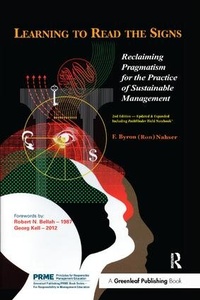
Learning to Read the Signs
Reclaiming Pragmatism for the Practice of Sustainable Management
2. Auflage
Erschienen am 31. August 2013
Buch
Hardcover
236 Seiten
978-1-907643-90-3 (ISBN)
Beschreibung
The PathFinder Lab Journal Field Notebook (Appendix III) is available here.
It's not what we know, but how we learn. This is the key that Learning to Read the Signs uses in order to evaluate and apply ideas and facts to one's organization life. The book asks the reader to go back to and reclaim pragmatism: an activity of thought involving four parts: Investigation, Hypothesis, Action, and Testing. Pragmatism is a method of interpretation or inquiry which offers to the thoughtful business practitioner a way to better understand the reality in which we operate, to think critically and creatively, and for business people to think together to make the best use of all our perspectives and talents. Questions raised in this book include: What are the signs telling us? Where are we headed and why? Why are things going the way they are? What is our purpose?
Examples abound of companies and organizations that have failed to "read the signs": the automobile and the financial services industries are obvious examples. Doing business successfully in the 21st century means becoming aware of the filters that modify and limit business vision in our culture. Without this awareness, many businesses will continue to fall into short-term reactive thinking. In a world facing unprecedented social, environmental, and economic challenges, learning to read the signs is a business imperative. This is not a how-to book in the sense that it provides ten easy answers to everyday business problems. The help it gives is much more profound. This book outlines a mode of inquiry that can be used to solve cognitive as well as ethical questions. Drawing on the deepest resources of philosophical pragmatism, Nahser shows us that often we do not even know the right question to ask, that we must start by trusting our doubts and seeing where they lead, so that we can even begin to ask the right questions. He brings philosophy down to earth by showing that a practical philosophy can call into question our outworn assumptions, open up new lines in inquiry, and lead to conclusions we never imagined at the beginning of the process - conclusions not just about what to do next, but about our larger purposes, those frameworks that give us meaning and direction. In this long-overdue and radical update to his seminal book, Ron Nahser turns his attention to how pragmatism can be can be practiced by the management of business, government, and non-profit organizations to create both success and a better world for all.
It's not what we know, but how we learn. This is the key that Learning to Read the Signs uses in order to evaluate and apply ideas and facts to one's organization life. The book asks the reader to go back to and reclaim pragmatism: an activity of thought involving four parts: Investigation, Hypothesis, Action, and Testing. Pragmatism is a method of interpretation or inquiry which offers to the thoughtful business practitioner a way to better understand the reality in which we operate, to think critically and creatively, and for business people to think together to make the best use of all our perspectives and talents. Questions raised in this book include: What are the signs telling us? Where are we headed and why? Why are things going the way they are? What is our purpose?
Examples abound of companies and organizations that have failed to "read the signs": the automobile and the financial services industries are obvious examples. Doing business successfully in the 21st century means becoming aware of the filters that modify and limit business vision in our culture. Without this awareness, many businesses will continue to fall into short-term reactive thinking. In a world facing unprecedented social, environmental, and economic challenges, learning to read the signs is a business imperative. This is not a how-to book in the sense that it provides ten easy answers to everyday business problems. The help it gives is much more profound. This book outlines a mode of inquiry that can be used to solve cognitive as well as ethical questions. Drawing on the deepest resources of philosophical pragmatism, Nahser shows us that often we do not even know the right question to ask, that we must start by trusting our doubts and seeing where they lead, so that we can even begin to ask the right questions. He brings philosophy down to earth by showing that a practical philosophy can call into question our outworn assumptions, open up new lines in inquiry, and lead to conclusions we never imagined at the beginning of the process - conclusions not just about what to do next, but about our larger purposes, those frameworks that give us meaning and direction. In this long-overdue and radical update to his seminal book, Ron Nahser turns his attention to how pragmatism can be can be practiced by the management of business, government, and non-profit organizations to create both success and a better world for all.
Rezensionen / Stimmen
'This idea of pragmatism goes far beyond the conventional uses of today, but is a historically enduring principle that harnesses the deep intuition of our own perceptions and experiences and integrates it with the rapidly changing currents that surround us. Ron Nahser's remarkable effort to resurrect this profound philosophy in the business world is a bold and noble move and, when applied effectively, will bring forth better, more significant decisions that will enhance both our physical and our spiritual well-being". Dr. Stephen R. Covey - if only all business executives were to read and comprehend 'Learning to Read the Signs', the world would be a dramatically a better place, and corporations would be far more resilient and better prepared to manage present and future challenges.' Georg Kell - Executive Director, UN Global Compact SecretariatWeitere Details
Reihe
Auflage
2nd edition
Sprache
Englisch
Verlagsort
Saltaire
Großbritannien
Verlagsgruppe
Taylor & Francis Ltd
Zielgruppe
Für Beruf und Forschung
Postgraduate and Professional Practice & Development
Maße
Höhe: 234 mm
Breite: 156 mm
Gewicht
600 gr
ISBN-13
978-1-907643-90-3 (9781907643903)
Copyright in bibliographic data and cover images is held by Nielsen Book Services Limited or by the publishers or by their respective licensors: all rights reserved.
Schweitzer Klassifikation
Weitere Ausgaben
Andere Ausgaben
F. Byron (Ron) Nahser
Learning to Read the Signs
Reclaiming Pragmatism for the Practice of Sustainable Management
E-Book
09/2017
2. Auflage
Routledge
47,49 €
Als Download verfügbar
F. Byron (Ron) Nahser
Learning to Read the Signs
Reclaiming Pragmatism for the Practice of Sustainable Management
E-Book
09/2017
2. Auflage
Routledge
47,49 €
Als Download verfügbar
F. Byron (Ron) Nahser
Learning to Read the Signs
Reclaiming Pragmatism for the Practice of Sustainable Management
Buch
08/2013
2. Auflage
Greenleaf Publishing
54,10 €
Versand in 3-4 Wochen
Person
F. BYRON NAHSER is MD for Corporantes, Inc. and Provost Emeritus of Presidio School of Management, San Francisco. He lectures on business values, marketing strategy, social responsibility and sustainable management.
Inhalt
Foreword to the Second Edition by Georg Kell Foreword to the First Edition by Robert N. BellahPreface to the Second Edition: Nearly a generation laterPreface to the First EditionAcknowledgments Part I: Begin1. Why reclaim pragmatism for organizations? Part II: Explore2. The filtered view from the corporate tower3. The nature and purpose of business: Is it time to change our view?4. How our filters came to be Part III: Interpret5. Pragmatism: A community of inquirers6. Extending Peirce beyond science: Diverse voices and corporate change Part IV: Decide - Hypothesize7. Pragmatism from theory to practice: A PathFinder for organizations8. Pragmatism in business: Lessons learned Part V: Act: The path ahead9. The creative community10. The still, small voice within Epilogue: The story of the UN-supported Principles for Responsible Management Education by Jonas Haertle Appendix I: UN PRME 3rd Global Forum Participant's GuideAppendix II: UN models and Pragmatic Inquiry ModelAppendix III: The PathFinder Lab Journal - Field Notebook Selected bibliographyNotesAbout the authorIndex