

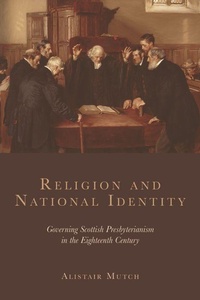
Religion and National Identity
Governing Scottish Presbyterianism in the Eighteenth Century
Erschienen am 23. März 2015
Buch
Hardcover
288 Seiten
978-0-7486-9915-5 (ISBN)
Beschreibung
Presbyterianism has shaped Scotland and its impact on the world. Behind its beliefs lie some distinctive practices of governance which endure even when belief fades. These practices place a particular emphasis on the detailed recording of decisions and what we can term a 'systemic' form of accountability.
This book examines the emergence and consolidation of such practices in the 18th-century Church of Scotland. Using extensive archival research and detailed local case studies, it contrasts them to what is termed a 'personal' form of accountability in England in the same period. The wider impact of the systemic approach to governance and accountability, especially in the United States of America, is explored, as is the enduring impact on Scottish identity.
This book offers a fresh perspective on the Presbyterian legacy in contemporary Scottish historiography, at the same time as informing current debates on national identity.
This book examines the emergence and consolidation of such practices in the 18th-century Church of Scotland. Using extensive archival research and detailed local case studies, it contrasts them to what is termed a 'personal' form of accountability in England in the same period. The wider impact of the systemic approach to governance and accountability, especially in the United States of America, is explored, as is the enduring impact on Scottish identity.
This book offers a fresh perspective on the Presbyterian legacy in contemporary Scottish historiography, at the same time as informing current debates on national identity.
Rezensionen / Stimmen
This book is an important addition to the study of Scottish Presbyterianism and piety, with a close examination of church records that indicate the way in which administrative records not only give an account of the religious shaping of the nation, but lie at the heart of the Presbyterian identity that has marked the nation since the middle of the sixteenth century. -- Kenneth B. E. Roxburgh, Samford University * Journal of Church and State * A book to be commended. -- Graeme Morton, University of Dundee * Journal of Scottish Historical Studies * Impressive and compelling. -- James J. S. Foster, University of Sioux Falls * Scottish Historical Review * An insightful and wonderfully researched book on the development of the practice of accountability in the Church of Scotland. Governance practices in the Kirk - record-keeping, accounting, inspections - have rarely been examined in such depth. -- Valerie Wallace, Victoria University of Wellington * The Journal of Ecclesiastical History *Weitere Details
Sprache
Englisch
Verlagsort
Edinburgh
Großbritannien
Zielgruppe
Für höhere Schule und Studium
Produkt-Hinweis
Fadenheftung
Gewebe-Einband
Illustrationen
27 black and white tables
Maße
Höhe: 236 mm
Breite: 157 mm
Dicke: 20 mm
Gewicht
567 gr
ISBN-13
978-0-7486-9915-5 (9780748699155)
Copyright in bibliographic data and cover images is held by Nielsen Book Services Limited or by the publishers or by their respective licensors: all rights reserved.
Schweitzer Klassifikation
Weitere Ausgaben
Andere Ausgaben
Alistair Mutch
Religion and National Identity
Governing Scottish Presbyterianism in the Eighteenth Century
E-Book
03/2015
1. Auflage
Edinburgh University Press
92,49 €
Als Download verfügbar
Alistair Mutch
Religion and National Identity
Governing Scottish Presbyterianism in the Eighteenth Century
E-Book
03/2015
1. Auflage
Edinburgh University Press
0,00 €
Als Download verfügbar
Person
Alistair Mutch is Professor of Information & Learning at Nottingham Business School. He combines organizational theory with business history and has published on Scottish rural and religious history. He is author of Managing Information and Knowledge in Organizations, 2008 and Strategic and Organizational Change: From Production to Retailing in UK Brewing 1950-1990, 2006.
Inhalt
Contents; Acknowledgements; Introduction; Chapter 1: Looking for practices; The Protestant Ethic and practice; The nature of practice; Scottish religious practice; Sources; Chapter 2: The emergence of a governance system; Structure of the church; An emerging system: the seventeenth century; Consolidating the Revolution settlement; Steuart of Pardovan; Chapter 3: Presbyterial business; Business as usual in the presbytery; The parochial visitation in practice; Ministerial conduct and the demise of the visitation; Monitoring sessions at a distance; Formalisation of the letter; relaxation of the spirit; Chapter 4: The kirk session; Ministers; The Session Clerk; Elders; Deacons and Heritors; Life of the Session; Making communion happen; Chapter 5: Handling finances; Developing the money register; Record format; Using the records; Getting the money in; The poor box; The treasurer; Disputes over accountability; Chapter 6: Scottish systemic accountability; Theory and practice; Regional differences; Law and education; Monymusk; Chapter 7: Contrasts and consequences; Personal accountability in the Church of England; Contrasts with Scotland; Consequences; Bonds; Accountancy; America; Chapter 8: Conclusion; Religion as a social practice; Scotland and Presbyterianism; Appendices; Appendix 1: Contrast of visitation questions; Appendix 2: Parochial visitations in four presbyteries 1700-1735; Appendix 3: Questions asked about ministerial conduct at parochial visitations in 1710 compared to 1704 Overtures; Appendix 4: Questions asked about sessions at parochial visitations in 1710 compared to 1704 Overtures; Appendix 5: Questions at privy censures in presbytery of Cupar in 1730 compared to 1704 Overtures; Appendix 6: Parish records examined for account formats; Appendix 7: Coding structure for analysis of recording of financial transactions; Appendix 8: Account formats across five presbyteries; Primary sources; National Records of Scotland; Nottinghamshire Record Office; University of Nottingham, Manuscripts and Special Collections; Liverpool Record Office; Derbyshire Record Office; Printed primary sources; Secondary sources.