

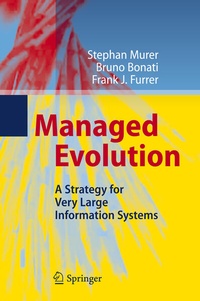
Managed Evolution
A Strategy for Very Large Information Systems
Erschienen am 28. September 2014
Buch
Softcover
XXIV, 264 Seiten
978-3-642-43131-9 (ISBN)
Beschreibung
Many organizations critically depend on very large information systems. In the authors' experience these organizations often struggle to find the right strategy to sustainably develop their systems. Based on their own experience at a major bank, over more than a decade, the authors have developed a successful strategy to deal with these challenges, including:
- A thorough analysis of the challenges associated with very large information systems
- An assessment of possible strategies for the development of these systems, resulting in managed evolution as the preferred strategy
- Describing key system aspects for the success of managed evolution, such as architecture management, integration architecture and infrastructure
- Developing the necessary organizational, cultural, governance and controlling mechanisms for successful execution
Weitere Details
Auflage
2011 ed.
Sprache
Englisch
Verlagsort
Berlin
Deutschland
Verlagsgruppe
Springer Berlin
Zielgruppe
Für Beruf und Forschung
Professional/practitioner
Illustrationen
XXIV, 264 p.
Maße
Höhe: 235 mm
Breite: 155 mm
Dicke: 16 mm
Gewicht
441 gr
ISBN-13
978-3-642-43131-9 (9783642431319)
DOI
10.1007/978-3-642-01633-2
Schweitzer Klassifikation
Weitere Ausgaben
Andere Ausgaben
Buch
10/2010
1. Auflage
Springer
80,24 €
Versand in 7-9 Tagen
Personen
Stephan Murer was born 1963 in Switzerland. He graduated with an information technology engineering diploma and a Ph.D. in computer science from the ETH in Zürich in 1992. After that he continued his academic career at the International Computer Science Institute of the University of California, Berkeley. 1994 Stephan joined Credit Suisse, where he held a number of different positions. In 2000 he completed his MBA from the University of St. Gallen. Since 2000 he has been managing director and chief architect, responsible for the overall design of Credit Suisse's Information systems. Stephan Murer can be reached at stephan.murer@credit-suisse.com. Bruno Bonati was born 1949 in Switzerland and studied Economics at the University of St.Gallen. He graduated as lic.oec.HSG in 1973. After graduation he worked in several companies and in 1996 he became Member of the Executive Board and Head of IT and Operations in Credit Suisse. In 1997 Credit Suisse started the managed evolution strategy inIT and developed the Service Oriented Architecture for the Swiss IT Platform. In 2005 after retirement from Credit Suisse he worked as an independent consultant for IT and Banking. He has been the senior consultant for the Industry Value Network, an initiative led by SAP with 40 member companies (20 large banks and 20 vendors) with the goal to develop SOA in banking, which shifted, in 2008, into an independent organization in order to enable the standardization of services in banking. He is a member of several non executive boards of directors, among them Tieto Helsinki/Stockholm and Swisscom IT Services. Bruno Bonati can be reached at bruno@bonati-consulting.com. Frank J. Furrer was born 1945 in Switzerland and studied electrical engineering at the Swiss Federal Institute of Technology in Zurich (ETH Zurich). He graduated as Master of Science in 1969. After graduation he worked as a research assistant at the Institute of Technical Physics at the Swiss Federal Institute of Technologyin Zurich (Prof. Dr. E. Baumann) and earned his Ph.D. in advanced communications engineering in the year 1975. In the following years he worked in several consulting firms. 1997 he started his own consulting practice, focussed on applications architecture and security for very large information systems. Frank J. Furrer is the author of several books on industrial communications and information system security and works as an independent consultant. Frank J. Furrer can be reached at frank.j.furrer@villa-aurora.ch.
Inhalt
PART 1: Structure, Properties, Challenges and Architecture of Very Large Information Systems: Very Large Information System Challenge.- Architecture Management.- Integration Architecture.- Infrastructure.- PART 2: Organization and Management Processes for the Execution of Managed Evolution: Business-IT Alignment.- People, Culture and Organization.- Measuring the Managed Evolution.- PART 3: Summary, Conclusions and Outlook: Conclusions and Outlook.