

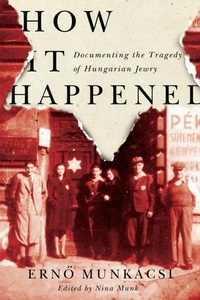
How It Happened
Documenting the Tragedy of Hungarian Jewry
3. Auflage
Erscheint ca. am 29. Oktober 2018
Buch
Hardcover
396 Seiten
978-0-7735-5512-9 (ISBN)
Beschreibung
A gripping first-hand account of the devastating "last chapter" of the Holocaust, written by a privileged eyewitness, the secretary of the Hungarian Judenrat, and a member of Budapest's Jewish elite, How It Happened is a unique testament to the senseless brutality that, in a matter of months, decimated what was Europe's largest and last-surviving Jewish community. Writing immediately after the war and examining only those critical months of 1944 when Hitler's Germany occupied its ally Hungary, Erno Munkacsi describes the Judenrat's desperation and fear as it attempted to prevent the looming catastrophe, agonized over decisions not made, and struggled to grasp the immensity of a tragedy that would take the lives of 427,000 Hungarian Jews in the very last year of the Second World War. This long-overdue translation makes available Munkacsi's profound and unparalleled insight into the Holocaust in Hungary, revealing the "choiceless choices" that confronted members of the Judenrat forced to execute the Nazis' orders. With an in-depth introduction, a brief biography of Erno Munkacsi, ample annotations by Laszlo Csosz and Ferenc Laczo, two dozen archival photographs, and detailed maps, How It Happened is an essential resource for historians and students of the Holocaust, the Second World War, and Central Europe.
Rezensionen / Stimmen
"Beyond its value as a primary source, Munkacsi's account is compelling as a human story, and will no doubt prove to be provocative reading for students, scholars, and the general public alike." Hungarian Studies Review "This is an increasingly anguished memoir by someone whose faith in law and humanity was broken as the details from the Auschwitz Protocols (testimony from camp escapees) became known ... profoundly sad but important reading. We all know how the war ends and how many lives were lost, but this eyewitness account is a good primary source document for understanding how ethnic hatred overtook one of Europe's most seemingly cultured societies." Foreword Reviews "Erno Munkacsi's How It Happened is a riveting account, told by one who was there, of the anguished decisions that Hungarian Jewish leaders made and of the actions that they took (or did not take) as the Holocaust unfolded around them. One of the very first histories of the Holocaust in Hungary, Munkacsi's account defies genre, combining careful analysis of documentary sources with powerful and detailed personal recollections. The publication of this expertly annotated English translation is a major contribution to international Holocaust studies." Paul Hanebrink, Rutgers University and author of In Defense of Christian Hungary: Religion, Nationalism, and Antisemitism, 1890-1944 "One of the first of several immediate postwar engagements with the Hungarian Holocaust, this volume-originally published in 1947 and now translated into English-breaks the myth of silence that the Holocaust historiography claimed has marked this period. The book can be read productively in conjunction with the rich secondary literature on other Jewish Councils set up by the Nazis in places like Warsaw and Lodz for a more nuanced understanding of the dilemmas of Jewish leaders. The book also includes an excellent contextual essay, glossary, biographical note, and critical apparatus. Summing Up: Essential." Choice "Could the members of the German-appointed Jewish Council in Hungary have done more to help their fellow Jews, miraculously still numbering more than eight hundred thousand in 1944? The fact that more than half a million perished but the rest survived, including the members of Jewish Council, has led to endless soul-searching and bitter reproaches. Erno Munkacsi's honest account of his and the rest of the Council's doings makes clear that it was not the Jewish Council but the non-Jewish Hungarians who decided who would live and who would die. It is therefore the Christians of Hungary who emerge from the tragedy in part as vile murderers and robbers, in part as indifferent onlookers, and in part as compassionate saviours." Istvan Deak, Columbia University and author of Europe on Trial: The Story of Collaboration, Resistance, and Retribution During World War II"How It Happened succeeds both as a riveting, personal account of the days leading up to the Holocaust in Hungary and as a scholarly work that sheds new light on the tragedy of Hungarian Jewry. A valuable addition to Holocaust literature, this is a very readable story drawn from the pages of a catastrophe we are still unable to fully comprehend." Anna Porter, author of Kasztner's Train: The True Story of Rezso Kasztner, Unknown Hero of the Holocaust
Weitere Details
Auflage
3rd edition
Sprache
Englisch
Verlagsort
Montreal
Kanada
Zielgruppe
Für höhere Schule und Studium
Für Beruf und Forschung
Produkt-Hinweis
Fadenheftung
Gewebe-Einband
Illustrationen
26 b&w photos, 3 maps
Maße
Höhe: 235 mm
Breite: 167 mm
Dicke: 32 mm
Gewicht
705 gr
ISBN-13
978-0-7735-5512-9 (9780773555129)
Copyright in bibliographic data and cover images is held by Nielsen Book Services Limited or by the publishers or by their respective licensors: all rights reserved.
Schweitzer Klassifikation
Weitere Ausgaben
Andere Ausgaben
Erno Munkácsi | Nina Munk | Ferenc Laczó and László Csosz
How It Happened
Documenting the Tragedy of Hungarian Jewry
E-Book
10/2018
1. Auflage
De Gruyter
29,49 €
Als Download verfügbar
Erno Munkacsi | Nina Munk | Ferenc Laczo and Laszlo Csosz
How It Happened
Documenting the Tragedy of Hungarian Jewry
E-Book
10/2018
1. Auflage
McGill-Queen's University Press
29,49 €
Als Download verfügbar
Personen
Erno Munkacsi (1896-1950), a distinguished Hungarian jurist and writer, was general counsel of the Israelite Congregation of Pest and Director of the Hungarian Jewish Museum. In 1944, during the Nazi occupation of Hungary, he served as secretary for the Hungarian Central Jewish Council or Judenrat. Nina Munk is a Canadian-American journalist and author. She is a contributing editor at Vanity Fair and the author of The Idealist: Jeffrey Sachs and the Quest to End Poverty. Laszlo Csosz is senior archivist at the Hungarian National Archives in Budapest and co-author, with Gabor Kadar and Zoltan Vagi, of The Holocaust in Hungary: Evolution of a Genocide. Ferenc Laczo is assistant professor of history at Maastricht University and author of Hungarian Jews in the Age of Genocide: An Intellectual History, 1929-1948. Peter Baliko Lengyel is a Hungarian writer and translator who earned his master's and PhD candidacy in English at the University of California, Santa Barbara. Susan Papp is a PhD candidate in the Department of History at the University of Toronto and author of Outcasts: A Love Story.