

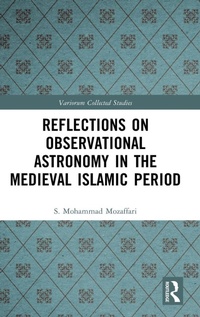
Reflections on Observational Astronomy in the Medieval Islamic Period
1. Auflage
Erschienen am 13. Dezember 2024
Buch
Hardcover
344 Seiten
978-1-032-77234-9 (ISBN)
Beschreibung
This volume presents comprehensive investigations into various facets of observational astronomy during the medieval Islamic period, spanning from the ninth to the seventeenth centuries. The chapters compiled here, originally published between 2012 and 2018, have undergone significant revisions to enhance their accuracy and explore a broad spectrum of topics organized into five main sections.
Reflections on Observational Astronomy in the Medieval Islamic Period begins with solar astronomy, providing a detailed evaluation of Islamic astronomers' determinations of fundamental solar parameters. In the realm of lunar astronomy, it examines the gradual endorsement and rationalization of annular solar eclipses, along with an exclusive historical account of predicting and observing such an event in 1283 CE. The section on planetary astronomy scrutinizes empirical discoveries that distinguish between the precession of equinoxes and the motion of apogees, as well as significant enhancements to Ptolemy's parameters for planetary latitudes. Stellar astronomy is explored through a non-Ptolemaic star table that encompasses observations from ninth-century Baghdad to thirteenth-century Maragha. The final section examines observational instruments, focusing on those constructed during the second period of activities at the Maragha observatory. A critical analysis of astronomical observations conducted at the Maragha and Istanbul observatories is a key focus of this work.
This book will be invaluable to those interested in the historical progression of exact sciences; the scope, distinctive aspects, and caliber of experimental activities in medieval times; and the interplay between theory and observation throughout history. It is intended for historians, scientists (including astronomers and physicists), and particularly, historians of astronomy.
Reflections on Observational Astronomy in the Medieval Islamic Period begins with solar astronomy, providing a detailed evaluation of Islamic astronomers' determinations of fundamental solar parameters. In the realm of lunar astronomy, it examines the gradual endorsement and rationalization of annular solar eclipses, along with an exclusive historical account of predicting and observing such an event in 1283 CE. The section on planetary astronomy scrutinizes empirical discoveries that distinguish between the precession of equinoxes and the motion of apogees, as well as significant enhancements to Ptolemy's parameters for planetary latitudes. Stellar astronomy is explored through a non-Ptolemaic star table that encompasses observations from ninth-century Baghdad to thirteenth-century Maragha. The final section examines observational instruments, focusing on those constructed during the second period of activities at the Maragha observatory. A critical analysis of astronomical observations conducted at the Maragha and Istanbul observatories is a key focus of this work.
This book will be invaluable to those interested in the historical progression of exact sciences; the scope, distinctive aspects, and caliber of experimental activities in medieval times; and the interplay between theory and observation throughout history. It is intended for historians, scientists (including astronomers and physicists), and particularly, historians of astronomy.
Weitere Details
Reihe
Sprache
Englisch
Verlagsort
London
Großbritannien
Verlagsgruppe
Taylor & Francis Ltd
Zielgruppe
Für höhere Schule und Studium
Academic
Illustrationen
49 s/w Abbildungen, 21 s/w Photographien bzw. Rasterbilder, 28 s/w Zeichnungen
28 Line drawings, black and white; 21 Halftones, black and white; 49 Illustrations, black and white
Maße
Höhe: 240 mm
Breite: 161 mm
Dicke: 23 mm
Gewicht
693 gr
ISBN-13
978-1-032-77234-9 (9781032772349)
Copyright in bibliographic data and cover images is held by Nielsen Book Services Limited or by the publishers or by their respective licensors: all rights reserved.
Schweitzer Klassifikation
Weitere Ausgaben
Andere Ausgaben
S. Mohammad Mozaffari
Reflections on Observational Astronomy in the Medieval Islamic Period
E-Book
12/2024
1. Auflage
Routledge
60,49 €
Als Download verfügbar
S. Mohammad Mozaffari
Reflections on Observational Astronomy in the Medieval Islamic Period
E-Book
12/2024
1. Auflage
Routledge
60,49 €
Als Download verfügbar
Person
S. Mohammad Mozaffari is an Iranian historian of medieval astronomy currently serving at the Research Institute for Astronomy and Astrophysics of Maragha (RIAAM), University of Maragheh, in Iran. He is also a research associate in the project of the Ptolemaeus Arabus et Latinus (Bavarian Academy of Sciences and Humanities, Munich). His primary research focus lies in the growth and development of observational astronomy, particularly its interplay with theoretical astronomy, during the medieval Islamic period. He is an active member of the International Astronomical Union and holds editorial roles as an advisory editor for the Journal for the History of Astronomy, an associate editor for SCIAMVS (Sources and Commentaries in the Exact Sciences), and an associate editor for the Journal of Astronomical History and Heritage.
Inhalt
Introduction
Part I. Solar Astronomy
Chapter 1. Limitations of Methods: The Accuracy of the Values Measured for the Earth's/Sun's Orbital Elements in the Middle East, 800-1500 ce
Part II. Lunar Astronomy and Theory of Eclipses
Chapter 2. How Natural Phenomena Were Justified in Medieval Science: The Situation of Annular Eclipses in Medieval Astronomy
Chapter 3. Wabkanawi's Observation and Calculations of the Annular Solar Eclipse of 30 January 1283
Chapter 4. Biruni's Examination of the Path of the Centre of the Epicycle in Ptolemy's Lunar Model
Chapter 5. Solar and Lunar Observations at Istanbul in the 1570s
Part III. Planetary Astronomy
Chapter 6. Four-Point Method for Determining the Eccentricity and the Direction of the Apsidal Lines of the Sun and Superior Planets
Chapter 7. Planetary Latitudes in Medieval Islamic Astronomy: An Analysis of the Non-Ptolemaic Latitude Parameter Values in the Maragha and Samarqand Astronomical Traditions
Chapter 8. Holding or Breaking with Ptolemy's Generalization: Considerations about the Motion of the Planetary Apsidal Lines in Medieval Islamic Astronomy
Chapter 9. Astronomical Observations at the Maragha Observatory in the 1260s-70s
Part IV. Stellar Astronomy
Chapter 10. A Medieval Bright Star Table: The Non-Ptolemaic Star Table in the Ilkhani Zij
Part V. Observational Instrumentation
Chapter 11. Ghazan Khan's Astronomical Innovations at Maragha Observatory
Part I. Solar Astronomy
Chapter 1. Limitations of Methods: The Accuracy of the Values Measured for the Earth's/Sun's Orbital Elements in the Middle East, 800-1500 ce
Part II. Lunar Astronomy and Theory of Eclipses
Chapter 2. How Natural Phenomena Were Justified in Medieval Science: The Situation of Annular Eclipses in Medieval Astronomy
Chapter 3. Wabkanawi's Observation and Calculations of the Annular Solar Eclipse of 30 January 1283
Chapter 4. Biruni's Examination of the Path of the Centre of the Epicycle in Ptolemy's Lunar Model
Chapter 5. Solar and Lunar Observations at Istanbul in the 1570s
Part III. Planetary Astronomy
Chapter 6. Four-Point Method for Determining the Eccentricity and the Direction of the Apsidal Lines of the Sun and Superior Planets
Chapter 7. Planetary Latitudes in Medieval Islamic Astronomy: An Analysis of the Non-Ptolemaic Latitude Parameter Values in the Maragha and Samarqand Astronomical Traditions
Chapter 8. Holding or Breaking with Ptolemy's Generalization: Considerations about the Motion of the Planetary Apsidal Lines in Medieval Islamic Astronomy
Chapter 9. Astronomical Observations at the Maragha Observatory in the 1260s-70s
Part IV. Stellar Astronomy
Chapter 10. A Medieval Bright Star Table: The Non-Ptolemaic Star Table in the Ilkhani Zij
Part V. Observational Instrumentation
Chapter 11. Ghazan Khan's Astronomical Innovations at Maragha Observatory