

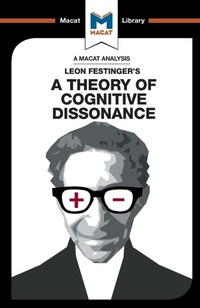
An Analysis of Leon Festinger's A Theory of Cognitive Dissonance
1. Auflage
Erschienen am 15. Juli 2017
Buch
Softcover
96 Seiten
978-1-912127-81-8 (ISBN)
Beschreibung
Leon Festinger's 1957 A Theory of Cognitive Dissonance is a key text in the history of psychology - one that made its author one of the most influential social psychologists of his time. It is also a prime example of how creative thinking and problem solving skills can come together to produce work that changes the way people look at questions for good.
Strong creative thinkers are able to look at things from a new perspective, often to the point of challenging the very frames in which those around them see things. Festinger was such a creative thinker, leading what came to be known as the "cognitive revolution" in social psychology. When Festinger was carrying out his research, the dominant school of thought - behaviorism - focused on outward behaviors and their effects. Festinger, however, turned his attention elsewhere, looking at "cognition:" the mental processes behind behaviors. In the case of "cognitive dissonance", for example, he hypothesized that apparently incomprehensible or illogical behaviors might be caused by a cognitive drive away from dissonance, or internal contradiction. This perspective, however, raised a problem: how to examine and test out cognitive processes. Festinger's book records the results of the psychological experiments he designed to solve that problem. The results helped prove the existence for what is now a fundamental theory in social psychology.
Strong creative thinkers are able to look at things from a new perspective, often to the point of challenging the very frames in which those around them see things. Festinger was such a creative thinker, leading what came to be known as the "cognitive revolution" in social psychology. When Festinger was carrying out his research, the dominant school of thought - behaviorism - focused on outward behaviors and their effects. Festinger, however, turned his attention elsewhere, looking at "cognition:" the mental processes behind behaviors. In the case of "cognitive dissonance", for example, he hypothesized that apparently incomprehensible or illogical behaviors might be caused by a cognitive drive away from dissonance, or internal contradiction. This perspective, however, raised a problem: how to examine and test out cognitive processes. Festinger's book records the results of the psychological experiments he designed to solve that problem. The results helped prove the existence for what is now a fundamental theory in social psychology.
Weitere Details
Reihe
Sprache
Englisch
Verlagsort
London
Großbritannien
Maße
Höhe: 198 mm
Breite: 129 mm
Dicke: 6 mm
Gewicht
112 gr
ISBN-13
978-1-912127-81-8 (9781912127818)
Copyright in bibliographic data and cover images is held by Nielsen Book Services Limited or by the publishers or by their respective licensors: all rights reserved.
Schweitzer Klassifikation
Weitere Ausgaben
Andere Ausgaben
Camille Morvan
A Theory of Cognitive Dissonance
Buch
07/2017
1. Auflage
Macat International Limited
44,68 €
Versand in 3-4 Wochen
Camille Morvan | Alexander O'Connor
An Analysis of Leon Festinger's A Theory of Cognitive Dissonance
E-Book
07/2017
Routledge
8,99 €
Als Download verfügbar
Camille Morvan | Alexander O'Connor
An Analysis of Leon Festinger's A Theory of Cognitive Dissonance
E-Book
07/2017
Routledge
8,99 €
Als Download verfügbar
Person
Dr Camille Morvan is a pyschology researcher and founder of the psychological human resources company Goshaba. She has taught at Sciences Po in Paris and at Harvard University, as well as working at the Ecole Normale Superieure.
Dr Alexander O'Connor did his postgraduate work at the University of California, Berkeley, where he received a PhD for work on social and personality psychology.
Dr Alexander O'Connor did his postgraduate work at the University of California, Berkeley, where he received a PhD for work on social and personality psychology.
Inhalt
Ways In to the Text Who was Leon Festinger? What does A Theory of Cognitive Dissonance Say? Why does A Theory of Cognitive Dissonance Matter? Section 1: Influences Module 1: The Author and the Historical Context Module 2: Academic Context Module 3: The Problem Module 4: The Author's Contribution Section 2: Ideas Module 5: Main Ideas Module 6: Secondary Ideas Module 7: Achievement Module 8: Place in the Author's Work Section 3: Impact Module 9: The First Responses Module 10: The Evolving Debate Module 11: Impact and Influence Today Module 12: Where Next? Glossary of Terms People Mentioned in the Text Works Cited