

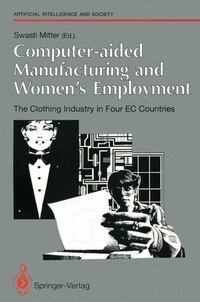
Computer-aided Manufacturing and Women's Employment: The Clothing Industry in Four EC Countries
For the Directorate-General Employment, Social Affairs and Education of the European Communities, June 1990
Erschienen am 11. November 1991
Buch
Softcover
XII, 236 Seiten
978-3-540-19656-3 (ISBN)
Beschreibung
Drawing on the experiences of four major EC countries, this book documents the way computer technology has changed the pattern of women's work in the manufacturing sector. The sixteen contributors are leading authorities on the subject and analyse how technology has transformed employment in the clothing industry, which is still the major employer of female blue-collar workers in the EC. The contributors assess the aspects of computerisation that particularly affect women's employment opportuni- ties: flexible hours, flexible work locations and flexible specialisation. The book also contains evaluations of post-Fordism and human-centred technology, two leading issues in the debate about the applications of artificial intelligence and computer-aided technology. These essays highlight a growing polarisation in the job market and suggest training schemes which can equip women for technical and managerial employment. This is a pioneering work; so far, most of the literature on women and computerisation has focussed on office automation and data processing.
Computer-aided
Manufacturing and Women's Employment
makes an important contribution to the fields of technology, employment, women's work, business management and trade union studies.
Weitere Details
Reihe
Auflage
Softcover reprint of the original 1st ed. 1992
Sprache
Englisch
Verlagsort
London
Großbritannien
Verlagsgruppe
Springer Berlin
Zielgruppe
Für Beruf und Forschung
Research
Illustrationen
XII, 236 p.
Maße
Höhe: 242 mm
Breite: 170 mm
Dicke: 14 mm
Gewicht
438 gr
ISBN-13
978-3-540-19656-3 (9783540196563)
DOI
10.1007/978-1-4471-1837-4
Schweitzer Klassifikation
Weitere Ausgaben
Andere Ausgaben
Swasti Mitter
Computer-aided Manufacturing and Women's Employment: The Clothing Industry in Four EC Countries
For the Directorate-General Employment, Social Affairs and Education of the European Communities, June 1990
E-Book
12/2012
Springer
53,49 €
Als Download verfügbar
Personen
Inhalt
Section I. Introduction.- 1. Introduction.- Section II. The Context.- 2. Reconfiguration of the Market and the Use of Computerised Technology.- Section III. Human-Centred Technology.- 3. On Using Women as Resources: Italian Unions' Strategies Towards Information Technology and New Organisation of Work.- 4. Taylorism or Human-Centred Technology? Evaluating Alternative Paths of Technology in Germany.- Section IV. Organisational Innovations and the Use of Women's Tacit Knowledge.- 5. Benetton Italy: Beyond Fordism and Flexible Specialisation. The Evolution of the Network Firm Model.- 6. Homeworking in Italy in the Age of Computer Technology.- 7. Pronta Moda: The New Business Ventures for Women in Italy.- 8. New Openings for Women in the UK: Design and Craft for Computer-Aided Retailing.- Section V. At the Margin of New Technology.- 9. Technological Gradualism and Minority Women: A Case Study of the British and German Clothing Industries.- 10. An Aspect of Informalisation of Women's Work in a High-Tech Age: Turkish Sweatshops in the Netherlands.- Section VI. New Technology and the Internationalisation of Production.- 11. Technical Developments and Internationalisation of the German Clothing and Knitwear Industry.- 12. Computer-aided Technology and an Emerging International Division of Labour: Prospects for Women.- 13. Rationalisation and Internationalisation of Clothing Firms in the Netherlands: The Case of van Winkel Fashions Company in Budel.- Section VII. On Giving Access to Women.- 14. Why do Women Organise Through Trade Unions in Germany?.- 15. Empowerment or Escape? Technical Training for Homeworkers in Britain.- 16. The Role of Local Intervention: Choices and Agencies for Change.- Section VIII. Some Conclusions.- 17. Restructuring for 1992: Training Women toMeet Shortfalls in Technical and Managerial Skills.- Appendices. Supplementary Material on the Clothing Industries.- Appendix 1. The EC.- Appendix 2. Germany.- Appendix 3. Italy.- Appendix 4. The Netherlands.- Appendix 5. The United Kingdom.