

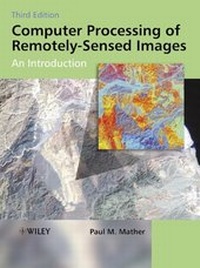
Computer Processing of Remotely-Sensed Images
An Introduction
3. Auflage
Erschienen am 27. April 2004
Buch
Softcover
442 Seiten
978-0-470-84919-4 (ISBN)
Beschreibung
Remotely-sensed images of the Earth's surface provide a valuable source of information about the geographical distribution and properties of natural and cultural features. This fully revised and updated edition of a highly regarded textbook deals with the mechanics of processing remotely-senses images. Presented in an accessible manner, the book covers a wide range of image processing and pattern recognition techniques. Features include:
* New topics on LiDAR data processing, SAR interferometry, the analysis of imaging spectrometer image sets and the use of the wavelet transform.
* An accompanying CD-ROM with:
* updated MIPS software, including modules for standard procedures such as image display, filtering, image transforms, graph plotting, import of data from a range of sensors.
* A set of exercises, including data sets, illustrating the application of discussed methods using the MIPS software.
* An extensive list of WWW resources including colour illustrations for easy download.
For further information, including exercises and latest software information visit the Author's Website at:
http://homepage.ntlworld.com/paul.mather/ComputerProcessing3/
* New topics on LiDAR data processing, SAR interferometry, the analysis of imaging spectrometer image sets and the use of the wavelet transform.
* An accompanying CD-ROM with:
* updated MIPS software, including modules for standard procedures such as image display, filtering, image transforms, graph plotting, import of data from a range of sensors.
* A set of exercises, including data sets, illustrating the application of discussed methods using the MIPS software.
* An extensive list of WWW resources including colour illustrations for easy download.
For further information, including exercises and latest software information visit the Author's Website at:
http://homepage.ntlworld.com/paul.mather/ComputerProcessing3/
Weitere Details
Auflage
3., Auflage
Sprache
Englisch
Verlagsort
Chichester
Großbritannien
Verlagsgruppe
John Wiley and Sons Ltd
Zielgruppe
Für Beruf und Forschung
Editions-Typ
Überarbeitete Ausgabe
Illustrationen
Illustrations
Maße
Höhe: 24.6 cm
Breite: 19 cm
Dicke: 20 mm
Gewicht
761 gr
ISBN-13
978-0-470-84919-4 (9780470849194)
Schweitzer Klassifikation
Weitere Ausgaben
Nachauflagen
Buch
12/2010
4. Auflage
Wiley
Preis leider unbekannt
Artikel ist vergriffen; siehe Neuauflage
Andere Ausgaben
E-Book
12/2005
3. Auflage
Wiley
48,99 €
Als Download verfügbar
Vorauflage
Buch
04/1999
2. Auflage
Wiley
69,90 €
Artikel ist vergriffen; siehe Neuauflage
Inhalt
Preface to the First Edition.
Preface to the Second Edition.
Preface to the Third Edition.
List of Examples.
1. Remote Sensing: Basic Principles.
1.1 Introduction.
1.2 Electromagnetic radiation and its properties.
1.3 Interaction with Earth-surface materials.
1.4 Summary.
2. Remote Sensing Platforms and Sensors.
2.1 Introduction.
2.2 Characteristics of imaging remote sensing instruments.
2.3 Optical, near-infrared and thermal imaging sensors.
2.4 Microwave imaging sensors.
2.5 Summary.
3. Hardware and Software Aspects of Digital Image Processing.
3.1 Introduction.
3.2 Properties of digital remote sensing data.
3.3 MIPS software.
3.4 Summary.
4. Pre-processing of Remotely Sensed Data.
4.1 Introduction.
4.2 Cosmetic operations.
4.3 Geometric correction and registration.
4.4 Atmospheric correction.
4.5 Illumination and view angle effects.
4.6 Sensor calibration.
4.7 Terrain effects.
4.8 Summary.
5. Image Enhancement Techniques.
5.1 Introduction.
5.2 Human visual system.
5.3 Contrast enhancement.
5.4 Pseudocolour enghancement.
5.5 Summary.
6. Image Transforms.
6.1 Introduction.
6.2 Arithmetic operations.
6.3 Empirically based image transforms.
6.4 Principal Components Analysis.
6.5 Hue, Saturation and Intensity (HIS) transform.
6.6 The Discrete Fourier Transform.
6.7 The Discrete Wavelet Transform.
6.8 Summary.
7. Filtering Techniques.
7.1 Introduction.
7.2 Spatial domain low-pass (smoothing) filters.
7.3 Spatial domain high-pass (sharpening) filters.
7.4 Spatial domain edge detectors.
7.5 Frequency domain filters.
7.6 Summary.
8. Classification.
8.1 Introduction.
8.2 Geometrical basis of classification.
8.3 Unsupervised classification.
8.4 Supervised classification.
8.5 Fuzzy classification and linear spectral unmixing.
8.6 Other approaches to image classification.
8.7 Incorporation of non-spectral features.
8.8 Contextual information.
8.9 Feature selection.
8.10 Classification accuracy.
8.11 Summary.
9. Advanced Topics.
9.1 Introduction.
9.2 SAR Interferometry.
9.3 Imaging spectrometry.
9.4 Lidar.
Appendix A: Description of Sample Image Data Sets.
References.
Index.
Preface to the Second Edition.
Preface to the Third Edition.
List of Examples.
1. Remote Sensing: Basic Principles.
1.1 Introduction.
1.2 Electromagnetic radiation and its properties.
1.3 Interaction with Earth-surface materials.
1.4 Summary.
2. Remote Sensing Platforms and Sensors.
2.1 Introduction.
2.2 Characteristics of imaging remote sensing instruments.
2.3 Optical, near-infrared and thermal imaging sensors.
2.4 Microwave imaging sensors.
2.5 Summary.
3. Hardware and Software Aspects of Digital Image Processing.
3.1 Introduction.
3.2 Properties of digital remote sensing data.
3.3 MIPS software.
3.4 Summary.
4. Pre-processing of Remotely Sensed Data.
4.1 Introduction.
4.2 Cosmetic operations.
4.3 Geometric correction and registration.
4.4 Atmospheric correction.
4.5 Illumination and view angle effects.
4.6 Sensor calibration.
4.7 Terrain effects.
4.8 Summary.
5. Image Enhancement Techniques.
5.1 Introduction.
5.2 Human visual system.
5.3 Contrast enhancement.
5.4 Pseudocolour enghancement.
5.5 Summary.
6. Image Transforms.
6.1 Introduction.
6.2 Arithmetic operations.
6.3 Empirically based image transforms.
6.4 Principal Components Analysis.
6.5 Hue, Saturation and Intensity (HIS) transform.
6.6 The Discrete Fourier Transform.
6.7 The Discrete Wavelet Transform.
6.8 Summary.
7. Filtering Techniques.
7.1 Introduction.
7.2 Spatial domain low-pass (smoothing) filters.
7.3 Spatial domain high-pass (sharpening) filters.
7.4 Spatial domain edge detectors.
7.5 Frequency domain filters.
7.6 Summary.
8. Classification.
8.1 Introduction.
8.2 Geometrical basis of classification.
8.3 Unsupervised classification.
8.4 Supervised classification.
8.5 Fuzzy classification and linear spectral unmixing.
8.6 Other approaches to image classification.
8.7 Incorporation of non-spectral features.
8.8 Contextual information.
8.9 Feature selection.
8.10 Classification accuracy.
8.11 Summary.
9. Advanced Topics.
9.1 Introduction.
9.2 SAR Interferometry.
9.3 Imaging spectrometry.
9.4 Lidar.
Appendix A: Description of Sample Image Data Sets.
References.
Index.