

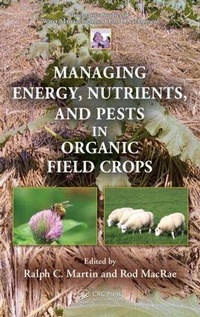
Managing Energy, Nutrients, and Pests in Organic Field Crops
1. Auflage
Erschienen am 7. Februar 2014
Buch
Hardcover
436 Seiten
978-1-4665-6836-5 (ISBN)
Beschreibung
The use of organic management practices in field cropping continues to rise globally, and these methods have proven to be a viable way to produce food with reduced resource use and environmental damage. Managing Energy, Nutrients, and Pests in Organic Field Crops challenges the popular misconception that organic systems are weak at managing energy, nutrients, and pests and shows how innovative farm designs can enhance organic performance. It provides information for assessing the current state of knowledge on organic field cropping and for making the systems more viable.
Each chapter summarizes the latest data from a wide range of sources, creating a comprehensive and coherent picture of the issues and integrating agronomic, economic, and policy aspects. Many chapters also include recent research from the authors. Section I, Soil Health, examines the importance of phosphorus balance, soil fertility, and tillage reduction. Section II, Pest Management, focuses on integrated weed management and long-term approaches to insect management.
Section III, Integrating Approaches, addresses multiple field cropping challenges. Chapters cover the oldest organic rotational trials in Canada, the issue of using cereals bred for conventional systems and more targeted organic cereal breeding strategies, and case studies of a broad spectrum of farming experiences that explore the broader social and ecological landscape. The final section, Economics, Energy, and Policy, examines environmental issues not previously addressed in the text as well as consumer, economic, and rural community matters. It also presents a reprint of an article that describes policies and programs (and their costs) needed to advance adoption of organic farming in Ontario. The text wraps up with key conclusions and a discussion of overarching themes for the book, summarizing the strengths of the available tool box for organic producers and the challenges that remain.
Each chapter summarizes the latest data from a wide range of sources, creating a comprehensive and coherent picture of the issues and integrating agronomic, economic, and policy aspects. Many chapters also include recent research from the authors. Section I, Soil Health, examines the importance of phosphorus balance, soil fertility, and tillage reduction. Section II, Pest Management, focuses on integrated weed management and long-term approaches to insect management.
Section III, Integrating Approaches, addresses multiple field cropping challenges. Chapters cover the oldest organic rotational trials in Canada, the issue of using cereals bred for conventional systems and more targeted organic cereal breeding strategies, and case studies of a broad spectrum of farming experiences that explore the broader social and ecological landscape. The final section, Economics, Energy, and Policy, examines environmental issues not previously addressed in the text as well as consumer, economic, and rural community matters. It also presents a reprint of an article that describes policies and programs (and their costs) needed to advance adoption of organic farming in Ontario. The text wraps up with key conclusions and a discussion of overarching themes for the book, summarizing the strengths of the available tool box for organic producers and the challenges that remain.
Weitere Details
Reihe
Sprache
Englisch
Verlagsort
Bosa Roca
USA
Verlagsgruppe
Taylor & Francis Inc
Zielgruppe
Für Beruf und Forschung
Academic and Professional Reference
Produkt-Hinweis
Fadenheftung
Gewebe-Einband
Illustrationen
38 b/w images and 57 tables
Maße
Höhe: 236 mm
Breite: 157 mm
Dicke: 25 mm
Gewicht
726 gr
ISBN-13
978-1-4665-6836-5 (9781466568365)
Copyright in bibliographic data and cover images is held by Nielsen Book Services Limited or by the publishers or by their respective licensors: all rights reserved.
Schweitzer Klassifikation
Weitere Ausgaben
Andere Ausgaben
Ralph C. Martin | Rod MacRae
Managing Energy, Nutrients, and Pests in Organic Field Crops
Buch
06/2019
1. Auflage
CRC Press
79,00 €
Versand in 15-20 Tagen
Ralph C. Martin | Rod MacRae
Managing Energy, Nutrients, and Pests in Organic Field Crops
E-Book
02/2014
1. Auflage
CRC Press
89,49 €
Als Download verfügbar
Ralph C. Martin | Rod MacRae
Managing Energy, Nutrients, and Pests in Organic Field Crops
E-Book
02/2014
CRC Press
89,49 €
Als Download verfügbar
Personen
Rod MacRae, Ph.D., is an associate professor in the Faculty of Environmental Studies, York University, Toronto, Ontario, Canada. His research focuses on creating a national food and agriculture policy for Canada and the set of coherent and comprehensive programs required to support such a policy. He has published extensively on this topic in the academic and popular press and has also conducted numerous policy analyses for the Canadian organic food sector.
Ralph C. Martin, Ph.D., grew up on a beef and hog farm in Wallenstein, Ontario, Canada. His love of teaching grew unexpectedly when he began teaching at the Nova Scotia Agricultural College, in 1990, and realized how students teach him too. In 2001, he founded the Organic Agriculture Centre of Canada to coordinate university research and education pertaining to organic systems across Canada. In 2011, he was appointed professor and Loblaw Chair in Sustainable Food Production at the University of Guelph.
Ralph C. Martin, Ph.D., grew up on a beef and hog farm in Wallenstein, Ontario, Canada. His love of teaching grew unexpectedly when he began teaching at the Nova Scotia Agricultural College, in 1990, and realized how students teach him too. In 2001, he founded the Organic Agriculture Centre of Canada to coordinate university research and education pertaining to organic systems across Canada. In 2011, he was appointed professor and Loblaw Chair in Sustainable Food Production at the University of Guelph.
Inhalt
Section I: Soil Health. Section II: Pest Management. Section III: Integrating Approaches. Section IV: Economics, Energy, and Policy. Index.