

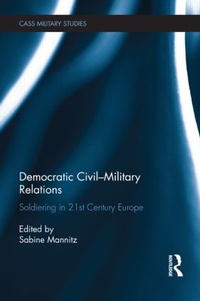
Democratic Civil-Military Relations
Soldiering in 21st Century Europe
1. Auflage
Erschienen am 26. April 2012
Buch
Hardcover
336 Seiten
978-0-415-51646-4 (ISBN)
Beschreibung
This book examines the ways in which European democracies, including former communist states, are dealing with the new demands placed on their security policies since the cold war by transforming their military structures, and the effects this is having on the conceptualisation of soldiering.
In the new security environment, democratic states have called upon their armed forces increasingly to fulfil unconventional tasks - partly civilian, partly humanitarian, and partly military - in most complex, multi-national missions. Not only have military structures been transformed to make them fit for these new types of deployments, but the new mission types highlight the necessity for democracies to come to terms with a new image and ethos of soldiering in defence of a transnational value community.
Combining a qualitative comparison of twelve countries with an interdisciplinary methodology, this edited volume argues that the ongoing transformations of international politics make it necessary for democracies to address both internal and external factors as they shape their own civil-military relations. The issues discussed in this work are informed by Democratic Peace theory, which makes it possible to investigate relations within the state at the same time as analysing the international dimension. This approach gives the book a systematic theoretical framework which distinguishes it from the majority of existing literature on this subject.
This book will be of much interest to students of civil-military relations, European politics, democratisation and post-communist transitions, and IR in general.
In the new security environment, democratic states have called upon their armed forces increasingly to fulfil unconventional tasks - partly civilian, partly humanitarian, and partly military - in most complex, multi-national missions. Not only have military structures been transformed to make them fit for these new types of deployments, but the new mission types highlight the necessity for democracies to come to terms with a new image and ethos of soldiering in defence of a transnational value community.
Combining a qualitative comparison of twelve countries with an interdisciplinary methodology, this edited volume argues that the ongoing transformations of international politics make it necessary for democracies to address both internal and external factors as they shape their own civil-military relations. The issues discussed in this work are informed by Democratic Peace theory, which makes it possible to investigate relations within the state at the same time as analysing the international dimension. This approach gives the book a systematic theoretical framework which distinguishes it from the majority of existing literature on this subject.
This book will be of much interest to students of civil-military relations, European politics, democratisation and post-communist transitions, and IR in general.
Weitere Details
Reihe
Sprache
Englisch
Verlagsort
London
Großbritannien
Verlagsgruppe
Taylor & Francis Ltd
Zielgruppe
Für höhere Schule und Studium
Für Beruf und Forschung
Illustrationen
1 s/w Zeichnung, 9 s/w Tabellen
9 Tables, black and white; 1 Line drawings, black and white
Maße
Höhe: 234 mm
Breite: 156 mm
Gewicht
780 gr
ISBN-13
978-0-415-51646-4 (9780415516464)
Copyright in bibliographic data and cover images is held by Nielsen Book Services Limited or by the publishers or by their respective licensors: all rights reserved.
Schweitzer Klassifikation
Weitere Ausgaben
Andere Ausgaben
Buch
06/2017
1. Auflage
Routledge
76,78 €
Versand in 10-20 Tagen
E-Book
05/2012
1. Auflage
Routledge
64,49 €
Als Download verfügbar
E-Book
05/2012
1. Auflage
Routledge
64,49 €
Als Download verfügbar
Person
Sabine Mannitz is Senior Researcher and Project Director at the Peace Research Institute Frankfurt. She has a PhD from the European University Viadrina in Frankfurt (Oder).
Inhalt
Part I: Introduction 1. Conceptualizations of the Democratic Soldier in 21st-Century Europe: Competing Norms and Practical Tensions Sabine Mannitz Part II: Case studies on Traditional Democracies 2. The Swiss Citizen-Soldier: A Contested Tradition Sabine Mannitz 3. The Ideal Type of the Democratic Soldier in Britain Marco Fey Part III: Case studies on Consolidated Post-Authoritarian Democracies 4. The German Bundeswehr Soldier between Constitutional Settings and Current Tasks Julika Bake and Berthold Meyer 5. The Image of the Spanish Soldier after the Transition to Democracy Eduardo Arranz Bueso and Jose Garcia Caneiro Part IV: Case studies on Post-Socialist Democracies 6. Model and Reality of the Democratic Soldier in the Czech Republic Zdenek Kriz 7. The Ongoing Transformation of the Estonian Defence Forces Leonid A. Karabeshkin 8. The Democratic Soldier in Hungary Andras Racz and Erzsebet N. Rozsa 9. The Lithuanian Reform of the Armed Forces after Independence Grazina Miniotaite 10. The Polish Soldier between National Traditions and International Projection Maria Wagrowska 11. Democratic Soldiering in Romania: From Norms through Policy to Reality Marian Zulean 12. State Building and Images of the Democratic Soldier in Serbia Filip Ejdus 13. The Ukrainian Model of the Democratic Soldier Sergiy Gerasymchuk Part V: Conclusions 14. Transformation Stress: Democratic Soldiers between Ideals and Mission Impossible Harald Mueller