

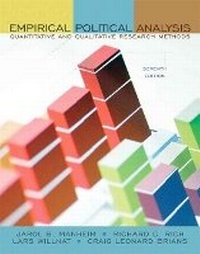
Empirical Political Analysis
Quantitative and Qualitative Research Methods
7. Auflage
Erschienen am 4. September 2007
Buch
Hardcover
448 Seiten
978-0-205-57640-1 (ISBN)
Beschreibung
This comprehensive research methods text introduces students, both concretely and theoretically, to a wide variety of techniques, applications, and concerns that are important to political science research.
Organized around the various stages of the research process, and balancing the competing demands placed on an introductory text, each chapter of the book is planned around a series of substantive questions and enhanced with a series of research exercises that give students practical insights into the important issues raised.
Organized around the various stages of the research process, and balancing the competing demands placed on an introductory text, each chapter of the book is planned around a series of substantive questions and enhanced with a series of research exercises that give students practical insights into the important issues raised.
Weitere Details
Auflage
7th edition
Sprache
Englisch
Verlagsort
New York
USA
Verlagsgruppe
Taylor & Francis Inc
Zielgruppe
Für Beruf und Forschung
Maße
Höhe: 195 mm
Breite: 248 mm
Dicke: 23 mm
Gewicht
912 gr
ISBN-13
978-0-205-57640-1 (9780205576401)
Copyright in bibliographic data and cover images is held by Nielsen Book Services Limited or by the publishers or by their respective licensors: all rights reserved.
Schweitzer Klassifikation
Weitere Ausgaben
Nachauflagen

Craig Leonard Brians | Lars Willnat | Jarol B. Manheim
Empirical Political Analysis
International Edition
Buch
06/2010
8. Auflage
Routledge
185,18 €
Artikel ist vergriffen; siehe Neuauflage
Vorauflage
Jarol B. Manheim | Richard C. Rich | Lars Willnat
Empirical Political Analysis
Research Methods in Political Science
Buch
08/2005
6. Auflage
Routledge
Preis leider unbekannt
Keine Lieferinformation verfügbar
Inhalt
Part I: Introduction.
1. The Research Process.
Part II: Preparing to Do Research.
2. Theory Building: Concepts and Hypotheses in Political Research.
3. Setting the Foundation: Techniques of Systematic Bibliographic Search.
4. Internet Research.
5. From Abstract to Concrete: Operationalization and Measurement.
6. Working from a Plan: Considerations in Research Design.
7. Who, What, Where, When: The Problem of Sampling.
Part III: Quantitative Methods.
8. Survey Research.
9. Scaling Techniques.
10. Content Analysis.
11. Sources and Applications of Aggregate Data.
12. Comparative Research.
13. Social Network Analysis: Finding Structure in a Complex World.
Part IV: Analyzing Quantitative Data.
14. Data Preparation and Data Processing.
15. Describing the Data: The Construction of Tables and Charts.
16. Statistics I: Summarizing Distributions on One Variable.
17. Statistics II: Examining Relationships Between Two Variables.
18. Statistics III: Examining Relationships Among Several Variables.
Part IV: Qualitative Methods.
19. Direct Observation.
20. Focus Group Methodologies.
21. Elite and Specialized Interviewing.
Part V: Conclusion.
22. Writing (and Reading) the Research Report.
23. Overview.
1. The Research Process.
Part II: Preparing to Do Research.
2. Theory Building: Concepts and Hypotheses in Political Research.
3. Setting the Foundation: Techniques of Systematic Bibliographic Search.
4. Internet Research.
5. From Abstract to Concrete: Operationalization and Measurement.
6. Working from a Plan: Considerations in Research Design.
7. Who, What, Where, When: The Problem of Sampling.
Part III: Quantitative Methods.
8. Survey Research.
9. Scaling Techniques.
10. Content Analysis.
11. Sources and Applications of Aggregate Data.
12. Comparative Research.
13. Social Network Analysis: Finding Structure in a Complex World.
Part IV: Analyzing Quantitative Data.
14. Data Preparation and Data Processing.
15. Describing the Data: The Construction of Tables and Charts.
16. Statistics I: Summarizing Distributions on One Variable.
17. Statistics II: Examining Relationships Between Two Variables.
18. Statistics III: Examining Relationships Among Several Variables.
Part IV: Qualitative Methods.
19. Direct Observation.
20. Focus Group Methodologies.
21. Elite and Specialized Interviewing.
Part V: Conclusion.
22. Writing (and Reading) the Research Report.
23. Overview.