

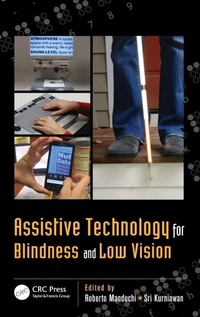
Assistive Technology for Blindness and Low Vision
1. Auflage
Erschienen am 26. Oktober 2012
Buch
Hardcover
441 Seiten
978-1-4398-7153-9 (ISBN)
Beschreibung
Assistive technology has made it feasible for individuals with a wide range of impairments to engage in many activities, such as education and employment, in ways not previously possible. The key factor is to create consumer-driven technologies that solve the problems by addressing the needs of persons with visual impairments. Assistive Technology for Blindness and Low Vision explores a broad range of technologies that are improving the lives of these individuals. Presenting the current state of the art, this book emphasizes what can be learned from past successful products, as well as what exciting new solutions the future holds.
Written by world-class leaders in their field, the chapters cover the physiological bases of vision loss and the fundamentals of orientation, mobility, and information access for blind and low vision individuals. They discuss technology for multiple applications (mobility, wayfinding, information access, education, work, entertainment), including both established technology and cutting-edge research. The book also examines computer and digital media access and the scientific basis for the theory and practice of sensory substitution.
This volume provides a holistic view of the elements to consider when designing assistive technology for persons with visual impairment, keeping in mind the need for a user-driven approach to successfully design products that are easy to use, well priced, and fill a specific need. Written for a broad audience, this book provides a comprehensive overview and in-depth descriptions of current technology for designers, engineers, practitioners, rehabilitation professionals, and all readers interested in the challenges and promises of creating successful assistive technology.
Written by world-class leaders in their field, the chapters cover the physiological bases of vision loss and the fundamentals of orientation, mobility, and information access for blind and low vision individuals. They discuss technology for multiple applications (mobility, wayfinding, information access, education, work, entertainment), including both established technology and cutting-edge research. The book also examines computer and digital media access and the scientific basis for the theory and practice of sensory substitution.
This volume provides a holistic view of the elements to consider when designing assistive technology for persons with visual impairment, keeping in mind the need for a user-driven approach to successfully design products that are easy to use, well priced, and fill a specific need. Written for a broad audience, this book provides a comprehensive overview and in-depth descriptions of current technology for designers, engineers, practitioners, rehabilitation professionals, and all readers interested in the challenges and promises of creating successful assistive technology.
Weitere Details
Reihe
Sprache
Englisch
Verlagsort
Bosa Roca
USA
Verlagsgruppe
Taylor & Francis Inc
Zielgruppe
Für Beruf und Forschung
Designers, engineers, practitioners, and rehabilitation professionals working in the area of assistive technology for visual impairment.
Illustrationen
100 s/w Abbildungen
100 Illustrations, black and white
Maße
Höhe: 240 mm
Breite: 161 mm
Dicke: 28 mm
Gewicht
825 gr
ISBN-13
978-1-4398-7153-9 (9781439871539)
Copyright in bibliographic data and cover images is held by Nielsen Book Services Limited or by the publishers or by their respective licensors: all rights reserved.
Schweitzer Klassifikation
Weitere Ausgaben
Andere Ausgaben
Roberto Manduchi | Sri Kurniawan
Assistive Technology for Blindness and Low Vision
E-Book
09/2018
CRC Press
80,49 €
Als Download verfügbar
Roberto Manduchi | Sri Kurniawan
Assistive Technology for Blindness and Low Vision
E-Book
09/2018
1. Auflage
CRC Press
80,49 €
Als Download verfügbar
Roberto Manduchi | Sri Kurniawan
Assistive Technology for Blindness and Low Vision
Buch
10/2017
1. Auflage
CRC Press
88,50 €
Versand in 10-20 Tagen
Personen
Roberto Manduchi, Ph.D., is a professor of computer engineering at the University of California, Santa Cruz. Before joining UC Santa Cruz in 2001, he worked at Apple Computer, Inc., and at the NASA Jet Propulsion Laboratory, where he conducted research on computer vision for autonomous navigation. His current research interest is in the application of computer vision and sensor processing to assistive technology for people with visual impairment.
Sri Kurniawan, Ph.D., is an associate professor of computer engineering, a faculty member of the Center for Games and Playable Media, and an affiliated faculty of the Digital Arts and New Media at the University of California, Santa Cruz. Her research focuses on human-centered fun and enjoyable interactive systems for health and healthy living. Her current projects include formatting and layout sociotechnical solution for blind authors.
Sri Kurniawan, Ph.D., is an associate professor of computer engineering, a faculty member of the Center for Games and Playable Media, and an affiliated faculty of the Digital Arts and New Media at the University of California, Santa Cruz. Her research focuses on human-centered fun and enjoyable interactive systems for health and healthy living. Her current projects include formatting and layout sociotechnical solution for blind authors.
Inhalt
Introduction. Vision and Vision Rehabilitation. Orientation and Mobility. Low Vision: Types of Vision Loss and Common Effects on Activities of Daily Life. Accessible Global Positioning Systems. Development, Evaluation, and Lessons Learned: A Case Study of Talking Signs (R) Remote Infrared Audible Signage. Evaluating the Effectiveness of Assistive Travel and Wayfinding Devices for Persons Who Are Blind or Visually Impaired. Sensory Substitution of Vision: Importance of Perceptual and Cognitive Processing. Tactile Reading: Tactile Understanding. Camera-Based Access to Visual Information. Screenreaders, Magnifiers, and Other Ways of Using Computers. Tools for Improving Web Accessibility for Blind Persons. Accessible DAISY Multimedia: Making Reading Easier for All. Math and the Blind. Video Games for Users with Visual Impairments. Descriptive Video Services. Employment, Technology, and Blind People: A Personal Perspective.