

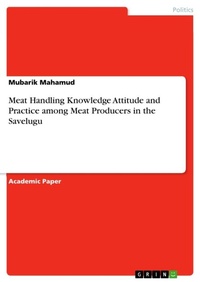
Meat Handling Knowledge Attitude and Practice among Meat Producers in the Savelugu
1. Auflage
Erschienen am 31. Dezember 2023
Buch
Softcover
42 Seiten
978-3-346-99270-3 (ISBN)
Beschreibung
Academic Paper from the year 2023 in the subject Politics - Region: Africa, , language: English, abstract: The purpose of this study is to determine the level of knowledge, attitude and practices towards meat hygiene among butchers in Savelugu in the Savelugu Municipality of the Northern region of Ghana.
Ghana's livestock industry is essential to the country's development and progress economically, as seen by the over 3 million animals sent there each year. Also, the industry contributes to 60% of new job possibilities while also making up 40% and 80% of Ghana's GDP and foreign exchange profits, respectively.
Meat hygiene is most simply defined as the conditions and actions required to guarantee the appropriateness and safety of meat at all points in the supply chain for meat and goods associated to it. The majority of meat inspectors in underdeveloped nations and rural abattoirs lack the necessary skills, expertise, and information to properly assess the hygienic conditions of the organs, meat, and corpses of the killed animals. Although meat contains a high percentage of nutrients, it is frequently contaminated, which can cause food-related ailments in consumers.
In addition, inappropriate handling of food is the main contributor to outbreaks of food-related diseases, including food poisoning. Raw meat is particularly susceptible to contamination. Most often, contamination occurs when food that doesn't need to be cooked, such salad, is prepared on a surface that was previously used to prepare raw meat without being properly cleaned.
Before an animal is killed, it must be carefully examined, and there must be an inspection procedure going on as the animal is being killed. These efforts are very important for preventing animal-related diseases and making sure that the public receives nutritious meat. Many developing nations' slaughterhouses lack sufficient slaughtering and processing equipment, clean water sources, effective sewage or waste disposal systems, and refrigerated facilities. For instance, in Ghana, this has resulted in contaminated meat and inadequate waste disposal practises.
Weitere Details
Auflage
1. Auflage
Sprache
Englisch
Produkt-Hinweis
Broschur/Paperback
Klebebindung
Maße
Höhe: 210 mm
Breite: 148 mm
Dicke: 4 mm
Gewicht
73 gr
ISBN-13
978-3-346-99270-3 (9783346992703)
Copyright in bibliographic data and cover images is held by Nielsen Book Services Limited or by the publishers or by their respective licensors: all rights reserved.
Schweitzer Klassifikation
Weitere Ausgaben
Andere Ausgaben
E-Book
01/2024
GRIN Verlag
15,99 €
Als Download verfügbar