

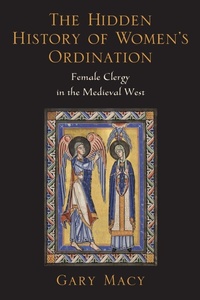
The Hidden History of Women's Ordination
Female Clergy in the Medieval West
Erschienen am 29. November 2012
Buch
Softcover
280 Seiten
978-0-19-994706-5 (ISBN)
Beschreibung
The Roman Catholic leadership still refuses to ordain women officially or even to recognize that women are capable of ordination. But is the widely held assumption that women have always been excluded from such roles historically accurate?
In the early centuries of Christianity, ordination was the process and the ceremony by which one moved to any new ministry (ordo) in the community. By this definition, women were in fact ordained into several ministries. A radical change in the definition of ordination during the eleventh and twelfth centuries not only removed women from the ordained ministry, but also attempted to eradicate any memory of women's ordination in the past. The debate that accompanied this change has left its mark in the literature of the time. However, the triumph of a new definition of ordination as the bestowal of power, particularly the power to confect the Eucharist, so thoroughly dominated western thought and practice by the thirteenth century that the earlier concept of ordination was almost completely erased. The ordination of women, either in the present or in the past, became unthinkable.
References to the ordination of women exist in papal, episcopal and theological documents of the time, and the rites for these ordinations have survived. Yet, many scholars still hold that women, particularly in the western church, were never "really" ordained. A survey of the literature reveals that most scholars use a definition of ordination that would have been unknown in the early middle ages. Thus, the modern determination that women were never ordained, Macy argues, is a premise based on false terms.
Not a work of advocacy, this important book applies indispensable historical background for the ongoing debate about women's ordination.
In the early centuries of Christianity, ordination was the process and the ceremony by which one moved to any new ministry (ordo) in the community. By this definition, women were in fact ordained into several ministries. A radical change in the definition of ordination during the eleventh and twelfth centuries not only removed women from the ordained ministry, but also attempted to eradicate any memory of women's ordination in the past. The debate that accompanied this change has left its mark in the literature of the time. However, the triumph of a new definition of ordination as the bestowal of power, particularly the power to confect the Eucharist, so thoroughly dominated western thought and practice by the thirteenth century that the earlier concept of ordination was almost completely erased. The ordination of women, either in the present or in the past, became unthinkable.
References to the ordination of women exist in papal, episcopal and theological documents of the time, and the rites for these ordinations have survived. Yet, many scholars still hold that women, particularly in the western church, were never "really" ordained. A survey of the literature reveals that most scholars use a definition of ordination that would have been unknown in the early middle ages. Thus, the modern determination that women were never ordained, Macy argues, is a premise based on false terms.
Not a work of advocacy, this important book applies indispensable historical background for the ongoing debate about women's ordination.
Rezensionen / Stimmen
Here is a truly groundbreaking book, essential reading for anyone interested in the complex story of how the ministry of women has been valued (and devalued) within the Christian church. Gary Macy convincingly demonstrates that in the early church women were ordained into various roles, but in the eleventh and twelfth centuries a new definition of ordination was rigorously applied, which served to exclude them. This study is of crucial importance not only for an understanding of the development of medieval Christianity but also for the material it brings to contemporary debate on the ordination of women. * Alistair Minnis, Yale University *Weitere Details
Sprache
Englisch
Verlagsort
New York
USA
Zielgruppe
Für höhere Schule und Studium
Maße
Höhe: 234 mm
Breite: 156 mm
Dicke: 17 mm
Gewicht
474 gr
ISBN-13
978-0-19-994706-5 (9780199947065)
Copyright in bibliographic data and cover images is held by Nielsen Book Services Limited or by the publishers or by their respective licensors: all rights reserved.
Schweitzer Klassifikation
Weitere Ausgaben
Andere Ausgaben
Buch
12/2007
Oxford University Press Inc
78,40 €
Versand in 15-20 Tagen
E-Book
11/2007
1. Auflage
OUP eBook
21,99 €
Als Download verfügbar
E-Book
11/2007
1. Auflage
OUP eBook
21,99 €
Als Download verfügbar
Person
Gary Macy is John Nobili, S.J. Professor of Theology in the Department of Religious Studies at Santa Clara University.
Inhalt
Abbreviations ; 1. The State of the Question ; 2. What Did Ordination Mean? ; 3. The Ministry of Ordained Women ; 4. Defining Women Out of Ordination ; 5. Conclusion ; Historical and Theological Postscript ; Appendix 1: Prayers and Rites for the Ordination of a Deaconess ; Appendix 2: Ordination Rites for Abbesses from the Early Middle Ages ; Notes ; Bibliography