

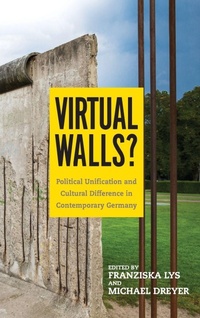
Virtual Walls?
Political Unification and Cultural Difference in Contemporary Germany
Erschienen am 8. Dezember 2017
Buch
Hardcover
212 Seiten
978-1-57113-980-1 (ISBN)
Beschreibung
A reassessment of the journey Germans in East and West have taken during the past two and a half decades: even today, an open-ended, unfinished journey.
On October 3, 1990, just a year after the Berlin Wall fell, the German Democratic Republic was absorbed into the Federal Republic of Germany, officially ceasing to exist. What was the GDR and how do we remember it? According to the dominant Western narrative, it was a country that brought neither unity nor justice nor freedom to its citizens. But if so, why does a virtual wall still seem to exist in Germany today between the erstwhile citizens of the GDR and FRG? The GDR very much remains in the public debate, and while political integration is well on its way, the cultural integration of the two former states has proven much more challenging.
This volume analyzes the culturaltransformation - or lack thereof - that has followed political unification. The contributions are interdisciplinary: essays on history and politics provide a framework and others on art, film, literature, museums, music, and education provide specific examples. These case studies allow us to examine the state of unification beyond statistics, opinion polls, and glib generalizations. The volume, then, is a reassessment of the journey Germans in East and West have taken during the past two and a half decades. Even today, it is an open-ended, unfinished journey. But such journeys tend to be the most interesting.
Contributors: Kerstin Barndt, Stephen Brockmann, Michael Dreyer, Andreas Eis, April A. Eisman, Peter Hayes, Franziska Lys, Charles S. Maier, Andreas Niederberger, Mary-Elizabeth O'Brien, Daniel Ortuno-Stuehring.
Franziska Lys is Professor of German at Northwestern University. Michael Dreyer is Professor in the Institute for Political Science at the University of Jena.
On October 3, 1990, just a year after the Berlin Wall fell, the German Democratic Republic was absorbed into the Federal Republic of Germany, officially ceasing to exist. What was the GDR and how do we remember it? According to the dominant Western narrative, it was a country that brought neither unity nor justice nor freedom to its citizens. But if so, why does a virtual wall still seem to exist in Germany today between the erstwhile citizens of the GDR and FRG? The GDR very much remains in the public debate, and while political integration is well on its way, the cultural integration of the two former states has proven much more challenging.
This volume analyzes the culturaltransformation - or lack thereof - that has followed political unification. The contributions are interdisciplinary: essays on history and politics provide a framework and others on art, film, literature, museums, music, and education provide specific examples. These case studies allow us to examine the state of unification beyond statistics, opinion polls, and glib generalizations. The volume, then, is a reassessment of the journey Germans in East and West have taken during the past two and a half decades. Even today, it is an open-ended, unfinished journey. But such journeys tend to be the most interesting.
Contributors: Kerstin Barndt, Stephen Brockmann, Michael Dreyer, Andreas Eis, April A. Eisman, Peter Hayes, Franziska Lys, Charles S. Maier, Andreas Niederberger, Mary-Elizabeth O'Brien, Daniel Ortuno-Stuehring.
Franziska Lys is Professor of German at Northwestern University. Michael Dreyer is Professor in the Institute for Political Science at the University of Jena.
Rezensionen / Stimmen
The essays succeed both in presenting a mass of material and in raising questions that will interest anyone concerned with contemporary Germany...A very good basis for a student seminar at either undergraduate or graduate level. * JOURNAL OF EUROPEAN STUDIES *Weitere Details
Reihe
Sprache
Englisch
Verlagsort
Columbia, MD
USA
Verlagsgruppe
Boydell & Brewer Ltd
Zielgruppe
Für Beruf und Forschung
Produkt-Hinweis
Gewebe-Einband
Illustrationen
8 s/w Abbildungen
9 b/w illus.
Maße
Höhe: 235 mm
Breite: 157 mm
Dicke: 17 mm
Gewicht
502 gr
ISBN-13
978-1-57113-980-1 (9781571139801)
Copyright in bibliographic data and cover images is held by Nielsen Book Services Limited or by the publishers or by their respective licensors: all rights reserved.
Schweitzer Klassifikation
Weitere Ausgaben
Personen
APRIL A. EISMAN is Professor of Art History at Iowa State University. STEPHEN BROCKMANN is Professor of German with courtesy appointments in English and History at Carnegie Mellon University.
Inhalt
Introduction: United Politics-Divided Culture? - Franziska Lys and Michael Dreyer
Lost in Transition: Reflections on the Spectral History of the GDR - Charles S. Maier
Reconstituting the Federal Republic? Constitutional Law and Politics before and since 1989 - Andreas Niederberger
East German Literature and Reunification: Continuities and Discontinuities - Stephen Brockmann
The Afterlife of the GDR in Post-Wall German Cinema - Mary-Elizabeth O'Brien
Exhibiting 1989/2009: Memory, Affect, and the Politics of History - Kerstin Barndt
Reexamining the Staatskuenstler Myth: Bernhard Heisig and the Post-Wall Reception of East German Painting - April A. Eisman
East German Orchestras and Theaters: The Transformation since the Wende - Daniel Ortuno-Stuehring
What Do German High School Students Think about the GDR? Memory Culture between Glorification and Evaluation - Andreas Eis
The Ongoing Significance of East Germany and the Wende Narrative in Public Discourse - Michael Dreyer
Epilogue: The Wende and the End of "the German Problem" - Peter Hayes
Notes on the Contributors
Index
Lost in Transition: Reflections on the Spectral History of the GDR - Charles S. Maier
Reconstituting the Federal Republic? Constitutional Law and Politics before and since 1989 - Andreas Niederberger
East German Literature and Reunification: Continuities and Discontinuities - Stephen Brockmann
The Afterlife of the GDR in Post-Wall German Cinema - Mary-Elizabeth O'Brien
Exhibiting 1989/2009: Memory, Affect, and the Politics of History - Kerstin Barndt
Reexamining the Staatskuenstler Myth: Bernhard Heisig and the Post-Wall Reception of East German Painting - April A. Eisman
East German Orchestras and Theaters: The Transformation since the Wende - Daniel Ortuno-Stuehring
What Do German High School Students Think about the GDR? Memory Culture between Glorification and Evaluation - Andreas Eis
The Ongoing Significance of East Germany and the Wende Narrative in Public Discourse - Michael Dreyer
Epilogue: The Wende and the End of "the German Problem" - Peter Hayes
Notes on the Contributors
Index