

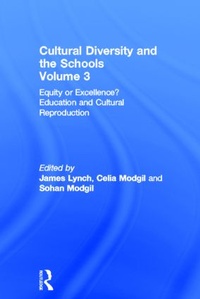
Equity Or Excellence? Educ & C
1. Auflage
Erschienen am 3. September 1992
Buch
Hardcover
310 Seiten
978-1-85000-993-1 (ISBN)
Beschreibung
First published in 1992. The books aim to engage with a broad audience, aiming at new 'laicized' paradigms of understanding, capable of being shared with a wider international public. This series of books is committed to the premise that racism and all other forms of negative prejudice are detrimental to a harmonious and healthy pluralist world society, and that it is the duty of all good democratic citizens to combat them, but that there are many valid routes by which such prejudice can be challenged, and that there are other kinds of prejudice and abuse which must also be combatted. This is the third volume in a series of four books, dedicated to a re-examination of cultural diversity and its implications for education and schooling.
Weitere Details
Sprache
Englisch
Verlagsort
London
Großbritannien
Verlagsgruppe
Taylor & Francis Ltd
Zielgruppe
Für höhere Schule und Studium
Für Beruf und Forschung
Maße
Höhe: 234 mm
Breite: 156 mm
Gewicht
960 gr
ISBN-13
978-1-85000-993-1 (9781850009931)
Copyright in bibliographic data and cover images is held by Nielsen Book Services Limited or by the publishers or by their respective licensors: all rights reserved.
Schweitzer Klassifikation
Weitere Ausgaben
Andere Ausgaben
James Lynch | Celia Modgil | Sohan Modgil
Equity Or Excellence? Educ & C
E-Book
07/2014
Routledge
73,49 €
Als Download verfügbar
James Lynch | Celia Modgil | Sohan Modgil
Equity Or Excellence? Educ & C
E-Book
07/2014
Routledge
73,49 €
Als Download verfügbar
Personen
James Lynch works for the World Bank in Washington, specializing in education projects in least developed countries in Asia. Celia Modgil is Senior Lecturer and Head of Department of Undergraduate Teacher Education at Goldsmith's College, University of London. Sohan Modgil is Reader in Educational Research and Development at Brighton Polytechnic.
Inhalt
Introduction Editors' Introduction, James Lynch, Celia Modgil, Sohan Modgil; Part 1 Discrimination and Inequality; Chapter 1 Employment, Education and Discrimination, John Eggleston; Chapter 2 Immigration, Ghettoization and Educational Opportunity, Martine Abdallah-Pretceille; Chapter 3 Immigration, Marginalization and Educational Opportunity, Micheline C. Rey-von Allmen; Chapter 3a Interchange; Chapter 4 The Dominant Nation: Subordinated Nations and Racial Inequalities, Jagdish Gundara; Part 2 Discrimination, Schooling and Achievement; Chapter 5 Schooling and Gender: The Cycle of Discrimination, Rosemary Deem; Chapter 6 Schooling and the Reproduction of Gender Relations, Sue Middleton; Chapter 6a Interchange; Chapter 7 Social Class, School Effectiveness and Cultural Diversity, Brian Davies; Chapter 8 Locus of Control, Academic Achievement and Fostering Internality, James Vasquez; Chapter 9 Cognitive Style and Academic Attainment, James Vasquez; Part 3 Values, Ideology and Social Justice; Chapter 10 Disproportionality, Education and Social Justice, Lois Weis; Chapter 11 'Nations at Risk' and 'National Curriculum': Ideology and Identity, Ivor Goodson; Chapter 12 Antiracism versus New Multiculturalism: Moving beyond the Interminable Debate, Mal Leicester; Chapter 13 Freedom of Speech in the Multicultural Society, Chris Wilkins; Chapter 13a Interchange; Chapter 14 British Values, Liberal Values or Values of Justice and Equality: Three Approaches to Education in Multicultural Britain, Mike Cole; Chapter 14a Interchange; epilogue Epilogue; Chapter 0 The Dilemma for Cultural Diversity: Education for Equity and Excellence, James Lynch, Celia Modgil, Sohan Modgil;