

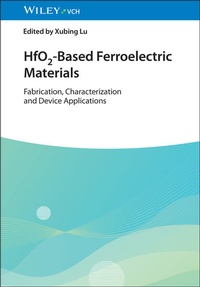
HfO2-Based Ferroelectric Materials
Fabrication, Characterization and Device Applications
1. Auflage
Erscheint ca. am 24. Juni 2026
Buch
Hardcover
480 Seiten
978-3-527-35318-7 (ISBN)
Beschreibung
Explores HfO2-based ferroelectrics for memory, sensing, and advanced electronic applications
Ferroelectric hafnium oxide (HfO2)-based materials have transformed the field of electronic materials and device design, offering pathways to overcome long-standing barriers in scalability, compatibility, and reliability. The emergence of robust ferroelectricity in doped HfO2 has revolutionized both research and industry perspectives, providing a viable solution where conventional ferroelectrics often fell short.
With contributions from leading experts, HfO2-Based Ferroelectric Materials addresses the critical need for a consolidated reference on HfO2-based ferroelectrics, offering foundational knowledge as well as the latest insights into fabrication, material characterization, and device integration. The book opens with fundamentals of ferroelectricity and the mechanisms driving HfO2-based ferroelectric behavior, before progressing to detailed examinations of deposition techniques, superlattice structures, and reliability considerations. It further explores a broad spectrum of applications, including non-volatile memories, neuromorphic computing, compute-in-memory architectures, and negative capacitance transistors, alongside emerging roles in energy storage, microwave technologies, and piezoelectric systems. Special attention is given to persistent challenges?such as the wake-up effect, fatigue, and imprint issues?and the strategies developed to mitigate them.
An authoritative and well-structured resource for advancing the frontiers of electronic materials and device technologies, HfO2-Based Ferroelectric Materials:
* Explains the origins of ferroelectricity in doped HfO2 and its unique material advantages
* Details deposition techniques and approaches to regulating ferroelectric behavior
* Examines device-level challenges, including wake-up effect, fatigue, and imprint reliability
* Highlights applications spanning non-volatile memories, neuromorphic computing, and energy-efficient devices
* Discusses advanced designs such as superlattice-like laminate structures and 3D ferroelectric memories
* Provides insight into the reliability of HfO2-based thin films, capacitors, and field-effect transistors
HfO2-Based Ferroelectric Materials: Fabrication, Characterization, and Device Applications is an essential resource for materials scientists, electronics engineers, semiconductor and solid-state physicists, and professionals in the semiconductor and sensor industries. It is also a valuable reference for graduate-level courses in electronic materials, semiconductor devices, and advanced nanotechnology within physics, materials science, and electrical engineering degree programs.
Ferroelectric hafnium oxide (HfO2)-based materials have transformed the field of electronic materials and device design, offering pathways to overcome long-standing barriers in scalability, compatibility, and reliability. The emergence of robust ferroelectricity in doped HfO2 has revolutionized both research and industry perspectives, providing a viable solution where conventional ferroelectrics often fell short.
With contributions from leading experts, HfO2-Based Ferroelectric Materials addresses the critical need for a consolidated reference on HfO2-based ferroelectrics, offering foundational knowledge as well as the latest insights into fabrication, material characterization, and device integration. The book opens with fundamentals of ferroelectricity and the mechanisms driving HfO2-based ferroelectric behavior, before progressing to detailed examinations of deposition techniques, superlattice structures, and reliability considerations. It further explores a broad spectrum of applications, including non-volatile memories, neuromorphic computing, compute-in-memory architectures, and negative capacitance transistors, alongside emerging roles in energy storage, microwave technologies, and piezoelectric systems. Special attention is given to persistent challenges?such as the wake-up effect, fatigue, and imprint issues?and the strategies developed to mitigate them.
An authoritative and well-structured resource for advancing the frontiers of electronic materials and device technologies, HfO2-Based Ferroelectric Materials:
* Explains the origins of ferroelectricity in doped HfO2 and its unique material advantages
* Details deposition techniques and approaches to regulating ferroelectric behavior
* Examines device-level challenges, including wake-up effect, fatigue, and imprint reliability
* Highlights applications spanning non-volatile memories, neuromorphic computing, and energy-efficient devices
* Discusses advanced designs such as superlattice-like laminate structures and 3D ferroelectric memories
* Provides insight into the reliability of HfO2-based thin films, capacitors, and field-effect transistors
HfO2-Based Ferroelectric Materials: Fabrication, Characterization, and Device Applications is an essential resource for materials scientists, electronics engineers, semiconductor and solid-state physicists, and professionals in the semiconductor and sensor industries. It is also a valuable reference for graduate-level courses in electronic materials, semiconductor devices, and advanced nanotechnology within physics, materials science, and electrical engineering degree programs.
Weitere Details
Weitere Ausgaben
Andere Ausgaben
E-Book
05/2026
1. Auflage
Wiley-VCH
151,99 €
Als Download verfügbar
E-Book
05/2026
1. Auflage
Wiley-VCH
151,99 €
Als Download verfügbar
Person
Xubing Lu is a professor in South China Normal University. He received his PhD degree in Physics from Nanjing University in 2002. From 2002 to 2010, he worked as postdoctoral researcher, JSPS research fellow and Humbolt experienced researcher in several universities and research institutions in China and abroad. He has been working at South China Normal University as a full professor since 2010. His research focuses on high-dielectric materials, ferroelectric materials, and their applications in nonvolatile memory devices. Professor Lu has authored over 250 scientific publications, one book chapter, and more than 20 Chinese patents.
Inhalt
Chapter 1 Fundamentals of ferroelectricity and ferroelectric materials
Chapter 2 Oxygen Vacancy-induced Ferroelectricity in HfO2
Chapter 3 Origin and Multiple Regulations of Ferroelectric Properties in HfO2-Based Materials
Chapter 4 Design of HfO2 ferroelectric materials with superlattice-like laminate structure
Chapter 5 High energy-efficiency computing applications for HfO2-based ferroelectric materials
Chapter 6 1T1C HfO2 FeRAM Materials
Chapter 7 3D Ferroelectric Capacitor Memories for Data-Centric Computing
Chapter 8 Basic Mechanism of Si-channel HfO2-FeFET and its reliability
Chapter 9 Reliability of the Hafnia-based Ferroelectric Memory
Chapter 10 Reliability of HfO2-based ferroelectric thin films and field-effect transistors
Chapter 11 Hafnia-based Materials for Neuromorphic Devices
Chapter 13 HfO2-based Ferroelectric Materials for Energy Storage Applications
Chapter 14 HfO2-based Ferroelectric Materials for Piezoelectric Applications
Chapter 2 Oxygen Vacancy-induced Ferroelectricity in HfO2
Chapter 3 Origin and Multiple Regulations of Ferroelectric Properties in HfO2-Based Materials
Chapter 4 Design of HfO2 ferroelectric materials with superlattice-like laminate structure
Chapter 5 High energy-efficiency computing applications for HfO2-based ferroelectric materials
Chapter 6 1T1C HfO2 FeRAM Materials
Chapter 7 3D Ferroelectric Capacitor Memories for Data-Centric Computing
Chapter 8 Basic Mechanism of Si-channel HfO2-FeFET and its reliability
Chapter 9 Reliability of the Hafnia-based Ferroelectric Memory
Chapter 10 Reliability of HfO2-based ferroelectric thin films and field-effect transistors
Chapter 11 Hafnia-based Materials for Neuromorphic Devices
Chapter 13 HfO2-based Ferroelectric Materials for Energy Storage Applications
Chapter 14 HfO2-based Ferroelectric Materials for Piezoelectric Applications