

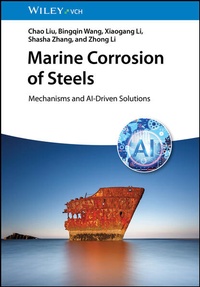
Marine Corrosion of Steels
Mechanisms and AI-Driven Solutions
1. Auflage
Erschienen am 15. April 2026
Buch
Hardcover
608 Seiten
978-3-527-35593-8 (ISBN)
Beschreibung
This book investigates the corrosion mechanisms and resistance regulation of commonly used engineering steels, such as low-alloy steel rebar, high-manganese steel, low-density steel, titanium-steel composite plates, ductile iron, and high-performance corrosion-resistant offshore steel. It analyzes the corrosion behavior and key influencing factors of these materials. It further explores the regulation of corrosion resistance in steel materials and the development of novel corrosion-resistant steels using a new evaluation method. More importantly, it combines corrosion big data technology and artificial intelligence to assess the corrosion resistance of steel materials, providing crucial support for developing new corrosion-resistant materials. This book offers cutting-edge insights and practical solutions for enhancing the corrosion resistance of engineering steels, making it a valuable resource for materials scientists, researchers, and engineers.
Weitere Details
Weitere Ausgaben
Andere Ausgaben
E-Book
03/2026
1. Auflage
Wiley-VCH
178,99 €
Als Download verfügbar
E-Book
03/2026
1. Auflage
Wiley-VCH
178,99 €
Als Download verfügbar
Personen
Chao Liu is a professor at the Institute of Advanced Materials and Technology, University of Science and Technology Beijing. After obtaining his PhD degree from University of Science and Technology Beijing, he stayed in the university as a teacher and visited VUB in Brussels, Belgium and Massachusetts Institute of Technology (MIT) in the United States successively. Based on the major national strategies and the practical needs of material corrosion protection, he has been carrying out research work on the theory and application of the frontiers of micro-zone electrochemical technology for localised corrosion of materials, the theory and technology of corrosion big data, and the research and development of corrosion-resistant new materials. He has published more than 60 SCI papers and won several scientific awards.
Bingqin Wang is an assistant researcher at the Institute of Advanced Materials snd Technology, University of Science and Technology Beijing. After earning his PhD degree from University of Science and Technology Beijing, he has been engaged in research work centered on corrosion big data technology. He has discovered the dynamic evolution law of weathering steel rust layers and the critical temperature of atmospheric corrosion that affects the protective performance of rust layers. Additionally, he has developed corrosion image big data technology, successfully achieving atmospheric corrosion prediction under multi-modal conditions and quantification of the protective performance of rust layers. He has published more than 20 SCI papers and won several scientific awards.
Xiaogang Li is a professor at the University of Science and Technology Beijing. He holds several leadership roles in prominent academic and professional organizations. His research interests include material corrosion theory, development of corrosion-resistant new steel grades, and improving the performance of traditional weathering steel. He has received many scientific and technological awards, including the NACE International Outstanding Engineering Contribution Award and the National Outstanding Engineer Award.
Shasha Zhang is an engineer at the School of Advanced Engineering at the University of Science and Technology Beijing. Based on the national artificial intelligence technology development strategy and the actual needs of material corrosion protection, she has been dedicated to research in artificial intelligence and Internet of Things (IoT) technology, the application of artificial intelligence technology in material corrosion detection, and the theory and technology of corrosion big data. Her academic contributions include three published papers, two authored books, and multiple awards in science and technology competitions.
Zhong Li is an associate professor in the Institute for advanced Materials and Technology, University of Science and Technology Beijing. Her graduated from Harbin Engineering University for Bachelor of Science, University of Calgary for Master degree and Ohio University for Ph. D degree. She was employed in Institute of corrosion control systems engineering. Her research work focusses on the theory and behavior of microbiologically induced corrosion, theory and behavior of stress corrosion cracking, the theory and technology of corrosion big data and the research and development of advanced materials for microbiologically induced corrosion resistance. She has published more than 20 SCI papers and won several scientific awards.
Bingqin Wang is an assistant researcher at the Institute of Advanced Materials snd Technology, University of Science and Technology Beijing. After earning his PhD degree from University of Science and Technology Beijing, he has been engaged in research work centered on corrosion big data technology. He has discovered the dynamic evolution law of weathering steel rust layers and the critical temperature of atmospheric corrosion that affects the protective performance of rust layers. Additionally, he has developed corrosion image big data technology, successfully achieving atmospheric corrosion prediction under multi-modal conditions and quantification of the protective performance of rust layers. He has published more than 20 SCI papers and won several scientific awards.
Xiaogang Li is a professor at the University of Science and Technology Beijing. He holds several leadership roles in prominent academic and professional organizations. His research interests include material corrosion theory, development of corrosion-resistant new steel grades, and improving the performance of traditional weathering steel. He has received many scientific and technological awards, including the NACE International Outstanding Engineering Contribution Award and the National Outstanding Engineer Award.
Shasha Zhang is an engineer at the School of Advanced Engineering at the University of Science and Technology Beijing. Based on the national artificial intelligence technology development strategy and the actual needs of material corrosion protection, she has been dedicated to research in artificial intelligence and Internet of Things (IoT) technology, the application of artificial intelligence technology in material corrosion detection, and the theory and technology of corrosion big data. Her academic contributions include three published papers, two authored books, and multiple awards in science and technology competitions.
Zhong Li is an associate professor in the Institute for advanced Materials and Technology, University of Science and Technology Beijing. Her graduated from Harbin Engineering University for Bachelor of Science, University of Calgary for Master degree and Ohio University for Ph. D degree. She was employed in Institute of corrosion control systems engineering. Her research work focusses on the theory and behavior of microbiologically induced corrosion, theory and behavior of stress corrosion cracking, the theory and technology of corrosion big data and the research and development of advanced materials for microbiologically induced corrosion resistance. She has published more than 20 SCI papers and won several scientific awards.
Inhalt
Chapter 1. Stress corrosion behavior of high manganese steel in polluted marine atmospheric environments.
Chapter 2.Corrosion fatigue behavior of high manganese steel in atmospheric environment.
Chapter 3.Effect of Microalloying Elements on The Corrosion Resistance of Low-Density Steel.
Chapter 4. Coupling of Multiple Corrosion in the Corrosion Process of Titanium-Steel Composites .
Chapter 5.Effects of Corrosion Inhibitors and Flow rate on the Corrosion Resistance of Ductile Iron Pipes.
Chapter 6. Application of Novel Big Data Intelligent Corrosion Assessment Approach in Rebar Corrosion Resistance Modulation.
Chapter 7.Application of Novel Big Data Intelligent Corrosion Assessment Approach in blast furnace gas pipe steel corrosion resistance Analysis.
Chapter 8. Application of Novel Big Data Intelligent Corrosion Assessment Approach in Corrosion-Resistant Low Alloy Steel Development.
Chapter 9. Application of Novel Big Data Intelligent Corrosion Assessment Approach in Corrosion Prediction and Data Mining Modeling.
Chapter 10. Perspectives on the Application of Artificial Intelligence in Investigating Corrosion Mechanisms of Steel and Designing Corrosion-Resistant Alloys.
Chapter 2.Corrosion fatigue behavior of high manganese steel in atmospheric environment.
Chapter 3.Effect of Microalloying Elements on The Corrosion Resistance of Low-Density Steel.
Chapter 4. Coupling of Multiple Corrosion in the Corrosion Process of Titanium-Steel Composites .
Chapter 5.Effects of Corrosion Inhibitors and Flow rate on the Corrosion Resistance of Ductile Iron Pipes.
Chapter 6. Application of Novel Big Data Intelligent Corrosion Assessment Approach in Rebar Corrosion Resistance Modulation.
Chapter 7.Application of Novel Big Data Intelligent Corrosion Assessment Approach in blast furnace gas pipe steel corrosion resistance Analysis.
Chapter 8. Application of Novel Big Data Intelligent Corrosion Assessment Approach in Corrosion-Resistant Low Alloy Steel Development.
Chapter 9. Application of Novel Big Data Intelligent Corrosion Assessment Approach in Corrosion Prediction and Data Mining Modeling.
Chapter 10. Perspectives on the Application of Artificial Intelligence in Investigating Corrosion Mechanisms of Steel and Designing Corrosion-Resistant Alloys.