

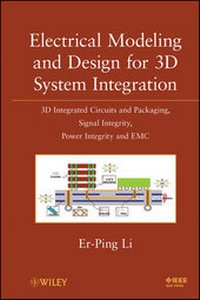
Electrical Modeling and Design for 3D System Integration
3D Integrated Circuits and Packaging, Signal Integrity, Power Integrity and EMC
Erscheint ca. am 19. April 2012
Buch
Hardcover
384 Seiten
978-0-470-62346-6 (ISBN)
Beschreibung
The first book to address electromagnetic modeling methodologies for analysis of the large complex electronic structures, Efficient Electromagnetic Modeling for High Speed Electronics systematically reviews a series of fast and efficient electromagnetic modeling techniques. The book presents a number of special methods to solve the SI, PI, and EMI problems and provides an overview of the existing electromagnetic modeling methods used in electronic chips, package, and PCB. The text also addresses the limitations individuals in the real-world engineering community face for design engineers, researchers, postgraduates, postdoctoral researchers, university professors, and consultants.
Weitere Details
Produkt-Info
gebunden
Auflage
1. Auflage
Sprache
Englisch
Verlagsort
USA
Verlagsgruppe
John Wiley & Sons Inc
Zielgruppe
Für Beruf und Forschung
Produkt-Hinweis
Fadenheftung
Pappband
Illustrationen
Photos: 50 B&W, 0 Color; Drawings: 50 B&W, 0 Color; Graphs: 20 B&W, 0 Color
Maße
Höhe: 241 mm
Breite: 162 mm
Dicke: 30 mm
Gewicht
784 gr
ISBN-13
978-0-470-62346-6 (9780470623466)
Schweitzer Klassifikation
Weitere Ausgaben
Andere Ausgaben
Er-Ping Li
Electrical Modeling and Design for 3D System Integration
3D Integrated Circuits and Packaging, Signal Integrity, Power Integrity and EMC
E-Book
03/2012
Wiley-IEEE Press
115,99 €
Als Download verfügbar
Er-Ping Li
Electrical Modeling and Design for 3D System Integration
3D Integrated Circuits and Packaging, Signal Integrity, Power Integrity and EMC
E-Book
03/2012
Wiley-IEEE Press
111,99 €
Als Download verfügbar
Person
ER-PING LI, PhD, holds an appointment as Chair Professor at Zhejiang University, China, and has also been a principal scientist and director at the Institute of High Performance Computing, Singapore. He is a Fellow of the IEEE and a Fellow of the Electromagnetics Academy. He has received numerous awards and honors in recognition of his professional work from the IEEE and other professional bodies. Dr. Li is a pioneer in the modeling and simulation for signal/power and EMC in integrated circuits and electronic systems packaging. He has chaired or spoken at numerous international conferences and universities, and has also served as editor to several IEEE Transactions.
Inhalt
Foreword xi
Preface xiii
1. Introduction 1
1.1 Introduction of Electronic Package Integration, 1
1.2 Review of Modeling Technologies, 6
1.3 Organization of the Book, 10
2. Macromodeling of Complex Interconnects in 3D Integration 16
2.1 Introduction, 16
2.2 Network Parameters: Impedance, Admittance, and Scattering Matrices, 19
2.3 Rational Function Approximation with Partial Fractions, 25
2.4 Vector Fitting (VF) Method, 29
2.5 Macromodel Synthesis, 41
2.6 Stability, Causality, and Passivity of Macromodel, 48
2.7 Macromodeling Applied to High-Speed Interconnects and Circuits, 79
2.8 Conclusion, 91
3. 2.5D Simulation Method for 3D Integrated Systems 97
3.1 Introduction, 97
3.2 Multiple Scattering Method for Electronic Package Modeling with Open Boundary Problems, 98
3.3 Novel Boundary Modeling Method for Simulation of Finite-Domain Power-Ground Planes, 127
3.4 Numerical Simulations for Finite Structures, 133
3.5 Modeling of 3D Electronic Package Structure, 142
3.6 Conclusion, 182
4. Hybrid Integral Equation Modeling Methods for 3D Integration 185
4.1 Introduction, 185
4.2 2D Integral Equation Equivalent Circuit (IEEC) Method, 186
4.3 3D Hybrid Integral Equation Method, 220
4.4 Conclusion, 238
5. Systematic Microwave Network Analysis for 3D Integrated Systems 241
5.1 Intrinsic Via Circuit Model for Multiple Vias in an Irregular Plate Pair, 242
5.2 Parallel Plane Pair Model, 281
5.3 Cascaded Multiport Network Analysis of Multilayer Structure with Multiple Vias, 305
6. Modeling of Through-Silicon Vias (TSV) in 3D Integration 331
6.1 Introduction, 331
6.2 Equivalent Circuit Model for TSV, 336
6.3 MOS Capacitance Effect of TSV, 351
6.4 Conclusion, 356
References, 358
Index 361