

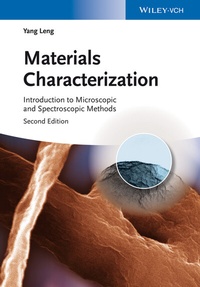
Materials Characterization
Introduction to Microscopic and Spectroscopic Methods
2. Auflage
Erschienen am 11. September 2013
Buch
Hardcover
392 Seiten
978-3-527-33463-6 (ISBN)
Beschreibung
Now in its second edition, this continues to serve as an ideal textbook for introductory courses on materials characterization, based on the author's experience in teaching advanced undergraduate and postgraduate university students.
The new edition retains the successful didactical concept of introductions at the beginning of chapters, exercise questions and an online solution manual. In addition, all the sections have been thoroughly revised, updated and expanded, with two major new topics (electron backscattering diffraction and environmental scanning electron microscopy), as well as fifty additional questions - in total about 20% new content.
The first part covers commonly used methods for microstructure analysis, including light microscopy, X-ray diffraction, transmission and scanning electron microscopy, as well as scanning probe microscopy. The second part of the book is concerned with techniques for chemical analysis and introduces X-ray energy dispersive spectroscopy, fluorescence X-ray spectroscopy and such popular surface analysis techniques as photoelectron and secondary ion mass spectroscopy. This section concludes with the two most important vibrational spectroscopies (infra-red and Raman) and the increasingly important thermal analysis.
The theoretical concepts are discussed with a minimal involvement of mathematics and physics, and the technical aspects are presented with the actual measurement practice in mind. Making for an easy-to-read text, the book never loses sight of its intended audience.
The new edition retains the successful didactical concept of introductions at the beginning of chapters, exercise questions and an online solution manual. In addition, all the sections have been thoroughly revised, updated and expanded, with two major new topics (electron backscattering diffraction and environmental scanning electron microscopy), as well as fifty additional questions - in total about 20% new content.
The first part covers commonly used methods for microstructure analysis, including light microscopy, X-ray diffraction, transmission and scanning electron microscopy, as well as scanning probe microscopy. The second part of the book is concerned with techniques for chemical analysis and introduces X-ray energy dispersive spectroscopy, fluorescence X-ray spectroscopy and such popular surface analysis techniques as photoelectron and secondary ion mass spectroscopy. This section concludes with the two most important vibrational spectroscopies (infra-red and Raman) and the increasingly important thermal analysis.
The theoretical concepts are discussed with a minimal involvement of mathematics and physics, and the technical aspects are presented with the actual measurement practice in mind. Making for an easy-to-read text, the book never loses sight of its intended audience.
Weitere Details
Auflage
2. Auflage
Sprache
Englisch
Verlagsort
Berlin
Deutschland
Zielgruppe
Für Beruf und Forschung
Für höhere Schule und Studium
Illustrationen
364
337 s/w Abbildungen, 27 s/w Tabellen
Maße
Höhe: 24.4 cm
Breite: 17 cm
Dicke: 2.4 cm
Gewicht
888 gr
ISBN-13
978-3-527-33463-6 (9783527334636)
Schweitzer Klassifikation
Weitere Ausgaben
Andere Ausgaben
E-Book
08/2013
2. Auflage
Wiley-VCH
99,99 €
Als Download verfügbar
E-Book
07/2013
2. Auflage
Wiley-VCH
99,99 €
Als Download verfügbar
Vorauflage
Buch
07/2008
1. Auflage
Wiley
109,00 €
Artikel ist vergriffen; siehe Neuauflage
Person
Yang Leng is Professor, specialized in materials science and engineering, at The Hong Kong University of Science and Technology (HKUST). His research focuses on mechanical behavior of engineering materials, biomedical materials, and novel materials processing. Professor Leng has extensively published in international journals. In addition, he has actively engaged in industrial consultancy. His contribution to teaching materials science and engineering is exemplified by the Teaching Excellence Appreciation award from the HKUST.
Inhalt
PREFACE
LIGHT MICROSCOPY
Optical Principles
Instrumentation
Specimen Preparation
Imaging Modes
Confocal Microscopy
X-RAY DIFFRACTION METHODS
X-Ray Radiation
Theoretical Background of Diffraction
X-Ray Diffractometry
Wide-Angle X-Ray Diffraction and Scattering
TRANSMISSION ELECTRON MICROSCOPY
Instrumentation
Specimen Preparation
Image Modes
Selected-Area Diffraction (SAD)
Images of Crystal Defects
SCANNING ELECTRON MICROSCOPY
Instrumentation
Contrast Formation
Operational Variables
Specimen Preparation
Electron Backscatter Diffraction
Environmental SEM
SCANNING PROBE MICROSCOPY
Instrumentation
Scanning Tunneling Microscopy
Atomic Force Microscopy
Image Artifacts
X-RAY SPECTROSCOPY FOR ELEMENTAL ANALYSIS
Features of Characteristic X-Rays
X-Ray Fluorescence Spectrometry
Energy Dispersive Spectroscopy in Electron Microscopes
Qualitative and Quantitative Analysis
ELECTRON SPECTROSCOPY FOR SURFACE ANALYSIS
Basic Principles
Instrumentation
Characteristics of Electron Spectra
Qualitative and Quantitative Analysis
SECONDARY ION MASS SPECTROMETRY FOR SURFACE ANALYSIS
Basic Principles
Instrumentation
Surface Structure Analysis
SIMS Imaging
SIMS Depth Profiling
VIBRATIONAL SPECTROSCOPY FOR MOLECULAR ANALYSIS
Theoretical Background
Fourier Transform Infrared Spectroscopy
Raman Microscopy
Interpretation of Vibrational Spectra
THERMAL ANALYSIS
Common Characteristics
Differential Thermal Analysis and Differential Scanning Calorimetry
Thermogravimetry
INDEX
LIGHT MICROSCOPY
Optical Principles
Instrumentation
Specimen Preparation
Imaging Modes
Confocal Microscopy
X-RAY DIFFRACTION METHODS
X-Ray Radiation
Theoretical Background of Diffraction
X-Ray Diffractometry
Wide-Angle X-Ray Diffraction and Scattering
TRANSMISSION ELECTRON MICROSCOPY
Instrumentation
Specimen Preparation
Image Modes
Selected-Area Diffraction (SAD)
Images of Crystal Defects
SCANNING ELECTRON MICROSCOPY
Instrumentation
Contrast Formation
Operational Variables
Specimen Preparation
Electron Backscatter Diffraction
Environmental SEM
SCANNING PROBE MICROSCOPY
Instrumentation
Scanning Tunneling Microscopy
Atomic Force Microscopy
Image Artifacts
X-RAY SPECTROSCOPY FOR ELEMENTAL ANALYSIS
Features of Characteristic X-Rays
X-Ray Fluorescence Spectrometry
Energy Dispersive Spectroscopy in Electron Microscopes
Qualitative and Quantitative Analysis
ELECTRON SPECTROSCOPY FOR SURFACE ANALYSIS
Basic Principles
Instrumentation
Characteristics of Electron Spectra
Qualitative and Quantitative Analysis
SECONDARY ION MASS SPECTROMETRY FOR SURFACE ANALYSIS
Basic Principles
Instrumentation
Surface Structure Analysis
SIMS Imaging
SIMS Depth Profiling
VIBRATIONAL SPECTROSCOPY FOR MOLECULAR ANALYSIS
Theoretical Background
Fourier Transform Infrared Spectroscopy
Raman Microscopy
Interpretation of Vibrational Spectra
THERMAL ANALYSIS
Common Characteristics
Differential Thermal Analysis and Differential Scanning Calorimetry
Thermogravimetry
INDEX