

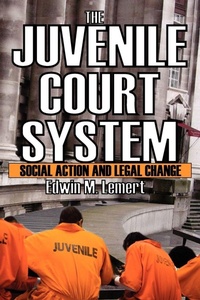
The Juvenile Court System
Social Action and Legal Change
1. Auflage
Erschienen am 15. Januar 2010
Buch
Softcover
256 Seiten
978-0-202-36340-0 (ISBN)
Beschreibung
This volume is based on a detailed analysis of change in the law and in the administration of justice affecting juvenile off enders in California in the fifties and sixties. It addresses how procedural law develops on a long-term basis and under what conditions. It also examines the processes by which revolutionary changes occur in law and the extent to which social change can be directed or controlled by legislation.
Social action to revise California's juvenile court law, which had remained little changed since 1915, began in 1958. Subsequently a small group of legal reformers who perceived anomalies in the law and in the underlying philosophy of the court overcame substantial resistance to effect revolutionary revisions of the law. Lemert examines their experience to determine how changes of such magnitude could take place after decades of gradual adaptations in the juvenile courts. His study also looks into the consequences of this change on the court and related agencies of law enforcement.
The author sets forth a socio-legal theory of change-a conception of paradigms, normal evolution, and revolution in law. He applies this theory to data, with special attention to the resistance to legal change and the processes by which it gives way to the adaptive process of normal law. Lemert discusses the substantive aspects of juvenile law as it relates to human affect and meaning, touching on the existential elements of justice. Professionals dealing with juveniles, legal scholars, sociologists, and political scientists will find this book, with its emphasis on how to achieve more equitable administration of juvenile justice, has much to contribute to our understanding of the dynamics of social change.
Social action to revise California's juvenile court law, which had remained little changed since 1915, began in 1958. Subsequently a small group of legal reformers who perceived anomalies in the law and in the underlying philosophy of the court overcame substantial resistance to effect revolutionary revisions of the law. Lemert examines their experience to determine how changes of such magnitude could take place after decades of gradual adaptations in the juvenile courts. His study also looks into the consequences of this change on the court and related agencies of law enforcement.
The author sets forth a socio-legal theory of change-a conception of paradigms, normal evolution, and revolution in law. He applies this theory to data, with special attention to the resistance to legal change and the processes by which it gives way to the adaptive process of normal law. Lemert discusses the substantive aspects of juvenile law as it relates to human affect and meaning, touching on the existential elements of justice. Professionals dealing with juveniles, legal scholars, sociologists, and political scientists will find this book, with its emphasis on how to achieve more equitable administration of juvenile justice, has much to contribute to our understanding of the dynamics of social change.
Weitere Details
Sprache
Englisch
Verlagsort
Somerset
USA
Verlagsgruppe
Taylor & Francis Inc
Zielgruppe
Für höhere Schule und Studium
Maße
Höhe: 229 mm
Breite: 152 mm
Dicke: 14 mm
Gewicht
379 gr
ISBN-13
978-0-202-36340-0 (9780202363400)
Copyright in bibliographic data and cover images is held by Nielsen Book Services Limited or by the publishers or by their respective licensors: all rights reserved.
Schweitzer Klassifikation
Weitere Ausgaben
Andere Ausgaben
Buch
07/2017
1. Auflage
Routledge
206,50 €
Versand in 10-20 Tagen
E-Book
07/2017
1. Auflage
Routledge
64,49 €
Als Download verfügbar
E-Book
07/2017
1. Auflage
Routledge
64,49 €
Als Download verfügbar
Person
Edwin Lemert
Inhalt
Preface Introduction 2. The First Revolution and Normal Law 3. The Transformation of Informal Justice 4. Anomalies, Issues and Social Action 5. Resistance and Communication of the Paradigm 6. Adaptations and Normal Law 7. The Logic of Revolution by Law 8. Postscript on Juvenile Justice Index