

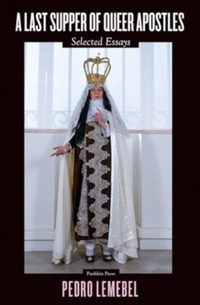
A Last Supper of Queer Apostles
Beschreibung
<b>Extravagantly stylish, searingly critical dispatches from the margins by a queer Latin American icon, in English for the first time</b>
<b>'He speaks brilliantly for a difference that refuses to disappear' Garth Greenwell</b>
<b>'Astonishing and tender and quite outrageous... What a powerful, mould-breaking voice' Tomasz Jedrowski</b>
"I speak from my difference" wrote Pedro Lemebel, the Chilean writer who became an icon of resistance and queer transgression across Latin America. His innovative essays-known as cronicas-combine memoir, reportage, history and fiction to bring visibility and dignity to the lives of sexual minorities, the poor and the powerless.
In a baroque, freewheeling style that fused political urgency with playfulness, resistance with camp, Lemebel shone a light on lives and events that many wanted to suppress: the glitzy literary salon held above a torture chamber, the queer sex and community that bloomed in Santiago's hidden corners and the last days of trans sex workers dying of AIDS, each cast in the starring role of her own private tragedy.
As Chile emerged from Pinochet's brutal dictatorship into a flawed democracy, Lemebel re-wrote the country's history from the margins, and today his subversive voice echoes around the world.
________
<b>'When everyone who has treated him like dirt is lost in the cesspit or in nothingness, Pedro Lemebel will still be a star' Roberto Bolano
'Pedro Lemebel is alive! And I am in love' Keith Ridgway
'A truly astonishing body of work' Lauren John Joseph
'A truly sensational addition to our collective heritage' Neil Bartlett</b>
Rezensionen / Stimmen
Astonishing and tender and quite outrageous. I'm so glad I discovered Lemebel's work - what a powerful, mould-breaking voice! -- Tomasz Jedrowski, author of 'Swimming in the Dark' Undaunted, lyrical... Offers a model of resistance... An exquisitely original writer... He uses humor, vulgarity, acidic commentary, and tenderness to describe the lives of the most marginalized people in his society * New Yorker * Lemebel made a career out of lobbing incendiaries both literary and political... an extraordinary-a necessary-voice in world literature... Lemebel's essays are incantatory and mutant... Part memoir, part reportage, part fantasia, they narrate history as it was experienced underground -- Jeremy Lybarger * 4Columns * Harper's translation is rich and graceful... Lemebel's stories are tender but raw, littered with jokes, innuendo and stabs at the heart * TLS * A seriously funny, unholy combination of postmodern critic and drag performer, Lemebel wrote in an ornate literary style that combines the high with the low unapologetically, almost rudely... He ruffled so many feathers because he wrote like no one else... Tender, funny, angry, elegiac... By challenging and provoking his audience, Lemebel almost seems to gaze through the page at the reader sitting there idly. His method was not purely an aesthetic formula; it constituted a way of living * LA Review of Books * This intoxicating and profane selection has been rendered into English with eye-bulging frankness by Gwendolyn Harper. Each brief "cronica" is a mini-revelation. Sexy, political and deeply humane, these coiled essays demonstrate clearly the perennial importance of radical speech acts... Exquisite * Washington Post * Lemebel doesn't have to write poetry to be the best poet of my generation... When everyone who has treated him like dirt is lost in the cesspit or in nothingness, Pedro Lemebel will still be a star -- Roberto Bolano He is one of the world's great writers; everyone should read him -- Garth Greenwell * New York Times Book Review * Lemebel's critique of the western colonisation of sexual identity was almost as vicious as it was of the Pinochet dictatorship * Observer * Pedro Lemebel's writing is a remarkable and radically uncompromising chronicle of queer life in anti-queer times. As such, its time is now. It is beautifully loyal to queer Santiago, queer Chile; to Chilean queers under the dictatorship, during the AIDS catastrophe, through the unrelenting poverty of neoliberalism. Such loyalty might exclude an anglophone reader. But Gwendolyn Harper's translation is astoundingly good. It allowed me to feel that I was being spoken to directly. And to know that Lemebel's personality, his poetry, his love, his grief, his anger, his generosity, his voice, are all still with us, and still true. Pedro Lemebel is alive! And I am in love -- Keith Ridgway, author of 'A Shock' This book reminds me of Jean Genet, of the late great Juan Goytisolo - of everything that I love about truly queer writing. It shares their rage, their laughter, their fierceness and their courage. A truly sensational addition to our collective heritage -- Neil Bartlett, author of Ready to Catch Him Should He Fall The writings of a curbside saint labouring serene under a weight of genius which would just about crush any other writer, images so alarming and original leap from every page, you come to believe that if you were to tear a page it would bleed scarlet... The fecund horror of a life in Chile in the last third of the last century, crushed under the boot of Pinochet, gnawed at by AIDS, is transfigured by Lemebel's bejewelled pen, borne up into a truly astonishing body of work -- Lauren J. Joseph, author of 'At Certain Points We Touch' Spiky, relentlessly caustic... stylish, challenging, and uncompromising -- Juliet Jacques * Tribune * Righteous rage, cutting humor, and lyric marvelousness unite Lemebel's essays... A Last Supper serves both as a political counterhistory and an intimate depiction of Chile's radical queer communities before, during, and after the two-decade dictatorship of Augusto Pinochet * Document * A literary explosion... Lemebel creates a "queer baroque", a language of excess to describe lives typified by deprivation... Lemebel's writing is beautiful and vicious, and Harper has done a brilliant job translating it * London Magazine * If the world were just, Pedro Lemebel would take his rightful place on the throne of literary royalty; although I'm certain he'd reject something as anti-democratic as monarchy. A Last Supper of Queer Apostles cements his place in the canon-the literary one, the queer one, the Chilean one, the Latin American one, the human one. This collection of devastatingly gay and unabashedly political essays is, in fact, a quiver of exquisite arrows, each dipped in the blood and bile of love and hate, the only tincture with the viscosity of truth. On every one of these electrifying and gorgeously written pages-brilliantly translated by Gwendolyn Harper-Lemebel spills anti-fascist tea in dizzying prose that spins us ever closer to the collective liberation he was seeking. All hail this queen -- Alejandro Varela, author of 'The Town of Babylon' His work was forged in the night, in the barrio, in life and not in literature... His books changed lives -- Alejandro Zambra, author of 'Chilean Poet' Lemebel said he writes from difference, and my god, what a difference. His writing is everything except boring-courageous, beautiful, vile, glorious, provocative, comforting, angry, loving, exquisite, and full of delicious venom. Reading a great writer makes life better. Reading Lemebel makes me want to live better -- Rabih Alamaddine, author of 'An Unnecessary Woman' What a joy for English readers to at last meet this humanist provocateur who celebrates and memorializes queer lives in a fascist state with fire, love, and a tireless spirit of play * Publishers Weekly * [His] writing leaps from slang to poetry, filth to beauty so quickly it collapses any distinction between them... The cronicas in A Last Supper of Queer Apostles still feel urgent. His phrases and clauses tumble over each other in their desire to get in one more joke, one more neologism, one more vignette, one more loca * Sewanee Review * Vividly captures the raw vibrancy of Lemebel's writing, showcasing his fearless engagement with themes of queerness, marginalisation and political activism. Harper's translation skilfully preserves Lemebel's linguistic nuances and quirks, both his dark sense of humour and tender self, offering Anglophone readers a rare glimpse into a world that defies simplification and classification -- Fernando Sdrigotti * The London Magazine, The Best Books of 2024 * Fucking fantastic, such great, alive writing by the queer Chilean activist, performer, writer and queen -- Michelle Tea, author of 'Valencia'Weitere Details
Weitere Ausgaben
Andere Ausgaben
Personen
Gwendolyn Harper won a National Endowment for the Arts fellowship and a Work in Progress grant from the Robert B. Silvers Foundation for A Last Supper of Queer Apostles. She holds an MFA from Brown University.